
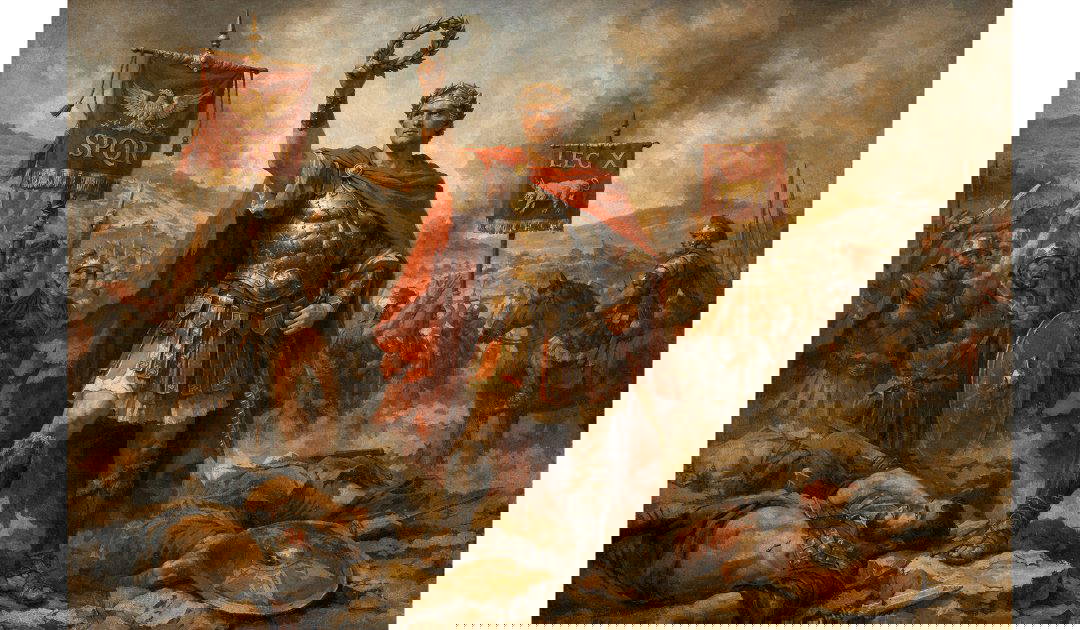
On the 17th of March, 45 BC, Julius Caesar achieved his last victory in the Battle of Munda. It was fought in southern Hispania (modern Spain). It was a brutal, hard-fought engagement that differed markedly from Caesar’s earlier, more elegant victories. At Munda, Caesar did not win through manoeuvre or stratagem, but through sheer determination in a grinding infantry struggle that nearly broke his army. The victory destroyed the last organised Pompeian resistance and left Caesar undisputed master of the Roman world.
After Caesar crossed the Rubicon in 49 BC, Rome plunged into civil war between Caesar and the forces of the Senate led by Pompey the Great. Caesar defeated Pompey at Pharsalus in 48 BC. Pompey fled to Egypt, where he was murdered, but the war did not end. Pompeian resistance regrouped in Africa under Metellus Scipio and Cato the Younger. Caesar crushed them at the Battle of Thapsus in 46 BC. Cato committed suicide at Utica, becoming a martyr to the republican cause.
Yet the Pompeian cause still had life. Pompey’s sons, Gnaeus Pompeius Magnus (Gnaeus Pompey) and Sextus Pompey, escaped to Hispania. There they found a fertile recruiting ground among veterans of earlier campaigns, local tribes resentful of Roman authority, and officers loyal to their father’s memory. Crucially, they were joined by Titus Labienus, once Caesar’s most trusted lieutenant in Gaul, who had defected to Pompey at the start of the civil war. Labienus brought experience, skill, and intimate knowledge of Caesar’s methods.
By 46–45 BC, Hispania had become the final stronghold of the republican resistance. The Pompeians raised a formidable army—possibly 50,000 men, including Roman legions and Spanish auxiliaries—and seized several key towns. Caesar, recognising the danger, decided to deal with the threat personally.
Caesar’s campaign in Hispania was not easy. The Pompeians avoided pitched battle at first, relying on strong defensive positions and the loyalty of local towns. Caesar had to conduct a series of sieges and manoeuvres in harsh winter conditions. Supplies were short, morale strained, and his legions—though veterans—were tired after years of continuous warfare.
The Pompeian leaders chose their ground carefully near the town of Munda (whose exact location is still debated, but likely near modern Montilla). They took position on a long ridge, forcing Caesar to attack uphill. This was a significant tactical advantage. Caesar, usually master of battlefield positioning, was compelled to assault a well-prepared enemy on unfavourable terrain.
Caesar commanded perhaps 40,000–45,000 troops, including several of his best veteran legions, such as the famed Legio X Equestris. The Pompeians had a similar or slightly larger force, strongly positioned and confident.
The Pompeian line stretched across the ridge, their legions deployed in depth, with cavalry and light troops on the flanks. Labienus commanded one wing, Gnaeus Pompey the other. They intended to let Caesar exhaust himself in a frontal assault. Caesar had little choice. He drew up his legions opposite the ridge and ordered the advance.
The fighting at Munda was ferocious and prolonged. Caesar’s troops had to climb the slope under missile fire before they could engage hand-to-hand. Unlike many Roman battles, which were decided by manoeuvre or morale collapse, this one turned into a sustained slogging match between tightly packed infantry lines.
For hours, neither side gained an advantage. Caesar’s men, though experienced, struggled against the superior position of the enemy. The Pompeians held firm, and Caesar later admitted this was one of the hardest battles he had ever fought. He is said to have remarked that at Munda he fought not for victory, but for his life.
At a critical moment, Caesar personally intervened. Seeing his right wing faltering, he rode into the thick of the fighting, seized a shield, and fought alongside his legionaries. His presence rallied the troops. Inspired by their commander’s example, the legions renewed their efforts.
Meanwhile, Labienus left his position to reinforce another part of the line. Pompeian troops, seeing him move away, mistakenly believed he was retreating. Panic spread. The cohesion of the Pompeian line wavered. Caesar’s men seized the moment, pressing forward with renewed energy. What had been a stalemate turned into a rout.
Once the Pompeian line broke, the slaughter was immense. Caesar’s cavalry pursued the fleeing enemy relentlessly. Estimates suggest that perhaps 30,000 Pompeian soldiers were killed. Caesar’s own losses were heavy by his standards, possibly around 1,000.
Labienus was killed in the fighting. Gnaeus Pompey fled but was captured and executed weeks later. Sextus Pompey escaped, to cause trouble for the Second Triumvirate years later, but as an organised republican resistance, the cause was finished.
Munda was decisive not because of tactical brilliance but because it ended the civil war. After Munda, no army remained in the field capable of challenging Caesar. He returned to Rome as the unquestioned ruler of the Roman world.
Within a year, in February 44 BC, Caesar was declared dictator perpetuo—dictator for life. The old republican system had effectively collapsed. Although Caesar would be assassinated on the Ides of March, the republic never truly recovered. The power struggles that followed led to the rise of Augustus and the establishment of the Roman Empire. In this sense, Munda was the last battle of the Roman Republic.
Historians often focus on Pharsalus or Thapsus, but Munda is arguably more important. It shows Caesar at his most vulnerable and determined. It demonstrates that even after years of victories, he could still be forced into a desperate fight where defeat was a real possibility. It also reveals how deeply the Roman world had fractured, with former comrades like Labienus fighting to the death against their old commander.
Munda was not a graceful victory; it was bloody, exhausting, and hard-won. Yet it sealed Caesar’s supremacy and marked the final extinguishing of organised republican resistance. On the dusty slopes of a Spanish ridge, the Roman Republic effectively died.