
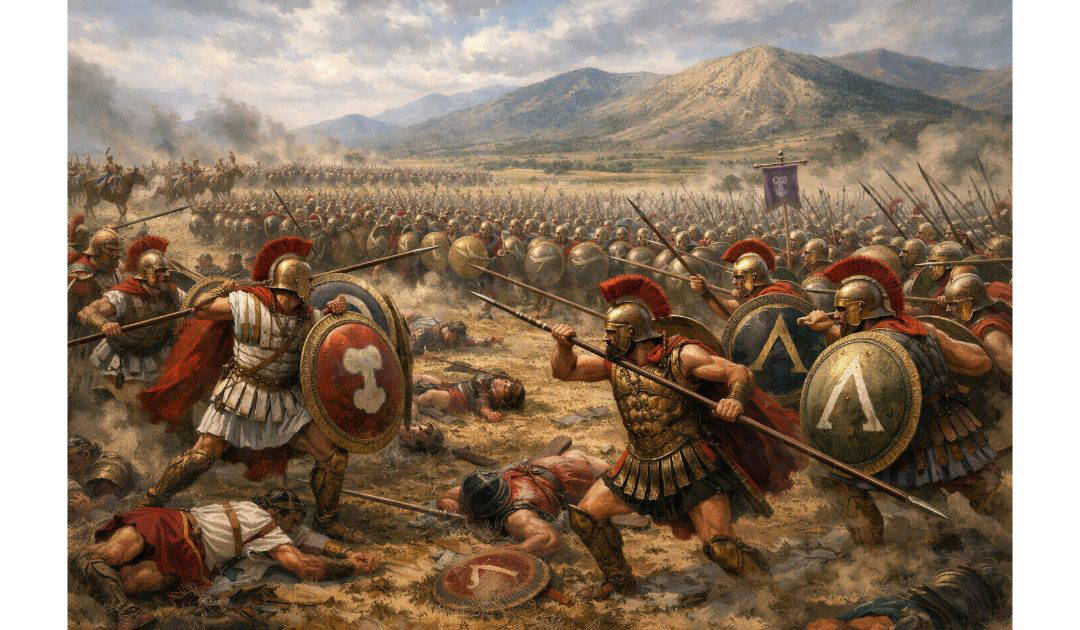
I have written about the Battle of Marathon. So let’s have a look at a later Ancient Greek battle. The Battle of Mantinea was fought on the 4th of July in 362 BCE. The Battle of Mantinea, fought in 362 BC, was one of the most significant and decisive engagements of classical Greek warfare. It marked the culmination of a prolonged struggle for dominance among the major Greek city-states in the fourth century BC, particularly between Sparta, Thebes, and their respective allies. Although tactically a victory for Thebes, the battle ultimately resulted in a strategic stalemate that reshaped the political landscape of Greece.
The roots of the conflict lay in the shifting balance of power following the Peloponnesian War. Sparta had emerged victorious in that war, establishing a short-lived hegemony over Greece. However, Spartan dominance provoked widespread resentment, and by the 370s BC, Thebes had risen as a formidable challenger. Under the leadership of innovative generals such as Epaminondas, Thebes dealt Sparta a crushing blow at the Battle of Leuctra, breaking Spartan military supremacy and ushering in a new era of Theban influence.
In the years that followed, alliances shifted frequently. Thebes sought to maintain its leadership, while Sparta attempted to recover its former power. Meanwhile, other states, including Athens and various Peloponnesian cities, pursued their own interests, often aligning opportunistically. By 362 BC, tensions had escalated into open conflict once more, with Mantinea in Arcadia becoming the focal point.
Mantinea itself, located in the region of Arcadia, was strategically important due to its central position in the Peloponnese. The city had switched allegiances multiple times, reflecting the fluid and unstable nature of Greek politics at the time. When war broke out, a coalition formed against Thebes, including Sparta, Athens, Mantinea, and others. Opposing them was a Theban-led alliance that included Arcadian factions and Boeotian forces.
The battle brought together some of the most experienced soldiers in Greece. The Theban army, led by Epaminondas, was renowned for its tactical innovation and discipline. Opposing them were the traditional hoplite forces of Sparta and its allies, still respected for their training and courage despite their declining dominance.
Epaminondas once again demonstrated his brilliance on the battlefield. Drawing on the tactics he had pioneered at Leuctra, he employed an oblique formation, concentrating his strongest troops on one wing while holding back others. This approach allowed him to deliver a powerful, focused attack against a specific section of the enemy line rather than engaging evenly across the entire front.
As the battle commenced, the Theban left wing advanced in a dense, deep formation, targeting the Spartan right. Cavalry skirmishes and light infantry engagements preceded the main clash, adding to the confusion and intensity. When the heavy infantry finally met, the fighting was fierce and brutal, with shields crashing together and spears thrust at close quarters.
The Theban assault proved effective. Their concentrated force began to push back the Spartan-led wing, creating disorder among the allied ranks. The disciplined advance of Epaminondas’ troops gradually broke the cohesion of the opposing line. However, the battle was far from straightforward. Other parts of the field saw mixed outcomes, and resistance remained strong.
At the height of the fighting, Epaminondas himself led a charge at the head of his troops. In the midst of the struggle, he was struck down—traditionally said to have been mortally wounded by a spear or javelin. His fall had a profound impact on the battle. Although the Thebans continued to press their advantage and ultimately held the field, the loss of their commander deprived them of the ability to exploit their success fully.
The outcome of the battle was therefore paradoxical. Tactically, Thebes had won: they had driven their enemies from the field and demonstrated the continued effectiveness of their military system. Strategically, however, the result was inconclusive. The death of Epaminondas removed the one leader capable of sustaining Theban dominance. Without his guidance, Thebes struggled to maintain its position.
For Sparta and its allies, the battle was a defeat, but not a catastrophic one. They retained enough strength to continue as significant players in Greek affairs. Similarly, Athens remained influential, though unable to assert clear leadership. The result was a fragmentation of power across Greece.
The broader consequence of the Battle of Mantinea was the exhaustion of the major city-states. Decades of nearly continuous warfare had weakened them all, preventing any single power from establishing lasting hegemony. This fragmentation created an opening for external forces, most notably the rising kingdom of Macedon under Philip II of Macedon. Within a few decades, Macedon would intervene decisively in Greek affairs, culminating in the Battle of Chaeronea and the subjugation of the Greek city-states.
In historical retrospect, the Battle of Mantinea represents both the height and the end of the era of independent Greek warfare. It showcased the tactical sophistication and martial skill of the classical Greek armies, particularly under leaders like Epaminondas. Yet it also underscored the limitations of the city-state system, whose rivalries ultimately prevented unity.
Thus, while Mantinea was a battlefield victory for Thebes, it marked the beginning of the end for the independence of the Greek polis. The death of Epaminondas symbolised the loss of the last great champion of that system, leaving Greece divided and vulnerable at a critical moment in its history.