
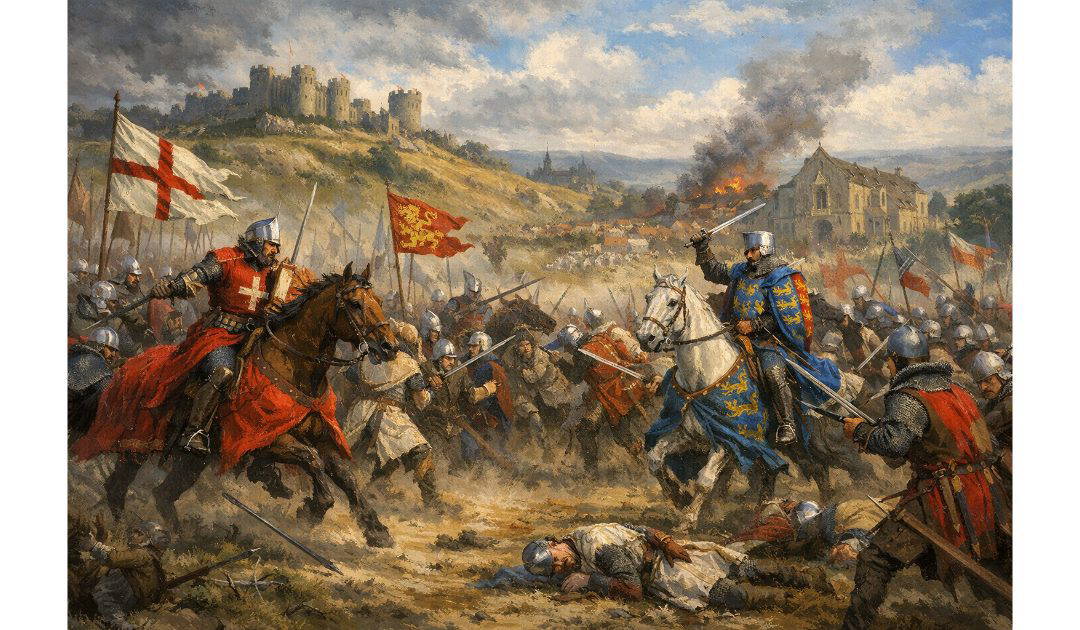
The Battle of Lewes, fought on 14th of May, 1264, was one of the most dramatic confrontations of the Second Barons’ War and a turning point in the long struggle between the English Crown and its leading nobles. The clash pitted the forces of King Henry III against a rebel baronial army led by Simon de Montfort. Its outcome briefly placed England under baronial control and marked a significant step in the evolution of parliamentary government. I have posted before about the oaths I had to swear when collecting my MA in Oxford’s Sheldonian Theatre. I’m certain I had to promise never to admit Simon de Montfort or his descendants into the university.
By the early 1260s, Henry III’s reign had become deeply unpopular among many of his barons. His costly and unsuccessful foreign ventures, particularly his attempts to secure the Sicilian crown for his son, had strained royal finances. Heavy taxation and reliance on foreign advisers—especially Poitevins and Savoyards—fuelled resentment among the English nobility.
In 1258 a group of barons forced the king to accept the Provisions of Oxford, which established a council of magnates to oversee royal administration. Though initially cooperative, tensions soon resurfaced. Henry sought to overturn these restrictions and in 1261 obtained a papal bull absolving him from his oath to uphold the Provisions. The baronial reform movement fractured, but Simon de Montfort emerged as its most determined champion.
De Montfort was no ordinary rebel. A French-born noble who had married the king’s sister, Eleanor, he combined personal ambition with a genuine commitment to reform. By 1263 open war had broken out between royalists and reformers, plunging England into civil conflict.
In the spring of 1264, Henry III and his son, the formidable Prince Edward (the future Edward I), marched south to confront de Montfort. The royal army gathered at Lewes in Sussex, occupying Lewes Castle and the nearby Priory of St Pancras. Lewes was strategically significant: it controlled key routes between London and the Channel ports.
De Montfort’s army approached from the north, taking position on the Downs above the town. Although outnumbered—modern estimates suggest he had perhaps 5,000 men against the king’s 10,000—he benefited from superior positioning. His forces were composed not only of barons but also of knights and townsmen from London, whose support for reform was strong.
At dawn on 14 May, de Montfort launched a surprise attack from the high ground. His army descended from the Downs toward the royalist positions below. The battle quickly divided into distinct engagements.
On the royalist right, Prince Edward led a fierce cavalry charge against the London militia, who were positioned on the rebel left. Edward’s knights smashed into them with devastating effect. The Londoners, inexperienced in open battle, broke and fled. Many were cut down as they ran. However, Edward’s impetuous pursuit proved a critical error. Carried away by the rout, he chased the fleeing Londoners for miles, removing a substantial portion of the royal cavalry from the main battlefield.
Meanwhile, in the centre and on the rebel right, de Montfort pressed the attack against King Henry’s forces. Fighting was intense and at times chaotic, with heavily armoured knights clashing in brutal hand-to-hand combat. The king himself reportedly fought with determination, taking shelter at one point in the priory.
With Edward absent and royal coordination faltering, de Montfort’s forces gained the upper hand. The Earl of Cornwall, Henry’s brother, sought refuge in a windmill but was captured. As rebel troops tightened their grip, the royalist position became untenable.
When Prince Edward finally returned, he found the situation irretrievable. The king’s army had effectively collapsed. Rather than prolong bloodshed, negotiations began.
The immediate result of the battle was the capture of both King Henry III and Prince Edward. De Montfort now held the king in his power. The terms of settlement, known as the Mise of Lewes, restored the Provisions of Oxford and placed effective authority in the hands of a baronial council dominated by de Montfort.
For a brief period, England was governed not by its monarch but by a coalition of reforming barons. In January 1265, de Montfort summoned a parliament that included not only nobles and clergy but also elected representatives from counties and boroughs. This assembly is often regarded as a significant milestone in the development of the English Parliament, broadening political representation beyond the traditional elite.
However, de Montfort’s triumph proved short-lived. His rule alienated former allies and alarmed powerful magnates. In May 1265, Prince Edward escaped captivity. The conflict resumed, culminating in the Battle of Evesham in August 1265, where de Montfort was killed and royal authority was restored.
The Battle of Lewes stands as a pivotal episode in medieval English history. Though a civil war engagement rather than a foreign campaign, its consequences were profound. It demonstrated that a king could be defeated and constrained by his own subjects, reinforcing the principle—first articulated in Magna Carta—that royal power was not absolute.
While de Montfort’s regime ultimately failed, his parliamentary experiment left a lasting legacy. The inclusion of elected representatives in 1265 foreshadowed the later development of the House of Commons and the gradual emergence of constitutional monarchy.
Thus, the Battle of Lewes was more than a military confrontation. It was a struggle over governance, accountability, and the limits of royal authority—issues that would continue to shape English political life for centuries.