
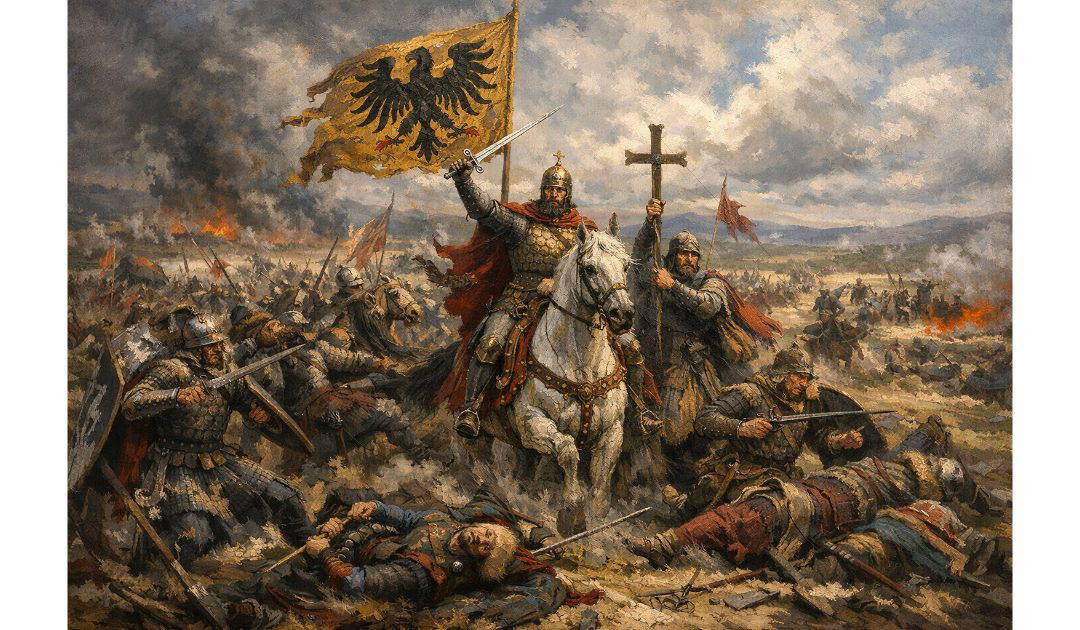
For much of the 10th century, the Magyar horsemen of Hungary terrified western Europe. Riding swiftly across the continent, they raided Germany, Italy, Burgundy, and even parts of France and Spain. Their armies were famous for mounted archery, speed, and sudden attacks. European rulers often struggled to stop them. Towns were burned, monasteries looted, and local armies defeated. The Magyars seemed almost unstoppable.
In 955 the political situation in Germany was tense. King Otto I of East Francia, later known as Otto the Great, had recently crushed rebellions among German nobles. Some of his enemies are believed to have encouraged the Magyars to invade again, hoping Otto would be weakened or overthrown. A large Hungarian army crossed into Bavaria during the summer and advanced toward the important city of Augsburg.
Augsburg was defended bravely by Bishop Ulrich, who organised soldiers and townspeople to hold the walls while awaiting Otto’s relief army. The siege lasted several days, and the defenders knew that if the city fell the surrounding lands would probably be devastated. The Hungarians hoped to draw Otto into open battle on ground favourable to their cavalry.
Otto gathered forces from across his kingdom. His army included Saxons, Bavarians, Swabians, Franks, and Bohemians. Estimates of numbers vary greatly, but historians generally believe he commanded perhaps 7,000 to 9,000 men. Unlike the Magyars, Otto’s strength lay in heavily armoured cavalry and disciplined close combat troops.
The battle took place on the Lechfeld plain near the River Lech between the10th and 12th of August 955. The terrain was broad and open, seemingly ideal for Magyar mounted warfare. Earlier in the century the Hungarians had already won victories in similar conditions. Otto therefore faced a dangerous opponent with decades of experience in mobile warfare.
As Otto’s army marched toward Augsburg, the Hungarian cavalry attacked the rear of his column. The Bohemian rearguard and baggage train suffered heavily. This sudden strike demonstrated the traditional Magyar tactic of rapid harassment and confusion. However, instead of panicking, Otto reorganised his forces. Conrad the Red, Duke of Lorraine, led a counterattack that drove the Hungarian raiders away from the baggage.
The main battle then developed into a fierce contest between the German heavy cavalry and the lighter Hungarian horse archers. The Magyars showered Otto’s troops with arrows, attempting to weaken and disorder them before closing in. But Otto’s army held together. The heavily armoured German knights and cavalry gradually forced the Hungarians into closer fighting, where the advantage of armour, shields, and lances became decisive.
A key factor in the battle was discipline. Earlier European armies had often broken formation while pursuing retreating horse archers, only to be ambushed. Otto avoided this mistake. His troops maintained cohesion and continued pressing forward steadily. Eventually the Hungarian lines collapsed and began retreating.
Nature also turned against the Magyars. Rain and flooding made escape difficult. River crossings were blocked or guarded, and retreating groups were hunted down by local forces. Many Hungarian warriors drowned or were killed during the pursuit. Several leading Magyar commanders, including Bulcsú and Lehel, were captured and later executed at Augsburg.
The consequences of Lechfeld were enormous. The battle effectively ended the great Magyar raids into western Europe. Although Hungary remained powerful, its rulers increasingly turned away from nomadic raiding and toward permanent state-building. Within decades Hungary adopted Christianity under Saint Stephen I and became an established Christian kingdom integrated into European politics.
For Otto I, the victory was transformative. He emerged as the unquestioned ruler of Germany and defender of Christendom. His prestige soared throughout Europe. Only seven years later, in 962, he was crowned Holy Roman Emperor in Rome, an event often regarded as the foundation of the Holy Roman Empire.
Medieval chroniclers saw the battle as a struggle for the survival of Christian Europe. Some later historians compared its importance to Charles Martel’s victory at Tours in 732. While such comparisons can be exaggerated, Lechfeld undeniably marked the end of one era and the beginning of another. The age of devastating Magyar invasions was over, and central Europe entered a more stable political order.
The battle also revealed changing patterns in medieval warfare. Heavily armoured cavalry, fighting in disciplined formations, had defeated one of the most feared mobile horse-archer armies in Europe. In this sense Lechfeld foreshadowed the knight-dominated warfare that would characterise much of the High Middle Ages.