
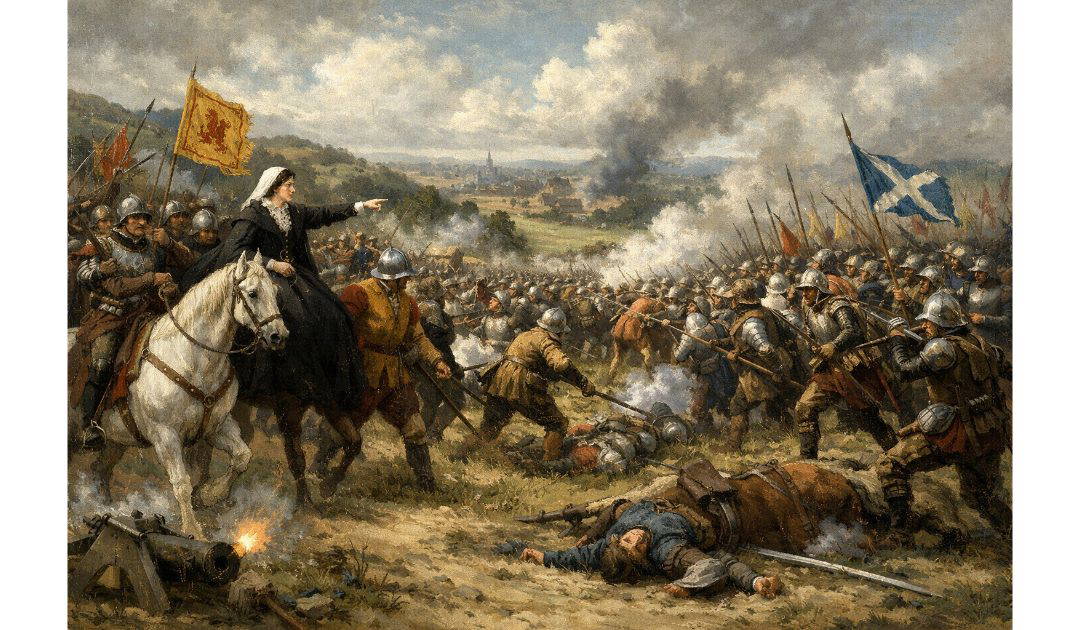
The Battle of Langside was fought on the 13th of May, 1568, between the forces of Mary Queen of Scots and the supporters of her son, James VI. My ancestor, the Elizabethan spy, Sir Anthony Standen, was master of horse to Lord Darnley, and travelled to Edinburgh with Darnley when he married Mary. However Standen was in France by 1568.
Mary’s difficulties stemmed from the political and religious upheavals of mid-sixteenth-century Scotland. After returning from France in 1561, she attempted to rule a kingdom that had embraced Protestant reform. Her marriage in 1565 to Henry Stuart, Lord Darnley proved disastrous. Darnley was implicated in factional intrigues and was murdered in February 1567 under suspicious circumstances. Soon afterwards Mary married James Hepburn, 4th Earl of Bothwell, widely believed to have been responsible for Darnley’s death.
The marriage scandalised many Scottish nobles. A confederate group rose against the queen, confronting her at Carberry Hill in June 1567. Mary surrendered and was imprisoned in Loch Leven Castle. There, in July 1567, she was forced to abdicate in favour of her infant son, the future James VI and I. The government passed into the hands of Protestant nobles acting as regents for the child king.
In May 1568 Mary escaped from Loch Leven. She quickly gathered support from loyal Catholic and moderate nobles, including the powerful Hamilton family. Determined to regain her throne, she raised an army of perhaps 5,000–6,000 men and marched westwards, intending to reach Dumbarton Castle, a strong fortress still held for her cause.
The king’s party, led by James Stewart, 1st Earl of Moray (Mary’s half-brother and regent for James VI), moved swiftly to intercept her. Moray was an experienced commander and a capable politician. His army was smaller—perhaps 3,000–4,000 men—but more disciplined and better positioned.
The two forces met near the village of Langside, just south of Glasgow. The terrain was uneven, with hedges, ditches, and rising ground favouring a defensive position. Moray deployed his troops carefully, placing arquebusiers (musketeers) and pikemen to take advantage of the cover. The regent also relied on experienced captains, such as William Kirkcaldy of Grange. Mary herself did not take part in the fighting. She watched from a nearby hill, reportedly at Cathcart Castle, as events unfolded below.
The engagement was short, lasting perhaps less than an hour. Mary’s forces advanced along a narrow lane bordered by ditches and hedges. This confined approach proved a serious disadvantage. As her vanguard pressed forward, Moray’s men delivered disciplined volleys of gunfire. The confined space created confusion, and the queen’s troops struggled to deploy effectively.
There followed a fierce push of pike, the characteristic infantry combat of the period. However, Moray’s troops held the higher ground and maintained cohesion. The Hamilton contingent, central to Mary’s army, faltered under sustained pressure. Once the front ranks broke, panic spread rapidly.
Casualties were relatively light by later standards—perhaps around 300 dead on Mary’s side, with far fewer losses among the king’s men—but the political consequences were enormous. Within a short time, Mary’s army dissolved, and the regent’s forces secured the field.
The defeat at Langside ended Mary’s last serious attempt to regain power in Scotland by force. Rather than seek refuge in Dumbarton, she made the fateful decision to cross the Solway Firth into England, hoping for assistance from her cousin, Elizabeth I.
Instead of aid, Mary found herself detained. Elizabeth, wary of supporting a Catholic claimant to her own throne, ordered an inquiry into Mary’s alleged complicity in Darnley’s murder. Though never formally tried in England at this stage, Mary remained a captive for nearly nineteen years. Ultimately, in 1587, she was executed after being implicated in plots against Elizabeth.
In Scotland, Langside consolidated the Protestant regime ruling in the name of James VI. The civil conflict did not end immediately—supporters of Mary continued resistance for several years—but the battle decisively shifted the balance. It ensured that the infant king’s government would endure and that Scotland would continue along a Protestant trajectory.
In retrospect, the Battle of Langside stands as a turning point. Militarily modest, it nonetheless determined the fate of a queen whose life has inspired centuries of drama and debate. The brief clash outside Glasgow shaped not only Scottish politics but also the future union of the Scottish and English crowns under James VI and I.