
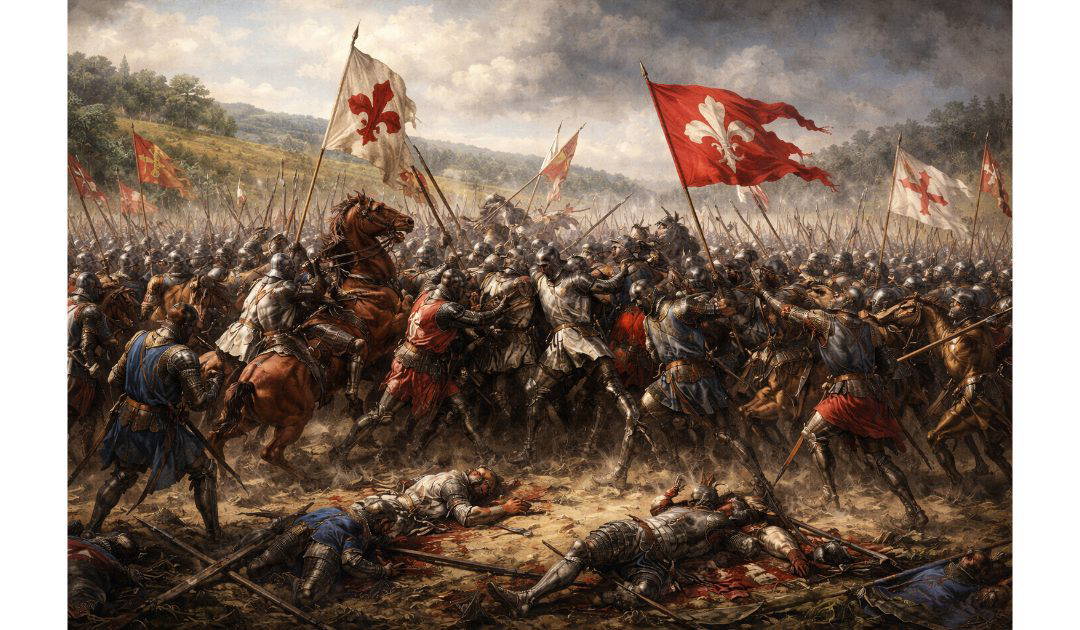
The Battle of Cascina was fought on the 28th of July, 1364, between Florentine and Pisan forces near Cascina, on the River Arno, in modern day Italy. This has caught my attention because in my research for Cade’s Point, the sixth book in the Sir Anthony Standen Adventures, I have been researching the Ciompi Revolt of 1378 in Florence. This uprising was led by wool carders (ciompi) and other disenfranchised labourers. Florence had been hit hard by war debts and the aftermath of the Black Death. To finance military campaigns, the ruling oligarchy relied heavily on direct taxation, including the estimo (a property tax). These burdens fell disproportionately on the lower and middling classes. Clearly the Battle of Cascina was a contributing factor in the later Ciompi Revolt.
The broader context of the Battle of Cascina lies in the bitter rivalry between Florence and Pisa, two powerful Tuscan cities with competing economic and territorial ambitions. Pisa, once a dominant maritime republic, had been in decline, while Florence was rising as a financial and political power. Their conflict formed part of the wider pattern of factional struggles across Italy, often involving shifting alliances and the employment of professional soldiers known as condottieri.
In 1364, Florence placed its forces under the command of Galeotto I Malatesta, an experienced military leader from the prominent Malatesta family. Pisa, meanwhile, entrusted its army to John Hawkwood, one of the most renowned mercenary captains of the age. Hawkwood, an Englishman who had made his career in Italy, was widely respected for his discipline and tactical skill, and his presence alone made the Pisan army a formidable opponent.
The Florentine army advanced toward Pisa and encamped near Cascina during the height of the summer. The intense July heat played a decisive role in what followed. On the day of the battle, many of the Florentine soldiers, believing themselves temporarily safe, removed their armour and entered the Arno River to bathe and cool off. This moment of vulnerability presented an opportunity that Hawkwood was quick to exploit. Leading a surprise attack, the Pisan forces descended upon the unsuspecting Florentines, aiming to catch them unprepared and rout them before they could form ranks.
However, the Florentine response was far more effective than Hawkwood may have anticipated. Despite being caught off guard, the troops rallied with remarkable speed. Galeotto Malatesta is said to have played a crucial role in restoring order, urging his men to arm themselves and form defensive lines. The Florentines quickly regrouped, retrieving their weapons and armour while resisting the initial Pisan assault.
As the battle developed, the advantage began to shift. The heat that had earlier encouraged the Florentines to bathe now worked against the attacking Pisans, who had marched under the blazing sun in full armour. Fatigue and disorganisation began to undermine their offensive. Meanwhile, the Florentines, now reassembled and fighting on familiar ground, launched a determined counterattack. Their resistance stiffened into a coordinated defence, and soon they were pressing the Pisan forces back.
The turning point came as the Pisan attack lost momentum. What had begun as a bold and promising ambush degenerated into a disorderly retreat. Florentine troops pursued their enemies vigorously, inflicting heavy casualties. Many Pisan soldiers were killed, captured, or scattered, and the engagement ended in a decisive victory for Florence.
The outcome of the Battle of Cascina had important consequences for the balance of power in Tuscany. It bolstered Florentine confidence and reinforced its growing dominance in the region, while further weakening Pisa’s already declining position. Although the war between the two cities did not end immediately, the battle marked a clear demonstration of Florence’s military resilience and organisational strength.
Beyond its immediate military significance, the Battle of Cascina achieved lasting fame in cultural history, particularly through its association with the Renaissance artist Michelangelo. In the early sixteenth century, Michelangelo was commissioned to create a fresco depicting the battle for the Palazzo Vecchio in Florence. His design focused not on the combat itself but on the dramatic moment when Florentine soldiers, surprised while bathing, scramble to arm themselves. Although the fresco was never completed, the preparatory cartoon became legendary, admired for its dynamic portrayal of the human form in motion and influencing generations of artists.