
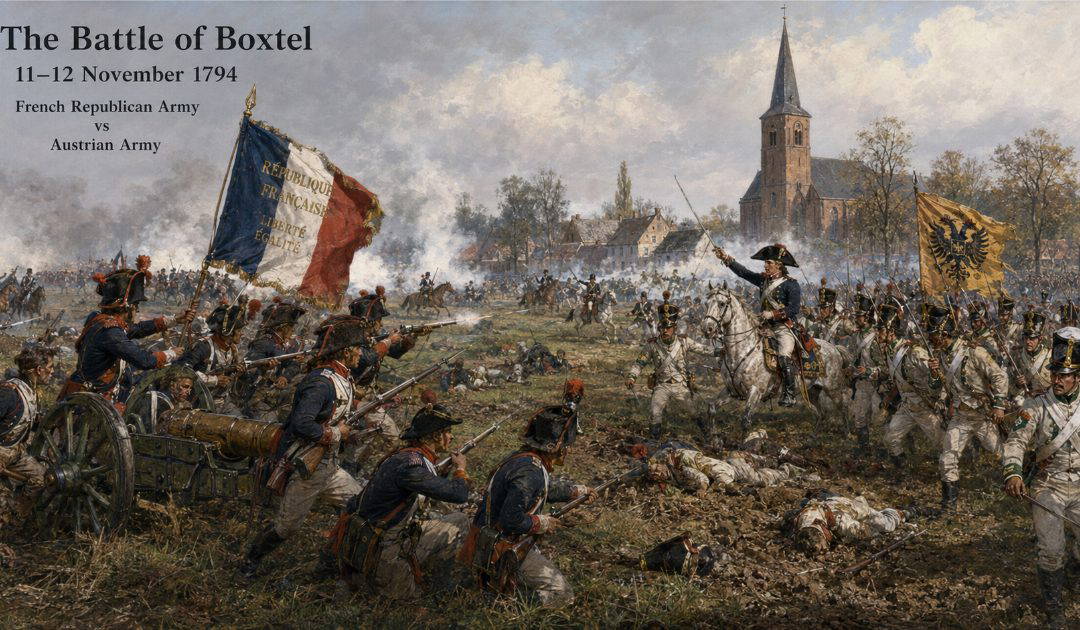
The Battle of Boxtel, fought on the 14th and 15th of September, 1794, was a relatively small but significant engagement during the Flanders Campaign of the French Revolutionary Wars. Although overshadowed by larger battles such as Fleurus, Boxtel marked another step in the collapse of Allied resistance in the Austrian Netherlands and the Dutch Republic. It also provided one of the earliest military experiences of the young Arthur Wellesley, the future Duke of Wellington, whose observations during the retreat helped shape the military principles that later brought him victory over Napoleon.
By 1794, Revolutionary France had recovered from the turmoil of its early wars. Following the decisive French victory at the Battle of Fleurus in June 1794, the Allied armies—including Austrian, British, Dutch and Hanoverian forces—were steadily driven northwards. The French armies, energised by mass conscription and aggressive leadership, advanced into what is now Belgium and the southern Netherlands. Their objective was to destroy the remaining Allied forces and carry the Revolution beyond France’s borders.
The Allied army in the Netherlands was commanded by Frederick, Duke of York, the second son of King George III. While personally brave and conscientious, the Duke faced an almost impossible task. His multinational army suffered from divided command structures, differing national priorities and chronic supply problems. Austrian commanders increasingly concentrated on defending their own territories, leaving the British and Dutch forces dangerously exposed.
The town of Boxtel lay in the Dutch province of North Brabant on the River Dommel. Its roads and river crossings made it an important communications point. Holding Boxtel would delay the French advance and protect the Allied line of retreat towards the River Waal.
French forces under General Jean-Charles Pichegru were advancing rapidly. One of his subordinate commanders, General Antoine Delmas, moved against Boxtel with a force of infantry, cavalry and artillery. Facing them were British, Hanoverian and Hessian troops, supported by Dutch units. Among the British officers was the twenty-five-year-old Lieutenant-Colonel Arthur Wellesley, commanding the 33rd Regiment of Foot.
The fighting began with French attacks designed to force the Allied troops from their defensive positions. Revolutionary French infantry, fighting in loose formations supported by artillery, pressed aggressively against the defenders. Although the British infantry remained disciplined under fire, the French enjoyed numerical superiority and possessed considerable momentum after months of successful campaigning.
The Allies attempted to hold the crossings over the River Dommel, but French pressure steadily increased throughout the engagement. Musketry echoed across the flat Dutch countryside while artillery batteries exchanged fire over open fields intersected by ditches, streams and hedgerows. Cavalry played an important role in scouting and protecting the flanks, although the terrain limited opportunities for large mounted charges.
Arthur Wellesley’s regiment was heavily involved in covering the Allied withdrawal. Although not commanding the battle, he demonstrated calm leadership in organising an orderly retreat under difficult circumstances. Rather than allowing his troops to panic or become isolated, he withdrew them methodically while maintaining discipline. This professionalism prevented greater losses.
The Duke of York recognised that Boxtel could no longer be held without risking encirclement. Orders were issued for a general withdrawal. The retreat was carried out successfully, although not without confusion. French troops occupied Boxtel after the Allies abandoned the town.
Casualties at Boxtel were modest by the standards of the Revolutionary and Napoleonic Wars. Several hundred men were killed, wounded or captured on both sides. However, the battle’s importance lay less in the number of casualties than in its strategic consequences. The Allied withdrawal surrendered another important defensive position, allowing the French to continue their advance into the Dutch Republic.
For Arthur Wellesley, the engagement proved highly educational. Years later he remarked that he had learned more from successful retreats than from victories. At Boxtel he witnessed the immense difficulties of withdrawing an army while maintaining order, protecting supply lines and preventing pursuit from turning into disaster. These lessons became fundamental to his later campaigns in Portugal and Spain, where carefully managed retreats repeatedly frustrated Napoleon’s marshals.
The loss of Boxtel formed part of the broader collapse of the Allied position in the Low Countries during 1794. As autumn progressed, British forces continued retreating northwards. Severe winter weather followed, and during the famous freezing conditions of early 1795 French troops crossed frozen rivers that had previously protected the Dutch Republic. The Dutch government collapsed and was replaced by the French-aligned Batavian Republic.
For Britain, the campaign exposed weaknesses in military organisation, logistics and strategic planning. The British Army was brave and professionally trained but relatively small, while Revolutionary France could field enormous armies through universal conscription. The experience encouraged reforms that gradually improved Britain’s military effectiveness during the long wars against France.
The Battle of Boxtel occupies an important place in British military history primarily because it marked the emergence of Arthur Wellesley as a capable field commander. Although still far from the fame he would achieve at the Peninsular War and the Battle of Waterloo, his conduct during the retreat demonstrated qualities of discipline, judgement and composure that would later define one of Britain’s greatest generals.
Today the Battle of Boxtel is remembered as one of the many engagements that collectively transformed Europe during the French Revolutionary Wars. It illustrates how campaigns are often decided not solely by great set-piece battles but by a succession of smaller actions, withdrawals and manoeuvres. Boxtel contributed to the French conquest of the Low Countries, reshaped the political map of north-west Europe, and provided invaluable experience for the young officer who would eventually defeat Napoleon at Waterloo twenty-one years later.