
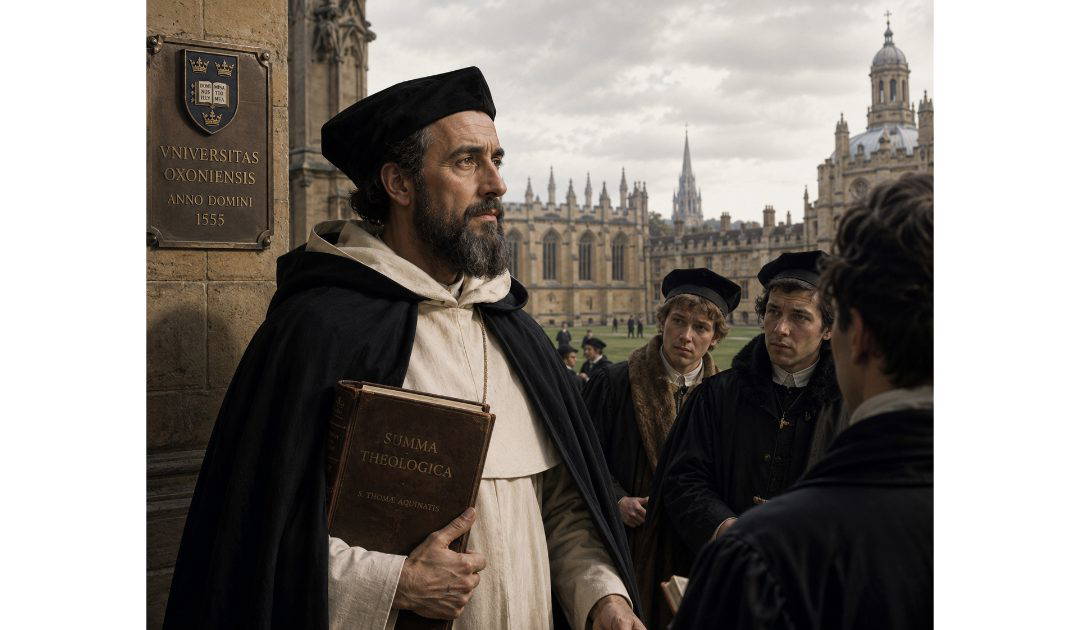
On the 22nd of August 1558, Bartolomé Carranza was arrested and taken to Valladolid. Bartolomé Carranza was one of the most brilliant, influential, and tragic churchmen of sixteenth-century Spain. A Dominican friar, scholar, diplomat, and eventually Archbishop of Toledo, his career appeared destined for the highest distinction. Instead, it became one of the most notorious miscarriages of justice in the history of the Spanish Church, as he spent almost seventeen years imprisoned on suspicion of heresy despite remaining a loyal Catholic throughout his life.
Carranza was born in 1503 at Miranda de Arga in Navarre. Entering the Dominican Order while still a young man, he quickly established himself as an exceptional student. He studied theology at the famous University of Alcalá before teaching at Valladolid, where his intellect, command of Scripture, and eloquence earned widespread admiration. At a time when Europe was being convulsed by the Protestant Reformation, Carranza believed that the Catholic Church needed better education for both clergy and ordinary believers. He advocated reform, but always from within the Church rather than against it.
His reputation brought him into the service of the Spanish Crown. During the reign of Charles V, Carranza acted as a theological adviser and accompanied the emperor on diplomatic and religious missions. He attended important ecclesiastical gatherings and became respected for his ability to defend Catholic doctrine against Protestant arguments while also acknowledging that genuine abuses existed within the Church. This balanced approach won him admirers but also made some conservatives suspicious that he was too sympathetic to reform.
Carranza played an important role during the opening sessions of the Council of Trent, the great assembly convened to respond to the Protestant Reformation. His contributions reflected his lifelong priorities: improving clerical education, encouraging regular preaching, strengthening pastoral care, and explaining Catholic teaching more clearly. These aims were entirely consistent with what later became central features of the Catholic Reformation.
In 1558 Carranza was appointed Archbishop of Toledo, the most prestigious ecclesiastical office in Spain after the monarchy itself. The Archbishop of Toledo enjoyed immense spiritual authority and considerable political influence. Carranza accepted the appointment reluctantly, conscious of its burdens, but he was determined to reform his vast archdiocese through better preaching and more rigorous standards among the clergy.
His downfall began almost immediately after the publication of his Commentary on the Christian Catechism. Intended as a clear exposition of Catholic belief, the work employed language that some critics believed resembled expressions used by Protestant reformers, particularly concerning justification and faith. Although Carranza consistently rejected Protestant theology, certain passages were interpreted in the worst possible light by his enemies.
Among those most determined to prosecute him was Fernando de Valdés, the powerful Inquisitor General. Valdés had become increasingly alarmed by the spread of Protestant ideas into Spain and regarded Carranza’s writings with deep suspicion. Political rivalry also played a part. Carranza’s prestige, learning, and influence created opponents who were eager to see him discredited.
One of the most interesting episodes in Carranza’s career occurred during his visit to England in the 1550s. After the accession of the Catholic Queen Mary I of England, Carranza accompanied the future Philip II of Spain to England as one of his theological advisers. The marriage of Mary and Philip was intended not only as a political alliance but also as an opportunity to restore England to communion with Rome after the religious changes introduced under Edward VI.
During his stay, Carranza visited the University of Oxford, where he met scholars and observed first-hand the religious turmoil that had transformed one of Europe’s oldest centres of learning. Oxford had become a battleground of competing theological ideas, with Protestant reformers challenging long-established Catholic doctrine. Carranza was deeply impressed by the intellectual calibre of the university but troubled by the divisions that had arisen among its scholars.
Tradition also associates Carranza with the final days of the imprisoned Protestant bishops Hugh Latimer and Nicholas Ridley before their execution at Oxford in October 1555. He is said to have visited them in an attempt to persuade them to abandon their Protestant beliefs and reconcile themselves with the Catholic Church. The discussions were courteous but unsuccessful, and both men steadfastly refused to recant. Carranza reportedly admired their sincerity even while believing them to be gravely mistaken.
The experience left a lasting impression on him. Witnessing the bitterness of England’s religious conflict reinforced his conviction that the Catholic Church needed learned clergy, effective preaching, and sound religious education if it was to answer the challenge of Protestantism. Ironically, some of the very theological language he employed in pursuing those aims would later be cited by his enemies in Spain as evidence that he himself had absorbed Protestant ideas—a charge that most modern historians regard as unfounded.
In August 1559, scarcely a year after becoming archbishop, Carranza was dramatically arrested by the Spanish Inquisition. Such an action against the Primate of Spain shocked Europe. He was imprisoned and subjected to repeated examinations. Although no convincing evidence established that he held Protestant beliefs, the investigation dragged on year after year. The enormous complexity of the theological issues, combined with political manoeuvring between Spanish authorities and the papacy, prolonged the proceedings to an extraordinary degree.
The case became an international embarrassment. Several popes sought to resolve the matter, while King Philip II of Spain insisted upon defending the authority of the Spanish Inquisition. Eventually the proceedings were transferred to Rome, where Carranza continued to live under effective imprisonment while theologians painstakingly reviewed hundreds of disputed propositions extracted from his writings.
After nearly seventeen years of confinement, Pope Gregory XIII finally pronounced judgment in 1576. The verdict neither declared Carranza a heretic nor fully acquitted him. Instead, he was required to abjure a small number of propositions that were considered capable of misunderstanding and to revise parts of his writings. The sentence was comparatively mild when measured against the accusations that had been levelled against him, suggesting that the evidence for outright heresy was insufficient.
The decision came too late to restore Carranza’s health. Years of imprisonment had broken his strength. Only a few weeks after receiving judgment, he died in Rome on 2 May 1576. His last reported words reflected his enduring loyalty to the Catholic Church despite the suffering it had inflicted upon him.
Historians today generally regard Carranza as an orthodox Catholic reformer caught in the atmosphere of fear that followed the Protestant Reformation. His emphasis on Scripture, personal faith, and effective preaching anticipated many of the pastoral reforms promoted by the Council of Trent itself. Modern scholarship has largely vindicated his reputation, seeing his prosecution as a product of theological misunderstanding, political rivalry, and the intense suspicion that characterised the Counter-Reformation.
Bartolomé Carranza’s life therefore illustrates the tensions that marked sixteenth-century Catholicism. He sought to renew the Church without breaking from it, yet became a victim of the very institution he had devoted his life to serving. His long imprisonment remains one of the most remarkable episodes in the history of the Spanish Inquisition and a cautionary example of how fear and politics can overwhelm justice, even within religious institutions.