
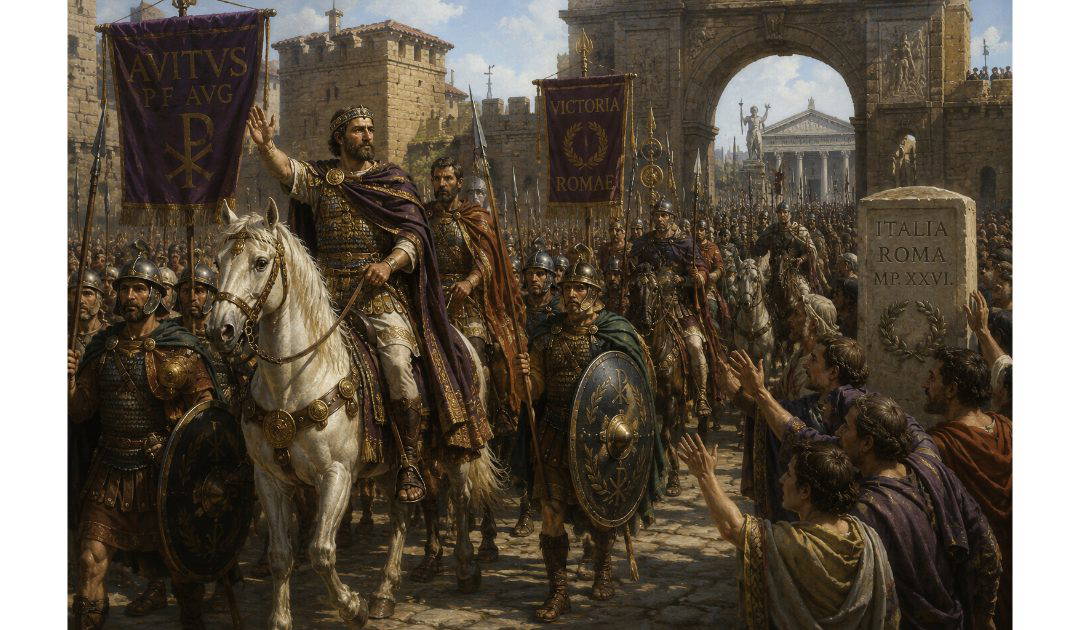
On the 21st of September, 455CE, Emperor Avitus entered Italy with a Gallic army and consolidated his power. I have written about several Roman emperors such as Julius Caesar and Marcus Aurelius, but I hadn’t heard of Avitus.
Avitus was one of the last emperors of the Western Roman Empire, ruling from AD 455 to 456 during one of the most turbulent periods in Roman history. His brief reign came at a time when the Empire was collapsing under the pressure of barbarian invasions, economic decline and political instability. Although often dismissed by later historians as an ineffective ruler, Avitus was an experienced diplomat and soldier who attempted to preserve what remained of Roman authority in the West. His failure reflected not so much personal shortcomings as the almost impossible circumstances in which he found himself.
Avitus was born around AD 385 into an influential aristocratic family in Auvergne, in what is now central France. His family belonged to the Gallo-Roman nobility, a wealthy provincial elite that had long supplied the Empire with capable administrators and military officers. He received an excellent education and became known for his skill in diplomacy as well as his military experience.
His career was closely connected with the Visigoths, who had established a powerful kingdom centred on Toulouse in southwestern Gaul. Although the Visigoths had once been enemies of Rome, they had become valuable, if unpredictable, allies known as foederati. Avitus served as an ambassador to the Visigothic court and developed a strong relationship with the Gothic king Theodoric II. This personal friendship would later prove decisive in his rise to power.
The Western Empire suffered a devastating blow in AD 455. Emperor Valentinian III was assassinated, ending the long Theodosian dynasty in the West. His successor, Petronius Maximus, ruled for only a few weeks before he was killed as the Vandals approached Rome. Under their formidable king Genseric, the Vandals captured and thoroughly looted Rome in June 455. The prestige of the imperial government reached a new low.
In the aftermath of this catastrophe, Avitus was in Gaul acting as imperial representative. With the support of Theodoric II and the Gallo-Roman aristocracy, he was proclaimed emperor at Arles in July 455. The Visigoths escorted him into Italy, where the Roman Senate reluctantly accepted him as emperor. His dependence upon Gothic military support, however, immediately created suspicion among many Romans, especially the influential aristocracy in Italy, who disliked the idea of an emperor appearing to owe his throne to barbarian allies.
Avitus inherited an empire reduced to Italy, parts of Gaul and fragments of Spain. North Africa, the Empire’s richest province and principal grain supplier, remained in Vandal hands. Britain had long since been abandoned, while much of Gaul and Spain was effectively controlled by barbarian kingdoms that acknowledged Roman authority only when it suited them.
Despite these difficulties, Avitus attempted to restore Roman fortunes. He encouraged the Visigoths to campaign against the Suebi in northwestern Spain, hoping to re-establish imperial influence there. The campaign achieved some military success, but most of the gains benefited the Visigoths rather than the Empire itself. This reinforced the perception that Avitus favoured his Gothic allies over Roman interests.
Meanwhile, Italy faced severe shortages of food because Vandal control of North Africa interrupted the grain supply. Maintaining the large Gothic force that had accompanied Avitus became increasingly unpopular. Eventually he dismissed many of the Gothic troops, partly to reduce expenses and partly to calm public opinion. Unfortunately, this also deprived him of the military support on which his authority depended.
At the same time, two ambitious Roman generals emerged as his principal rivals: Ricimer and Majorian. Ricimer won an important naval victory against the Vandals, greatly enhancing his prestige. With growing support from the Italian army and Senate, Ricimer and Majorian turned against Avitus.
In October 456, the opposing forces met near Piacenza. Avitus was defeated and forced to abdicate. He was compelled to become Bishop of Piacenza, a common method of removing unwanted political figures from power without immediate execution. His episcopate was brief. While attempting to return to Gaul, he died in 457. Ancient sources disagree about the cause, suggesting either natural illness or assassination.
Avitus left little lasting mark on imperial administration, yet his reign illustrates the changing nature of the late Western Empire. Increasingly, emperors depended upon barbarian armies and powerful military commanders rather than their own resources. Provincial aristocrats in Gaul, Italy and elsewhere often pursued local interests instead of imperial unity, while real military power was shifting to generals such as Ricimer.
Although Avitus failed to reverse the Empire’s decline, he was not an incompetent ruler. He was an able diplomat who understood the necessity of cooperating with Rome’s former enemies. His tragedy was that he ruled at a time when compromise with barbarian kingdoms was both essential and politically unacceptable to many Romans. Within twenty years of his death, the Western Roman Empire itself disappeared when the last emperor, Romulus Augustulus, was deposed in 476. Avitus therefore occupies an important place in history as one of the final emperors to struggle—ultimately in vain—to preserve the authority of ancient Rome in the West.