
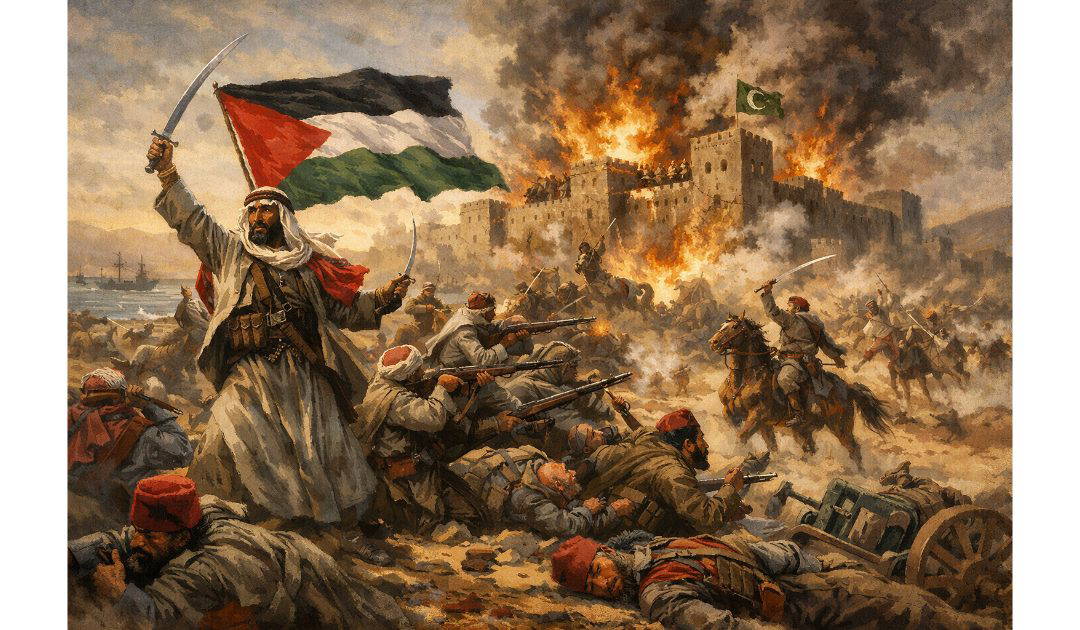
On the 5th of June, 1916, the Arab Revolt against the Ottoman Empire broke out. I have posted my review of Seven Pillars of Wisdom which gives a fascinating account of T.E. Lawrence’s role in the Arab Revolt. Let’s now take a wider view. It occured amid the upheaval of the First World War, reshaping the political future of the Middle East, and leaving a legacy still felt today. What began as a regional uprising in the Hejaz became a symbol of Arab nationalism and a pivotal campaign in the wider conflict between the Ottomans and the Allied Powers.
By the early twentieth century, the Ottoman Empire had ruled much of the Arab world for four centuries. While many Arabs had long accepted Ottoman sovereignty, tensions deepened after the Young Turk Revolution of 1908. The new leadership in Constantinople pursued centralisation and Turkification policies that alienated Arab elites, who feared the erosion of their local authority and cultural identity. These anxieties were particularly strong among notables in Damascus, Baghdad, and the holy cities of Mecca and Medina.
The revolt was led by Hussein bin Ali, the Sharif of Mecca and a direct descendant of the Prophet Muhammad. As guardian of the holy cities, Hussein held both religious prestige and political influence. When the Ottoman Empire entered the war in late 1914 on the side of the Central Powers, Hussein faced a difficult choice. The Ottoman Sultan, who also claimed the title of Caliph, called for jihad against the Allies. Yet Hussein distrusted Ottoman intentions and feared that his own authority in the Hejaz would be curtailed.
Behind the scenes, British diplomacy played a crucial role. Through correspondence with Sir Henry McMahon, the British High Commissioner in Egypt, Hussein was encouraged to lead an Arab uprising in exchange for British recognition of Arab independence after the war. The promises made in this correspondence were ambiguous and later bitterly disputed, but they were sufficient to persuade Hussein to act.
On the 10th of June 1916, Hussein declared the revolt in Mecca. His forces, composed of tribal fighters and local supporters, quickly seized much of the city after fierce fighting with Ottoman troops. Over the following weeks, Arab forces captured the port of Jeddah and laid siege to Medina, where a determined Ottoman garrison under Fakhri Pasha held out for years. The revolt initially appeared fragile; the Arabs lacked heavy weapons and modern military organisation. However, British naval support along the Red Sea coast and supplies of rifles, gold, and artillery strengthened their position.
Hussein’s sons became central figures in the campaign. Faisal I of Iraq emerged as the most effective military and political leader among them, forging alliances with Bedouin tribes and extending the revolt northward. Abdullah I of Jordan also played an important role, later establishing himself in Transjordan.
The revolt gained wider fame through the involvement of T. E. Lawrence, often known as “Lawrence of Arabia.” A British officer and archaeologist, Lawrence served as liaison between the Arab forces and British command. He advocated a strategy of guerrilla warfare rather than conventional battles. Arab fighters targeted the strategically vital Hejaz Railway, which linked Damascus to Medina, sabotaging tracks and bridges to disrupt Ottoman supply lines. These raids, dramatic and mobile, tied down significant Ottoman forces and contributed to the broader British campaign in the Middle East.
In 1917 and 1918, the revolt became increasingly coordinated with British advances under General Allenby in Palestine and Syria. Arab forces captured the port of Aqaba in July 1917 in a daring overland attack, opening a crucial supply route. As British and imperial troops advanced northwards, Arab units entered Damascus in October 1918, symbolising the collapse of Ottoman rule in much of the Arab east.
Yet the political outcomes of the revolt proved deeply contentious. Even as Britain encouraged Arab aspirations, it had already negotiated the secret Sykes–Picot Agreement with France in 1916, dividing much of the region into spheres of influence. After the war, the victorious Allies established mandates rather than granting full independence. Faisal briefly became king of Syria in 1920 but was expelled by French forces; he was later installed as king of Iraq under British supervision. Abdullah ruled Transjordan, also under British mandate. Meanwhile, Hussein’s own kingdom in the Hejaz was eventually conquered by Ibn Saud in the 1920s.
The Arab Revolt thus occupies a complex place in history. For some, it represents a heroic assertion of Arab identity against imperial domination. For others, it stands as a tragic episode in which wartime promises were betrayed, paving the way for new forms of foreign control. Militarily, the revolt contributed to the weakening of Ottoman forces and assisted the Allied victory in the Middle Eastern theatre. Politically, it accelerated the dismantling of the Ottoman Empire and shaped the borders and monarchies of modern Iraq and Jordan.
More than a century later, the events of June 1916 continue to echo in debates about nationalism, colonialism, and the origins of the modern Middle East. The Arab Revolt was not merely a regional uprising; it was a turning point in the transformation of an empire and the birth of new states from its ruins.