
I recently attended a lecture, via zoom, about the Anthropocene. That comes from the Greek, anthropo meaning human, and cene meaning new. It is used to describe the geological age which has been impacted fundamentally by human activity. The reason I’m prompted to write about it today is that it was on the 6th of August, 1945, that the atomic bomb was dropped on Hiroshima. That bomb killed around 70,000 people instantly, and a similar number afterwards through radiation poisoning. The fact I learnt at the lecture is that in nuclear tests held since the equivalent of 29,000 Hiroshima bombs have been detonated.
Another thing I learnt from the lecture concerns Saint Boniface. Boniface, born in Wessex in Anglo-Saxon England around 675, was originally named Wynfrith. A learned monk and skilled preacher, he felt called to missionary work among the Germanic peoples of the continent, who still practised forms of paganism centred on sacred groves, springs, and trees. By the time of this episode, Boniface had already gained support from the papacy and from Frankish rulers, giving him a degree of protection and authority as he travelled and preached. The event traditionally took place near Geismar, in Hesse, around 723. At the heart of the story stands the great oak dedicated to Donar, the Germanic god of thunder, known in Norse tradition as Thor. This tree was considered sacred by the local people. It was not merely a natural object but a focal point of religious life, a place where offerings were made and where divine power was believed to dwell.
According to early sources, most notably the Life of Boniface written by Willibald, Boniface resolved to cut down the oak in full view of the local population. The act was both a challenge and a demonstration. If Donar truly possessed divine power, it was expected that he would strike down anyone who dared harm his sacred tree. Thus, Boniface’s action was a direct test of pagan belief.
As the story goes, a crowd gathered, anticipating divine retribution. Boniface took an axe and began to chop at the trunk. Tension must have been immense, as onlookers waited for a thunderbolt or some sign of the god’s wrath. Instead, nothing happened. In some versions of the story, a great wind suddenly arose and helped to topple the oak in a dramatic crash, splitting it into pieces. The silence of Donar—his apparent inability to defend his own sacred tree—had a profound effect on the spectators. Rather than confirming the god’s power, the event undermined it. Boniface seized the moment to preach the superiority of the Christian God, presenting the felling of the oak as proof that the old gods were powerless. The wood from the fallen tree was then reportedly used to build a chapel dedicated to Saint Peter, further reinforcing the symbolic transformation of the site: what had once been a centre of pagan worship became a place of Christian devotion. The felling by Boniface of the oak tree was presented as one example of human power subverting nature. Perhaps the pagans had a closer relationship with nature than Boniface did?
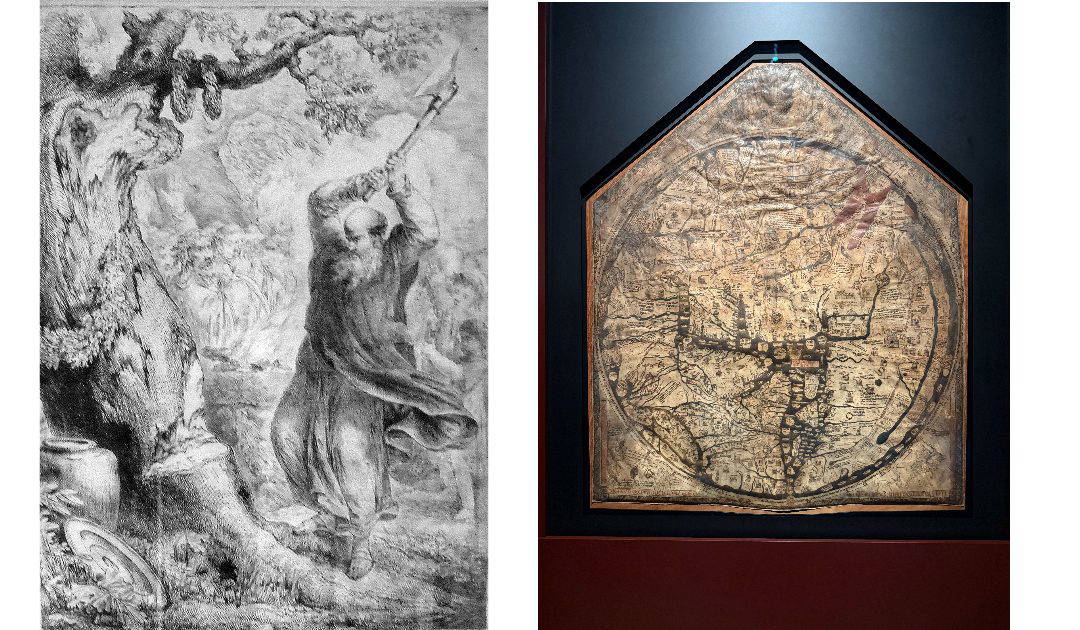
Other exhibits were ancient maps which featured little other than human creations. I recalled our recent visit to Hereford to see the Mappa Mundi. That certainly has a rather distorted view of the natural world and emphasized the creations of man.