
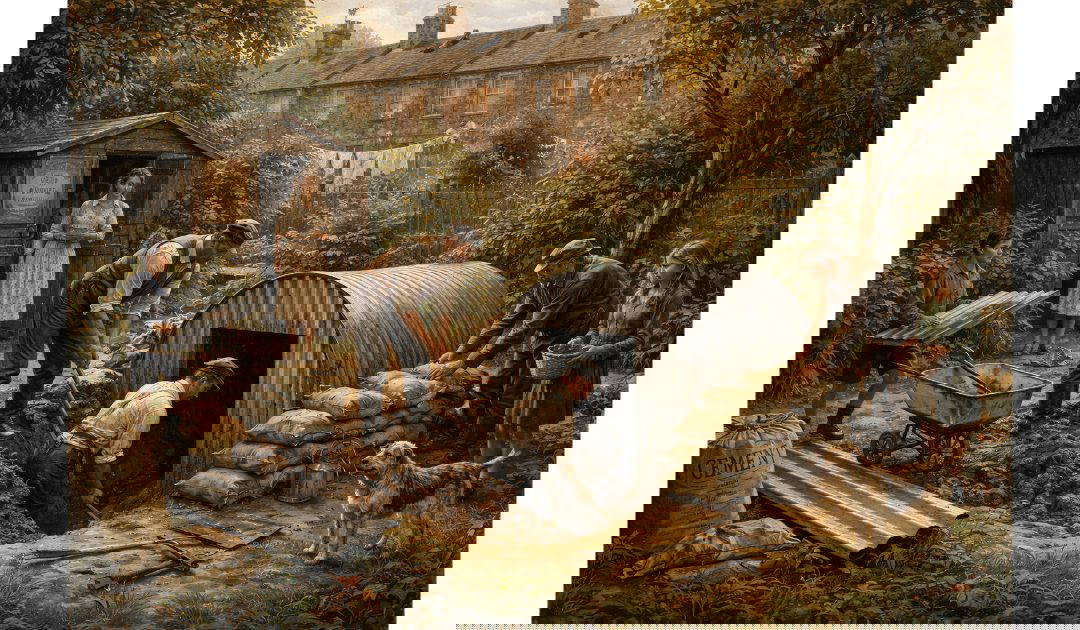
On the 25th of February, 1939, the first Anderson Shelter was constructed in a garden in Islington. I remember when I was a child that one of my friends still had an Anderson Shelter in his back garden.
The Anderson shelter was one of the most important civil-defence innovations of the Second World War, created in response to the looming threat of aerial bombardment against Britain. Its invention was not the result of a single dramatic breakthrough, but of urgent planning, practical engineering, and political resolve in the tense months before war broke out in 1939. Simple in design yet profound in impact, the Anderson shelter became a symbol of Britain’s attempt to protect ordinary families in an age of total war.
The intellectual roots of the shelter lay in the changing nature of warfare during the interwar period. The First World War had shown that civilians were no longer safely removed from conflict, and the bombing of cities during the Spanish Civil War—most famously Guernica in 1937—convinced British planners that future wars would bring devastating air attacks on population centres. Government forecasts predicted hundreds of thousands of civilian casualties in the first weeks of war. Protecting the public from air raids became an urgent priority.
By the late 1930s, Britain had already established an Air Raid Precautions (ARP) system, but existing shelter ideas were inadequate. Large communal shelters were expensive and slow to build, and basements were not universally available or structurally reliable. What was needed was a shelter that could be produced rapidly, cheaply, and in enormous numbers, using materials and skills already available within British industry.
Responsibility for solving this problem fell to Sir John Anderson, who was appointed Home Secretary in 1938. Anderson was not an engineer himself, but as chairman of the ARP committee he oversaw the development of a standard domestic shelter. The design work was carried out by government engineers early in 1939, drawing on the use of corrugated steel, a material already widely employed in agricultural buildings, culverts, and industrial roofing.
The resulting Anderson shelter was strikingly straightforward. It consisted of six curved panels of galvanised steel bolted together to form a semi-cylindrical arch, with flat steel end pieces. The shelter was designed to be sunk into a pit around four feet deep, with earth banked over the top to a depth of at least fifteen inches. This covering absorbed blast energy and protected occupants from shrapnel and falling debris. Inside, the shelter was cramped but functional, typically fitted with wooden benches and capable of accommodating up to six people.
One of the most significant aspects of the Anderson shelter’s invention was its emphasis on standardisation and mass production. The shelter used a small number of identical components that could be manufactured quickly and distributed nationwide. Rather than requiring skilled builders, the government expected householders themselves to dig the pit and assemble the shelter, often with advice from local authorities. This approach reduced costs dramatically and allowed production to scale up at remarkable speed.
The scheme was formally announced in February 1939, months before Britain entered the war. Under government policy, Anderson shelters were provided free to households earning less than £250 a year, ensuring that working-class families were not excluded. Those with higher incomes could purchase one at a subsidised price. Distribution was handled by local councils, and within weeks suburban gardens across Britain were being dug up as families prepared for the worst.
By the outbreak of war in September 1939, approximately 1.5 million Anderson shelters had already been issued, a remarkable logistical achievement. Eventually, more than two million would be installed. Their presence reshaped the domestic landscape, turning back gardens into defensive spaces and making civil defence part of everyday life.
In use, the Anderson shelter proved both effective and uncomfortable. Structurally, it offered good protection against blast and debris, and many lives were undoubtedly saved. However, the shelters were cold, damp, and prone to flooding, particularly in areas with heavy soil or high water tables. Condensation dripped from the steel roof, and during long nights of bombing conditions could be bleak. Despite this, many families preferred the shelter to remaining indoors during raids.
The invention of the Anderson shelter also had an important psychological dimension. It reassured the public that the government was taking civilian protection seriously and gave families a sense of agency in preparing for war. Building and maintaining the shelter became a shared act of endurance, reinforcing the idea that survival depended on collective effort.
By 1940, the limitations of the Anderson shelter led to the introduction of the indoor Morrison shelter, better suited to urban households without gardens. Nevertheless, the Anderson shelter remained an enduring symbol of Britain’s early wartime response. Its invention demonstrated how necessity, rather than innovation for its own sake, could produce a solution that was modest, practical, and life-saving. In its simplicity and ubiquity, the Anderson shelter stands as a defining artefact of the British home front.