
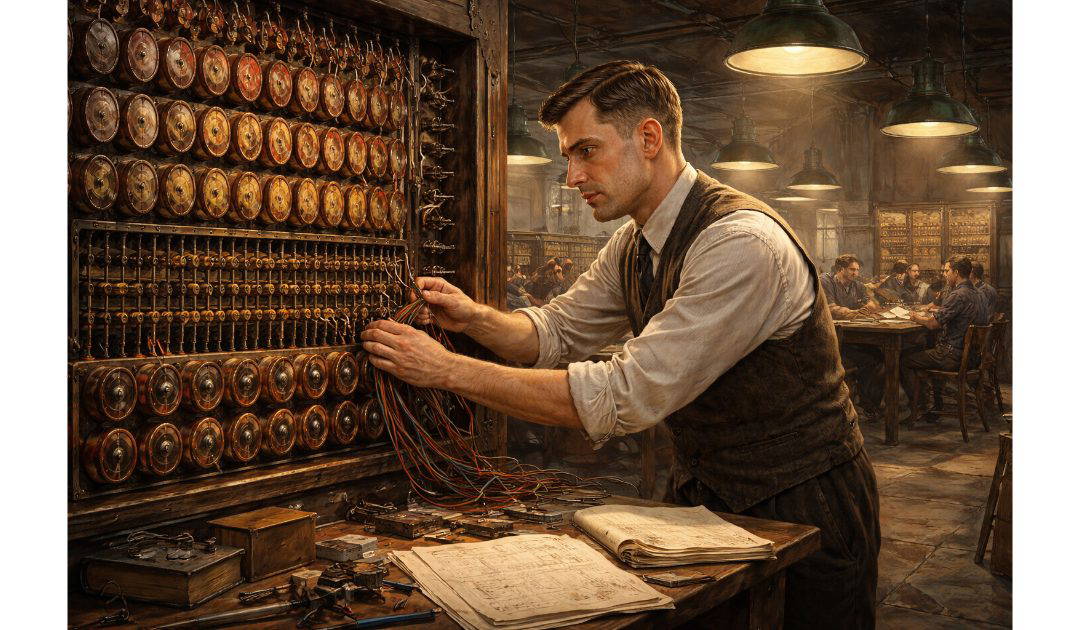
On the 28th of May, 1936, Alan Turing submitted his paper On Computable Numbers for publication. Alan Turing was one of the most influential scientists of the twentieth century, a pioneer of computer science, artificial intelligence, and modern cryptography. His theoretical insights laid the foundations for the digital age, and his wartime codebreaking work played a decisive role in the Allied victory during the Second World War. Despite his extraordinary achievements, his life was cut short at the age of forty-one, and only decades later was he fully recognised for his contributions.
Turing was born in London in 1912 and educated at Sherborne School before winning a scholarship to King’s College, Cambridge. There he studied mathematics and quickly distinguished himself as a brilliant and original thinker. In 1936, at just twenty-four, he published a groundbreaking paper titled “On Computable Numbers.” In it, he introduced the concept of what is now called the Turing machine—an abstract mathematical device capable of performing any computation that can be described algorithmically. Though purely theoretical, the Turing machine provided a precise definition of computation and remains central to computer science. It demonstrated that complex calculations could be broken down into simple, mechanical steps, anticipating the logic of modern programmable computers.
After Cambridge, Turing studied at Princeton University under the logician Alonzo Church, further developing his work in mathematical logic. By the late 1930s, Europe was on the brink of war, and Turing returned to Britain, where his talents would soon be put to critical use.
During the Second World War, Turing joined the Government Code and Cypher School at Bletchley Park, Britain’s secret codebreaking centre. There he worked on deciphering messages encrypted by the German military’s Enigma machine. The Enigma system used rotating wheels and electrical circuits to produce vast numbers of possible code settings, making it appear unbreakable.
Turing played a central role in developing the “Bombe,” an electromechanical machine designed to help identify the daily Enigma settings. Building on earlier Polish work, Turing’s refinements greatly increased the efficiency of codebreaking operations. The intelligence gathered from decrypted German communications—known as Ultra—proved crucial in the Battle of the Atlantic and other theatres of war. Many historians believe that the success at Bletchley Park shortened the war in Europe by at least two years and saved countless lives.
After the war, Turing turned his attention to building actual electronic computers. He worked at the National Physical Laboratory on the design of the Automatic Computing Engine (ACE), one of the earliest stored-program computer designs. Though bureaucratic delays limited the full realisation of his plans there, his ideas influenced subsequent British computing projects.
In 1948, Turing moved to the University of Manchester, where he worked on the Manchester Mark I, one of the world’s first operational electronic computers. It was during this period that he began exploring the possibility of artificial intelligence. In 1950 he published another landmark paper, “Computing Machinery and Intelligence,” in which he posed the question, “Can machines think?” He proposed what is now known as the Turing Test: if a machine could engage in a conversation indistinguishable from that of a human, it could be said to exhibit intelligence. The Turing Test remains a foundational concept in debates about AI and machine consciousness.
Turing’s scientific interests were remarkably broad. In the early 1950s he conducted pioneering research in mathematical biology, particularly in morphogenesis—the process by which patterns such as stripes and spots develop in plants and animals. His reaction-diffusion model showed how simple chemical interactions could generate complex biological forms, a theory that continues to influence developmental biology.
Despite his intellectual triumphs, Turing’s personal life was marked by hardship. In 1952 he was prosecuted for homosexual acts, which were then illegal in Britain. Rather than serve a prison sentence, he accepted chemical castration through hormone treatment. The conviction led to the loss of his security clearance and effectively ended his government cryptographic work.
In June 1954, Turing was found dead at his home in Wilmslow, Cheshire. An inquest ruled that he had died by suicide through cyanide poisoning, though some aspects of his death remain debated. He was just forty-one years old.
In the decades after his death, Turing’s reputation grew enormously. As the importance of computing became clear, he came to be regarded as one of its founding figures. In 2009, the British government formally apologised for his treatment, and in 2013 he was posthumously granted a royal pardon by Queen Elizabeth II. In 2017, legislation informally known as the “Turing Law” extended pardons to others convicted under historical anti-homosexuality laws.
Today, Alan Turing is celebrated not only as a mathematical genius and wartime hero but also as a symbol of the injustice suffered by many because of prejudice. His theoretical model of computation underpins every modern computer, while his vision of intelligent machines anticipated debates that continue to shape the twenty-first century. His life, brilliant and tragic, stands at the crossroads of science, war, and social change.