
I know that these days women actors prefer to be known as actors rather than actresses. For instance Cate Blanchett said “I have always referred to myself as an actor. I am of the generation where the word actress was used almost always in a pejorative sense. So I claim the other space.” Whoopi Goldberg told The Guardian: “An actress can only play a woman. I’m an actor—I can play anything.” But my post today will be rather clumsy if I keep refering to female actors so please excuse me.
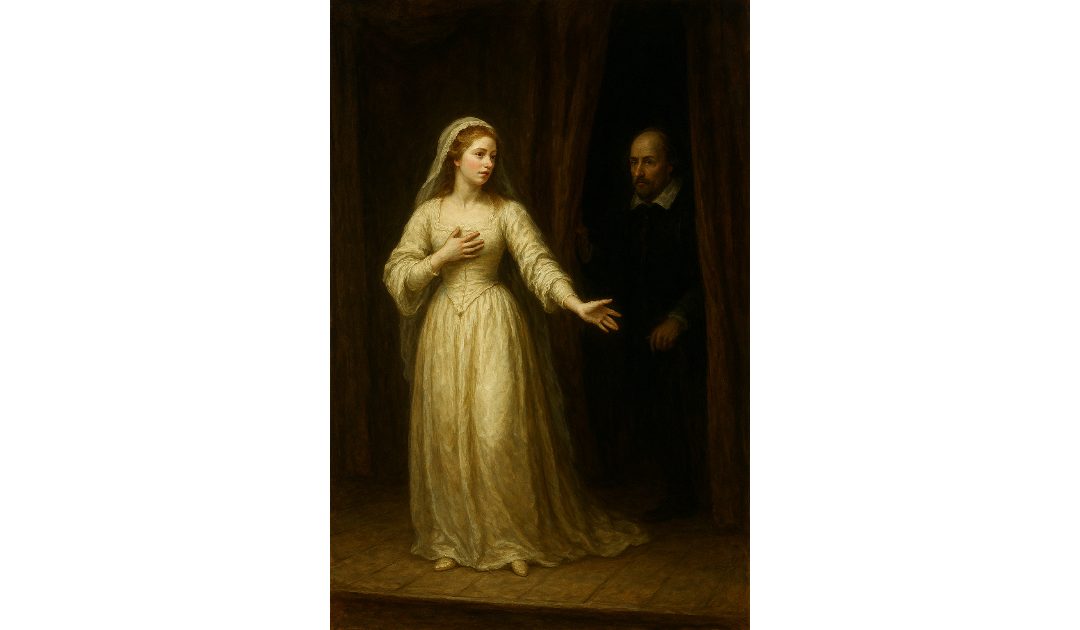
On the 8th of December, 1660, a woman appeared on an English public stage for the first time in the role of Desdemona in Shakespeare’s Othello. It was either Margaret Hughes or Anne Marshall, sources differ.
Before 1660, the English stage was dominated by male actors, as women had been formally forbidden from acting in public theatres. Female roles were traditionally performed by young boys or effeminate men, and the presence of women upon the stage was considered both scandalous and morally hazardous. The closing of the theatres in 1642, during the English Civil War and the subsequent Puritan regime, had silenced public performances for nearly two decades. When Charles II was restored to the throne in May 1660, he brought with him a taste for the theatre he had experienced in France, where women had long performed professionally. One of his first cultural acts was to grant patents to Thomas Killigrew and William Davenant to establish theatre companies in London, explicitly permitting the appearance of actresses for the first time in English history. It was during this pivotal time that Margaret Hughes and Anne Marshall emerged as two of the most notable women associated with the early appearances of actresses on the English stage. Their stories intertwine with the history of Restoration theatre, and their careers reflect both the opportunities and the controversies that accompanied the inclusion of women in performance.
Margaret Hughes is often celebrated as the first recorded professional actress on the English stage. She is most famously associated with the role of Desdemona in Shakespeare’s Othello, reportedly performed in December 1660 at the Vere Street Theatre by the King’s Company under Killigrew. Samuel Pepys, whose diaries provide a vivid chronicle of Restoration society, noted the novelty of a woman performing the role of Desdemona, expressing both fascination and approval. Hughes’s presence on the stage signalled a radical departure from previous norms, embodying the spirit of the Restoration’s embrace of pleasure, spectacle, and a loosening of the moral strictures of the Interregnum. Her acting career, while not extensively documented in terms of repertoire, became inextricably linked with this first public acknowledgment of female performance. Hughes later became the mistress of Prince Rupert of the Rhine, a prominent royal figure, further entwining her life with the courtly culture of the period.
Anne Marshall, meanwhile, was another early figure in the emergence of actresses in 1660, though her career trajectory differed from Hughes’s more sensational debut. Marshall was connected to the King’s Company as well and is believed to have been among the first actresses to appear on the English stage, possibly even rivaling Hughes for the distinction of the very first. Some contemporary sources suggest that Marshall was active in the company at the same moment Hughes achieved fame as Desdemona, indicating that multiple women were stepping into the limelight simultaneously as the innovation of female acting took hold. Anne Marshall specialised in tragic and serious roles, and she was regarded as a capable performer with a talent for eliciting sympathy and emotional engagement from audiences unaccustomed to seeing real women in such parts.
The novelty of women acting in 1660 cannot be overstated. Audiences were enthralled not only by the performances but by the mere fact of female presence on stage. It added a new dimension of realism and sensuality to theatre, particularly in plays that involved romantic or tragic female characters. The shift also coincided with a growing appetite for comedies of manners and heroic tragedies that featured complex female roles, which would come to define much of the Restoration repertoire.
Both Hughes and Marshall navigated a theatrical environment that was at once exhilarating and precarious. While their participation broke barriers, it also exposed them to the prurient gaze of audiences and the moral scrutiny of critics. Actresses were often conflated with courtesans, and many, like Hughes, had personal lives that intertwined with prominent men of the court, blurring the lines between art and scandal. Nonetheless, their careers laid the foundation for a professional tradition of female acting in England, and the success of the King’s Company and Duke’s Company in the early 1660s attested to the popular acceptance of actresses despite lingering societal reservations.