
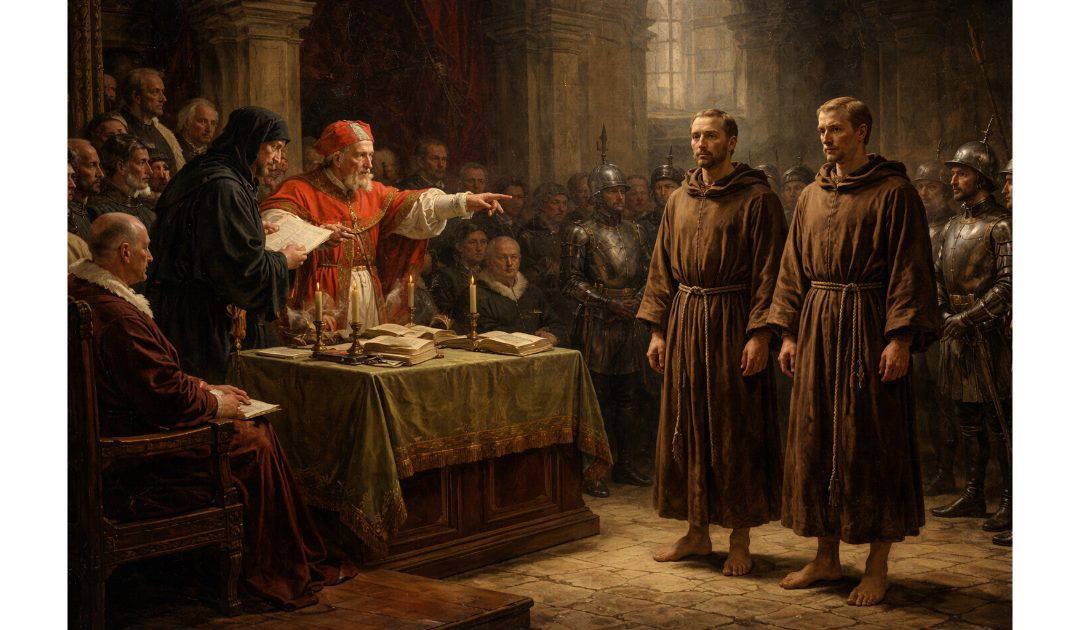
On the 1st of July, 1523, Jan Van Hessen and Hendrik Voes were burnt at the stake in Brussels. They were the first Lutheran martyrs executed by the Council of Brabant. When Martin Luther heard the news he wrote what is believed to be his first hymn, “Ein neues Lied wir heben an”, a new song we raise.
Jan van Essen and Hendrik Voes—often referred to in English as Jan (or Johannes) van Essen and Henry (or Hendrik) Voes—were among the earliest martyrs of the Protestant Reformation. Their execution in 1523 marked a significant moment in the spread of Reformation ideas beyond Germany into the Low Countries, and their deaths were widely publicised, becoming a powerful symbol of resistance to religious persecution.
Both men were members of the Augustinian order, a Catholic monastic community to which the reformer Martin Luther himself had belonged. They lived in a monastery in Antwerp, then part of the Habsburg Netherlands under the rule of Charles V. Antwerp at the time was a thriving commercial city and an important centre for the exchange of ideas, making it fertile ground for the spread of Luther’s teachings after 1517.
Jan van Essen and Hendrik Voes became influenced by Luther’s theology, particularly his emphasis on justification by faith alone and his criticism of certain practices of the Catholic Church, such as the sale of indulgences. These ideas were considered heretical by Church authorities, who were determined to suppress them. The Augustinian monastery in Antwerp had become known for its sympathy toward Lutheran reform, attracting the attention of both ecclesiastical and imperial officials.
In 1522, the authorities moved decisively against the monastery. It was closed, and many of its monks were arrested. Some recanted their beliefs under pressure, but Jan van Essen and Hendrik Voes remained steadfast in their adherence to the new teachings. Their refusal to renounce what were deemed heretical views set them apart and sealed their fate.
The two men were transferred to Brussels, where they were interrogated and put on trial by representatives of the Inquisition. During the proceedings, they were urged repeatedly to recant and return to orthodox Catholic doctrine. However, both refused. Their defiance was not merely stubbornness but reflected a deep conviction that the principles they had embraced were grounded in Scripture and truth.
On the 1st of July, 1523, Jan van Essen and Hendrik Voes were condemned to death. They were burned at the stake in the marketplace in Brussels, a punishment commonly used at the time for those convicted of heresy. Contemporary accounts suggest that they faced their execution with remarkable composure and faith, reportedly reciting the Apostles’ Creed and expressing confidence in their salvation.
Their deaths had a profound impact, particularly among supporters of the Reformation. News of their execution spread quickly across Europe, aided by the growing power of the printing press. Pamphlets and reports circulated, portraying them as heroic witnesses to the truth of the Gospel. Their martyrdom became a rallying point for reformers and a stark illustration of the dangers faced by those who challenged established religious authority.
Martin Luther himself responded to their execution with deep emotion. His hymn A New Song We Raise helped to immortalise their story and ensured that their sacrifice would be remembered within the Protestant tradition.
The execution of Jan van Essen and Hendrik Voes also highlighted the determination of Charles V and the Catholic authorities to maintain religious unity within their territories. As Holy Roman Emperor, Charles saw the spread of Lutheran ideas as a threat not only to the Church but also to political stability. The suppression of heresy was therefore both a religious and political priority.
Despite such efforts, the Reformation continued to spread, and the deaths of early martyrs like van Essen and Voes only strengthened the resolve of reformers. In the Low Countries, their story became part of a broader narrative of resistance that would later contribute to the religious and political upheavals of the sixteenth century, including the Dutch Revolt.
In historical perspective, Jan van Essen and Hendrik Voes stand as figures of conviction during a time of profound change. Their willingness to face death rather than abandon their beliefs underscores the intensity of the religious conflicts that defined the Reformation era. While they were not major theologians or leaders, their martyrdom gave a human face to the struggle and helped to galvanise support for the emerging Protestant movement.
Today, they are remembered as the first Lutheran martyrs, and their story continues to be cited as an example of faith, courage, and the high cost of religious conviction in a deeply divided age.