
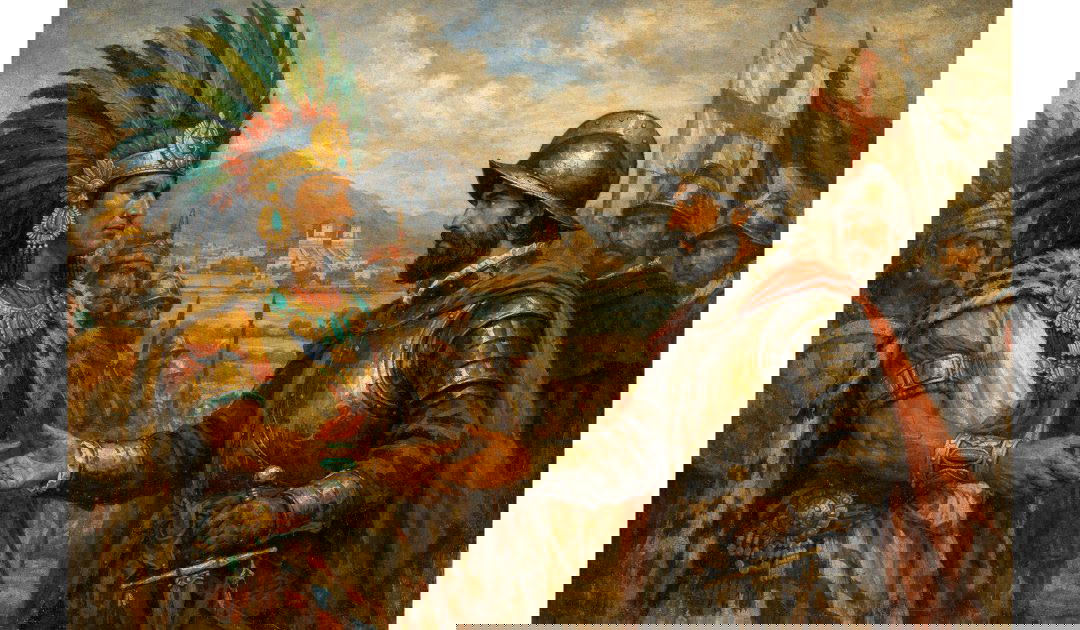
On the 28th of February, 1525, the Aztec King Cuauhtémoc was executed on the order of the conquistador Hernán Cortés. I have written about the Inca people of South America, so lets have a look at the Aztec people, who referred to themselves as the Mexica and created one of the most sophisticated and powerful civilizations in pre-Columbian Mesoamerica.
Emerging in the Valley of Mexico in the early 14th century, they transformed from a marginal migrant group into the rulers of a vast empire that dominated central Mexico until the Spanish conquest in the early 16th century. Their society combined military prowess, complex religious belief, advanced engineering, and a rich artistic tradition. At the tragic heart of their final chapter stands Cuauhtémoc, the last Aztec emperor, whose life and death came to symbolise resistance, dignity, and the destruction of an entire world.
According to Aztec tradition, the Mexica migrated from a mythical homeland called Aztlán, eventually settling on an island in Lake Texcoco in 1325. There they founded Tenochtitlán, a city that would become one of the largest and most impressive urban centres in the world. Built on artificial islands and linked by causeways, the city featured canals, aqueducts, bustling markets, and monumental temples, most notably the Templo Mayor, dedicated to the gods Huitzilopochtli and Tlaloc.
The Aztec political system was imperial in nature. Rather than directly ruling all conquered territories, the Aztecs demanded tribute—food, textiles, precious goods, and captives—from subject cities. This system enriched Tenochtitlán and sustained its population, which may have exceeded 200,000 inhabitants. Society was hierarchical, with nobles (pipiltin), commoners (macehualtin), serfs, and enslaved people, though social mobility was possible, especially through military achievement.
Religion permeated every aspect of Aztec life. The Aztecs believed the universe was fragile and that the gods required nourishment in the form of human sacrifice to maintain cosmic order. While often emphasised by Spanish chroniclers, sacrifice was part of a broader religious worldview that included poetry, philosophy, astronomy, and ritual. Education was universal, with schools for both nobles and commoners, reflecting the importance placed on discipline and civic duty.
In 1519, Hernán Cortés landed on the Gulf Coast and marched inland, exploiting existing rivalries among indigenous states hostile to Aztec dominance. By the time the Spanish reached Tenochtitlán, the empire was ruled by Moctezuma II, whose cautious response to the newcomers proved disastrous. Following Moctezuma’s death and a violent uprising, the Spanish were temporarily expelled during the event known as La Noche Triste in 1520. Yet disease—especially smallpox—ravaged the city, killing thousands and weakening its ability to resist. It was in this moment of crisis that Cuauhtémoc rose to power.
Cuauhtémoc, whose name means “Descending Eagle”, was a young nobleman and experienced warrior. He became tlatoani (emperor) in 1520, likely in his mid-twenties, after the deaths of Moctezuma II and his immediate successor, Cuitláhuac. Unlike his predecessors, Cuauhtémoc adopted a policy of uncompromising resistance. He organised the defence of Tenochtitlán, oversaw repairs to fortifications, and attempted to rally remaining allies.
The siege of Tenochtitlán in 1521 was brutal and protracted. Cortés, aided by tens of thousands of indigenous allies and armed with brigantines that controlled the lake, systematically cut off food and water supplies. Starvation, disease, and constant fighting devastated the population. Despite this, Cuauhtémoc refused to surrender until the city was utterly destroyed.
When he was finally captured in August 1521, Cuauhtémoc reportedly asked Cortés to kill him with his dagger, preferring death to humiliation. Cortés spared his life, but subjected him to torture—most notoriously by burning his feet—in an attempt to extract information about hidden Aztec treasure. Cuauhtémoc endured the agony in silence, rebuking another tortured noble with the words, “Am I on a bed of roses?”
Cuauhtémoc was kept alive for several years as a symbolic figurehead under Spanish control. In 1525, during an expedition to Honduras, Cortés accused him of plotting rebellion and ordered his execution by hanging. With his death, any lingering hope of Aztec political restoration vanished.
Today, Cuauhtémoc is remembered in Mexico as a national hero, a symbol of resistance against conquest and cultural annihilation. Monuments, streets, and cities bear his name. More broadly, the story of the Aztec people and their last emperor represents the collision of civilizations, the catastrophic impact of conquest, and the enduring resilience of indigenous identity. While their empire fell, Aztec language, traditions, and descendants continue to shape Mexican culture, ensuring that Cuauhtémoc and his people are not forgotten.