
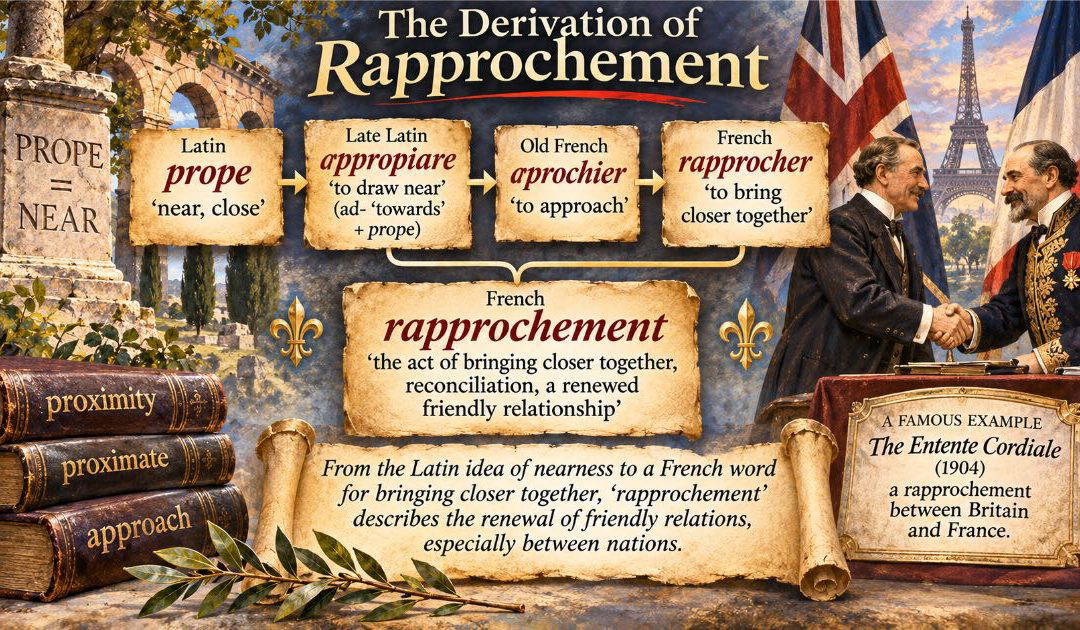
The word rapprochement is one of those elegant French imports that English has adopted almost unchanged. Meaning the restoration of friendly relations between individuals, organisations or nations, it has a linguistic history stretching back more than two thousand years.
At its heart lies the Latin adjective prope, meaning ‘near’ or ‘close’. From this developed propius, meaning ‘nearer’, and proximus, meaning ‘nearest’. The latter survives in English words such as proximity, describing physical or figurative closeness, and proximate, meaning immediately preceding or nearest.
The Latin prope also gave rise to the Late Latin appropiare, meaning ‘to draw near’, formed by combining the prefix ad-, meaning ‘towards’, with a derivative of prope. This passed into Old French as aprochier, eventually becoming the modern French verb approcher, meaning ‘to approach’.
The French prefix re- can indicate repetition or a return to an earlier condition. When attached to approcher, it produced rapprocher, meaning ‘to bring closer together’ or ‘to reconcile’. The associated noun rapprochement therefore describes the process of bringing previously separated or estranged parties into closer relations.
English borrowed rapprochement from French during the nineteenth century. Initially, it was employed particularly in diplomatic and political contexts, where it described attempts to restore cordial relations between governments whose interests had diverged.
One celebrated example was the Entente Cordiale of 1904, which marked a rapprochement between Britain and France after centuries of rivalry and colonial competition. Although the agreement did not constitute a formal military alliance, it helped transform the relationship between the two countries.
During the twentieth century, the word became especially associated with international diplomacy. The rapprochement between the United States and Communist China, initiated by President Richard Nixon’s visit to Beijing in 1972, dramatically altered the geopolitical balance of the Cold War.
Interestingly, rapprochement does not necessarily imply friendship, agreement or reconciliation in every respect. Two governments may pursue rapprochement while retaining profound disagreements. The essential idea is movement towards one another rather than the achievement of complete harmony.
There is a pleasing connection between rapprochement and the everyday English word approach. Both ultimately descend from the same Latin concept of nearness, although one has become a commonplace English verb while the other retains its distinctly French character.
Thus, from the simple Latin idea of being near, rapprochement has evolved into a sophisticated diplomatic expression describing one of humanity’s most important endeavours: transforming distance, suspicion and hostility into cooperation and understanding.