
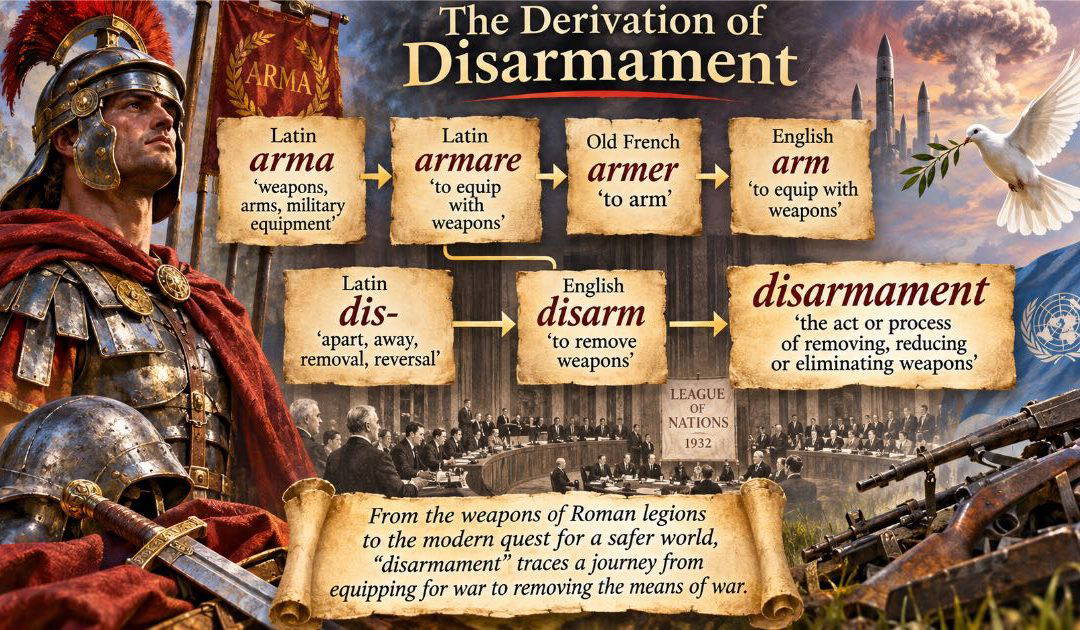
The word disarmament has a history stretching back through French to Latin, and ultimately to the weapons carried by Roman soldiers. Its evolution reflects humanity’s long struggle between preparing for war and seeking peace.
At the heart of the word lies the Latin arma, meaning weapons, military equipment or the implements of war. The opening words of Virgil’s Aeneid, Arma virumque cano — “I sing of arms and the man” — illustrate how deeply the concept of weaponry was embedded in Roman culture. Interestingly, arma was generally used in the plural, referring collectively to the equipment of warfare.
At this point I’m going to digress and talk about arms as our upper limbs. Although we normally wield weapons with our arms, there is no direct etymological connection between arms as weapons and arms as the limbs with which we wield weapons. The arm as a limb comes from Old English earm, meaning the upper limb from shoulder to hand. This developed from Proto-Germanic armaz, with relatives including German Arm, Dutch arm and Old Norse armr. Latin possessed a related anatomical word, armus, meaning the shoulder or upper foreleg of an animal. Right, back to weapons.
From arma developed the Latin verb armare, meaning “to equip with weapons”. This passed into Old French as armer, and subsequently into English as arm, a verb recorded in Middle English.
The prefix dis- has its origins in Latin, where it conveyed separation, reversal or removal. Through French, it became a familiar English prefix indicating the undoing of an action. Thus disarm literally means to remove someone’s weapons or deprive them of the means of fighting.
The English verb disarm appeared in the late Middle Ages, initially describing the physical removal of armour or weapons from a soldier. Over time, it acquired a figurative meaning: to overcome hostility or suspicion through charm, kindness or persuasion. A disarming smile, for example, metaphorically deprives another person of their defences.
The noun disarmament developed from disarm with the addition of -ment, a suffix of French and Latin origin indicating an action, process or result.
Although the word could originally describe the removal of weapons from individuals, its modern political significance emerged particularly during the nineteenth century, when European governments began discussing reductions in standing armies and naval forces.
Following the devastation of the First World War, disarmament became a central ambition of international diplomacy. The League of Nations regarded reducing national armaments as essential to maintaining peace. The Geneva Disarmament Conference of 1932 attempted to translate that aspiration into international agreement, but ultimately failed.
During the Cold War, the word acquired renewed urgency as nuclear weapons threatened destruction on an unprecedented scale. Distinctions emerged between disarmament, meaning the reduction or elimination of weapons, and arms control, which could involve limiting their deployment without necessarily abolishing them.
There is an intriguing linguistic irony in disarmament. Its roots concern the equipment needed to wage war, yet the completed word expresses the hope of making that equipment unnecessary. From Roman swords to nuclear missiles, it encapsulates humanity’s enduring aspiration to replace armed conflict with peaceful coexistence.