
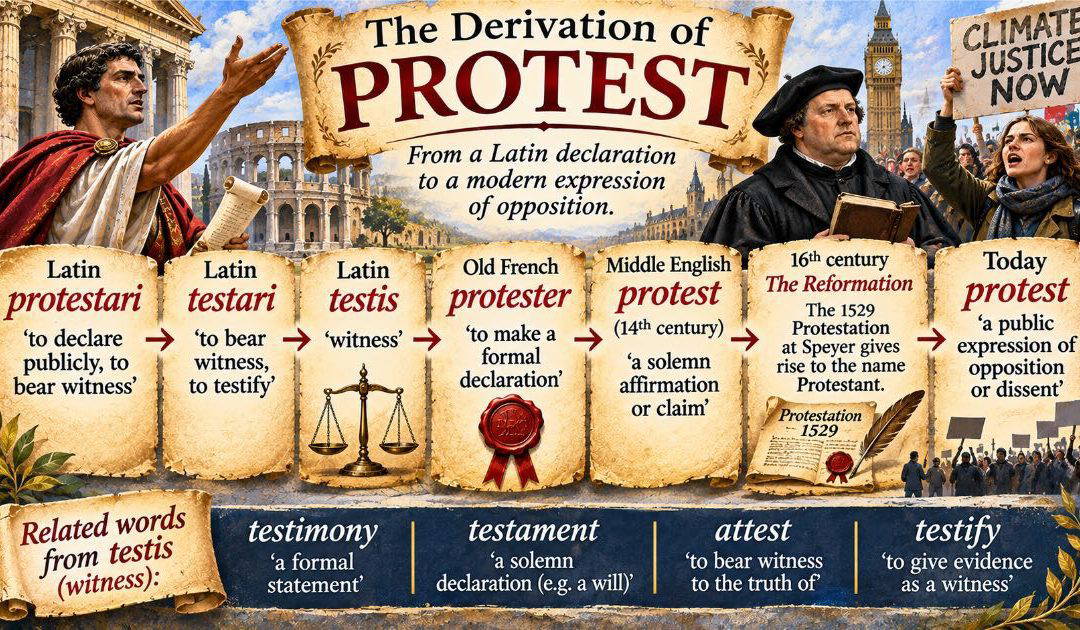
As usual the derivation of the word protest is from Latin. Today, it generally means expressing opposition or disapproval, but its original meaning was to make a solemn public declaration or bear witness to something.
The word derives from the Latin verb protestari, formed from pro-, meaning ‘forth’ or ‘publicly’, and testari, meaning ‘to bear witness’ or ‘testify’. Thus, protestari literally meant ‘to declare publicly’ or ‘to testify openly’.
The Latin testari derives from testis, meaning ‘witness’. This root has given English several familiar words, including testimony, testament, attest and testify. All preserve the underlying concept of bearing witness or establishing the truth of a statement.
The word passed into Old French as protester, retaining the sense of making a formal declaration. It entered English during the fourteenth century, initially referring to solemn affirmations, particularly those made in legal or religious contexts.
In medieval legal proceedings, someone might protest their innocence or declare their rights without necessarily challenging another person’s authority. A protest was fundamentally an assertion rather than an objection.
During the sixteenth century, however, the word began acquiring its modern association with opposition. The religious upheavals of the Reformation played an important role in this transformation.
In 1529, several German princes and representatives of imperial cities formally protested against a decision of the Diet of Speyer that threatened the progress of religious reform. Their declaration became known as the Protestation at Speyer, and its supporters subsequently acquired the name Protestants.
Interestingly, the word Protestant originally referred to those who had made this particular formal declaration, rather than simply to people who opposed the Roman Catholic Church.
Over subsequent centuries, protest increasingly came to mean an expression of dissent, particularly against political authority, government policies or perceived injustice.
By the eighteenth and nineteenth centuries, public protests had become important instruments of political reform. Demonstrations demanding parliamentary representation, improved working conditions and civil liberties helped establish the modern meaning.
Today, protests may involve marches, strikes, petitions or peaceful demonstrations. Yet the ancient meaning survives in expressions such as ‘protest one’s innocence’, where the word still signifies a solemn declaration.
There is a pleasing historical irony in this evolution. A word that originally meant speaking publicly in affirmation has become one of our most powerful expressions of public disagreement.