
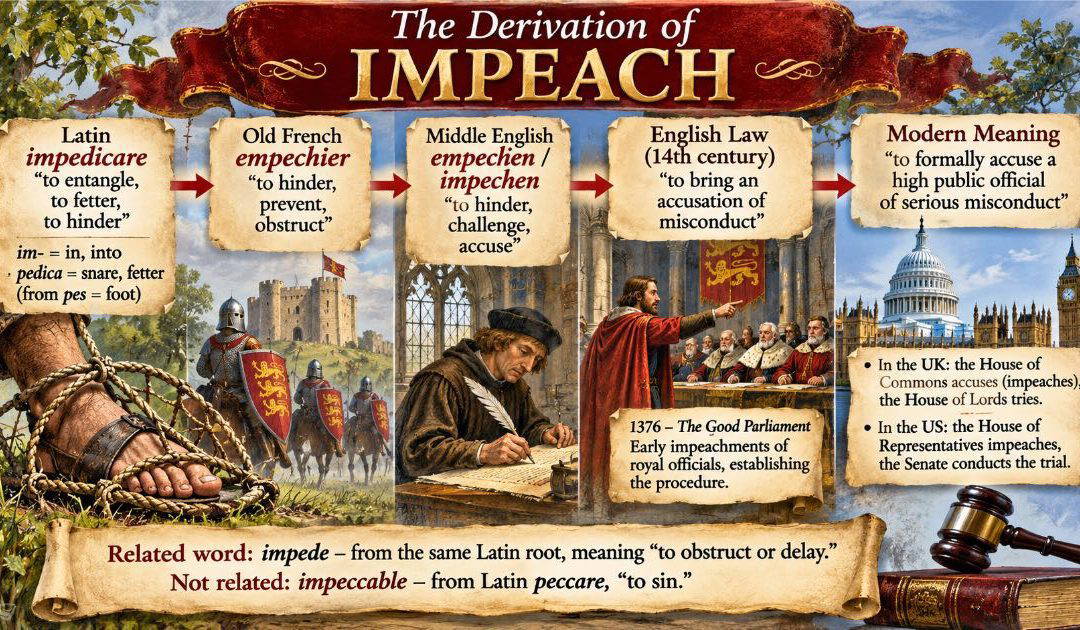
The word impeach has a fascinating history, stretching from the physical act of trapping someone to the political process of accusing a public official of misconduct. Its development illustrates how a word describing physical obstruction gradually acquired legal and constitutional significance.
Latin origins
The word ultimately derives from the Latin impedicare, meaning ‘to entangle’, ‘to fetter’ or ‘to hinder’. It combines im- (a form of in-, meaning ‘in’ or ‘into’) with pedica, meaning a snare or fetter, itself related to pes, the Latin word for ‘foot’. The original image is therefore of someone whose feet have become entangled in a trap, preventing them from moving freely. This same Latin root survives in the English word impede, meaning to obstruct or delay progress.
From Latin to French
As Latin developed into the Romance languages, impedicare contributed to the Old French verb empechier, meaning ‘to hinder’, ‘prevent’ or ‘obstruct’. Following the Norman Conquest of England in 1066, French vocabulary increasingly entered English, particularly in law, government and administration.
By the fourteenth century, Middle English had adopted forms such as empechen and impechen. Initially, these retained the general meaning of hindering or obstructing someone. However, the word also developed the sense of accusing someone of wrongdoing or challenging their honesty.
Impeachment in English law
During the fourteenth century, impeach acquired a more specialised parliamentary meaning. In 1376, during the so-called Good Parliament of Edward III’s reign, the House of Commons brought accusations against several royal officials and associates, including Richard Lyons and William Latimer. These proceedings are generally regarded as the earliest prominent examples of parliamentary impeachment in England.
The procedure eventually developed into one whereby the House of Commons could formally accuse an individual of serious misconduct, with the House of Lords conducting the trial. Importantly, impeachment meant bringing an accusation, not necessarily establishing guilt.
Impeachment in America
The framers of the United States Constitution adopted the English concept of impeachment but modified its application. Under the American system, the House of Representatives has the sole power to impeach federal officials, while the Senate conducts impeachment trials.
A president can therefore be impeached without being removed from office. Removal requires conviction by a two-thirds majority of senators present.
A curious linguistic journey
There is also an interesting distinction between impeach and impeccable. Despite their similar appearance, they have different origins. Impeccable derives from Latin peccare, meaning ‘to sin’, whereas impeach ultimately concerns entanglement and obstruction.
Thus, a word that originally evoked a foot caught in a snare has evolved into one of the most consequential terms in constitutional politics.