
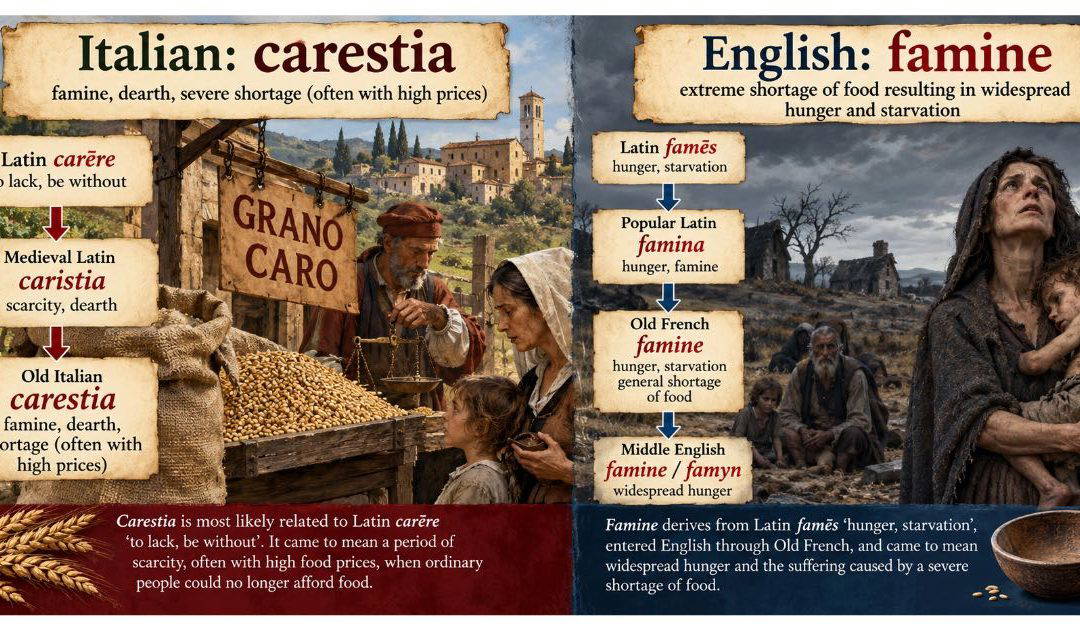
We were supposed to be going on holiday to Sicily last month, but an eruption of Mount Etna closed the airport and scuppered our holiday. I had been trying to learn Italian using Babbel (other apps are available), and I am continuing to do so. In my lesson today (dealing with natural disasters ironically) I learnt that the Italian word for famine is carestia. It has its origins in Latin and is closely related to the Italian adjective caro, meaning dear or expensive.
The underlying idea is that famine and high prices are intimately connected: when food becomes scarce, its price rises, sometimes beyond the reach of ordinary people.
The etymological development begins with the Latin adjective cārus, meaning dear, precious, valued or costly. This gave rise to Italian caro, which retains both the affectionate sense of dear and the economic sense of expensive.
The connection between scarcity, high prices and famine is particularly revealing. In medieval Italy, a carestia was not necessarily a complete absence of food. It could describe a period when grain and other necessities became so expensive that poorer people could no longer afford them.
There is, however, an important etymological complication. The precise origin of carestia is disputed. The authoritative Italian dictionary Treccani traces it to medieval Latin caristia, probably derived from carēre, meaning to lack or be without something. This is also the ancestor of Italian carenza (shortage or deficiency).
Another theory connects carestia with Greek akharistía, meaning ingratitude, perhaps originally suggesting land that was ungrateful because it failed to produce a harvest. Other scholars have proposed an influence from Latin caritas, in its sense of high prices. Neither explanation is universally accepted.
I find it a little strange that the English word famine is much more closely derived from the Latin famēs, meaning hunger, starvation or famine.