
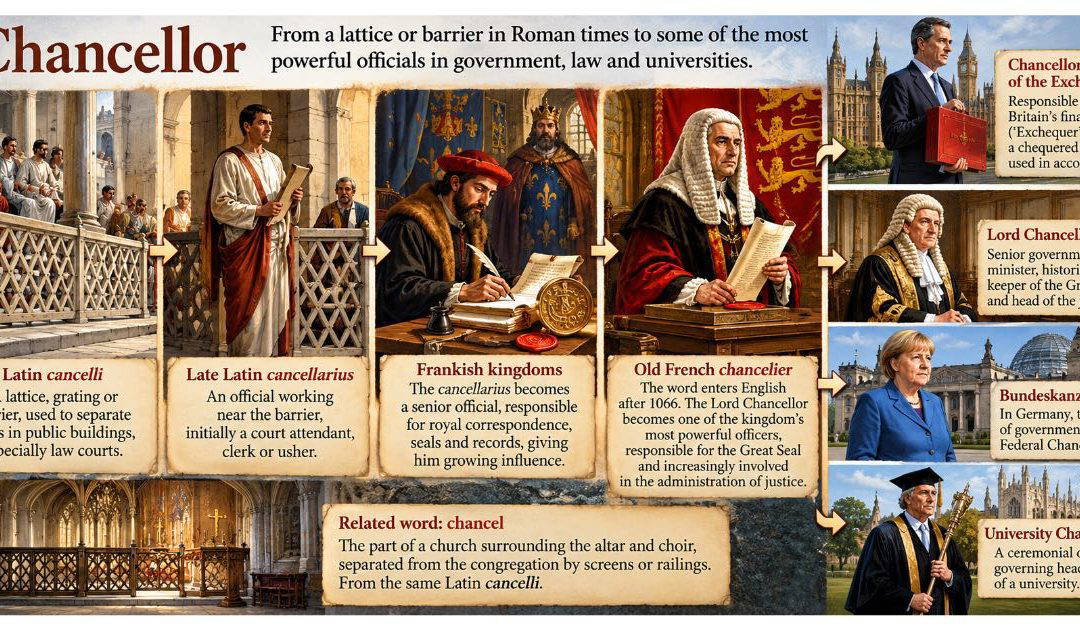
The word chancellor has a surprisingly humble origin. Today, it conjures up images of powerful politicians, senior judges and university dignitaries. Yet its ancestry can be traced to a Latin word meaning a lattice, grating or barrier.
The Latin cancelli referred to the latticework barriers used to separate different areas of Roman public buildings, particularly law courts. These barriers distinguished the space occupied by judges and officials from that reserved for the public.
An official who worked near these barriers became known in Late Latin as a cancellarius. Originally, this was a relatively modest administrative position, associated with court attendants, clerks and ushers. Over time, however, the cancellarius acquired increasingly important responsibilities, particularly the preparation and authentication of official documents.
As the Roman Empire evolved into the medieval kingdoms of Europe, the title developed accordingly. In the Frankish kingdoms, the cancellarius became a senior official responsible for royal correspondence, seals and records. Control over the documents through which a monarch exercised authority brought considerable political influence.
The word entered English through Old French chancelier, following the Norman Conquest of 1066. By the twelfth century, England’s Lord Chancellor was among the kingdom’s most powerful officers, responsible for the Great Seal and increasingly involved in the administration of justice.
Several modern titles preserve this history. The Lord Chancellor remains a senior British government minister, although the office’s judicial responsibilities have been substantially reduced. The Chancellor of the Exchequer, responsible for Britain’s finances, takes the second part of the title from the medieval exchequer, a chequered cloth used in calculating royal revenues.
In Germany, the head of government is the Bundeskanzler, or Federal Chancellor, reflecting the title’s long association with senior administration.
Universities also adopted the title, with chancellors becoming their ceremonial or governing heads.
Interestingly, chancellor shares its ancestry with chancel, the part of a church surrounding the altar and choir. The connection is the Latin cancelli, since this sacred area was traditionally separated from the congregation by screens or railings.
Thus, a word originally associated with someone standing beside a barrier eventually came to designate some of Europe’s most powerful officials. It is a remarkable example of how administrative authority can transform an occupational title over centuries.