
In an earlier post about education I mentioned how an ability for maths and sciences, physics in particular, helped me achieve an exhibition to Oxford. Physics is actually quite an interesting word.
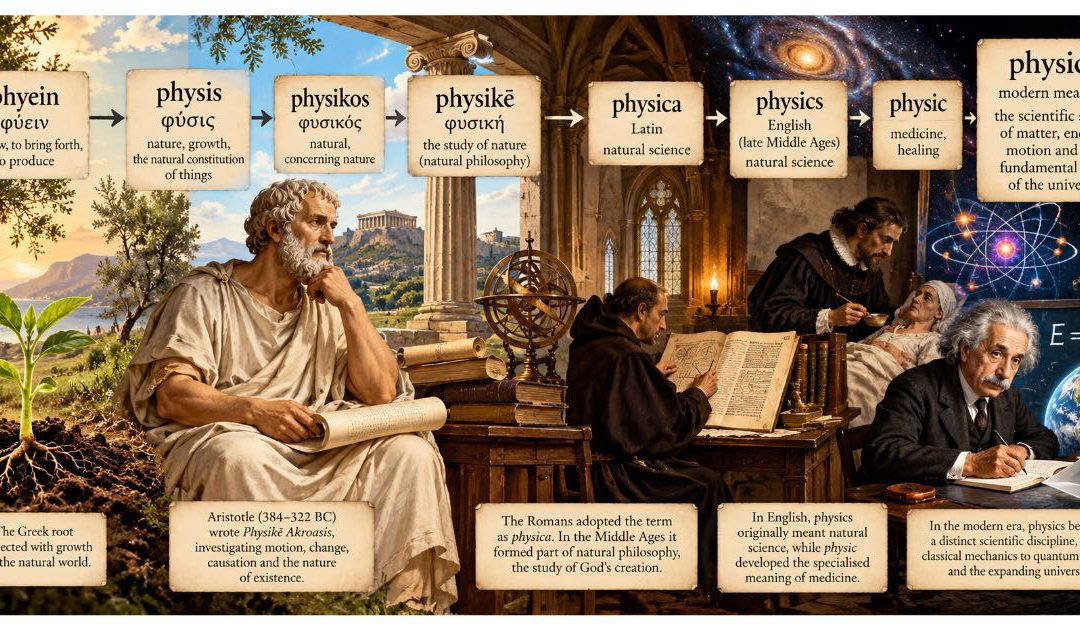
The word physics has a history stretching back more than two thousand years to ancient Greece. Its origins reveal how the study of nature gradually developed into the modern science of matter, energy, motion and the fundamental laws of the universe.
The word derives from the Ancient Greek φυσική (physikē), meaning ‘the study of nature’. This was an abbreviation of physikē epistēmē, literally ‘knowledge of nature’. The adjective physikos meant ‘natural’ or ‘concerning nature’, while the noun physis (φύσις) meant ‘nature’, ‘growth’ or ‘the natural constitution of things’.
At the root lies the Greek verb phyein (φύειν), meaning ‘to grow’, ‘to bring forth’ or ‘to produce’. This is particularly revealing because the Greeks understood nature as something that grew and developed according to its own inherent principles.
The philosopher Aristotle (384–322 BC) wrote a treatise known as Physikē Akroasis, generally translated as Physics. It investigated motion, change, causation, time and the nature of physical existence. Aristotle’s physics was considerably broader than today’s discipline, encompassing questions that we would now associate with philosophy and biology.
The Romans borrowed the Greek terminology, producing the Latin physica, meaning natural science. During the Middle Ages, scholars studied physica as part of natural philosophy, seeking to understand the workings of God’s creation.
The word entered English during the late Middle Ages, initially referring broadly to natural science. Interestingly, its relative physic acquired a specialised meaning: medicine or the art of healing. A physician was originally someone knowledgeable about nature who applied that understanding to treating disease. This explains why physicians practise medicine rather than what we now call physics.
During the Scientific Revolution of the sixteenth and seventeenth centuries, figures such as Galileo, Kepler and Newton transformed natural philosophy through mathematics, observation and experiment. Galileo features in Fire and Earth, the second book in the Sir Anthony Standen Adventures.
By the eighteenth and nineteenth centuries, physics increasingly denoted the distinct scientific discipline familiar today.
Several related words preserve the Greek root: physical, physiology, physiognomy and physiotherapy.
Thus, a word originally associated with growth and the natural world has evolved into the name of a science investigating everything from subatomic particles to the expanding universe. The linguistic journey is particularly appropriate: physics remains, fundamentally, humanity’s attempt to understand how nature works.