
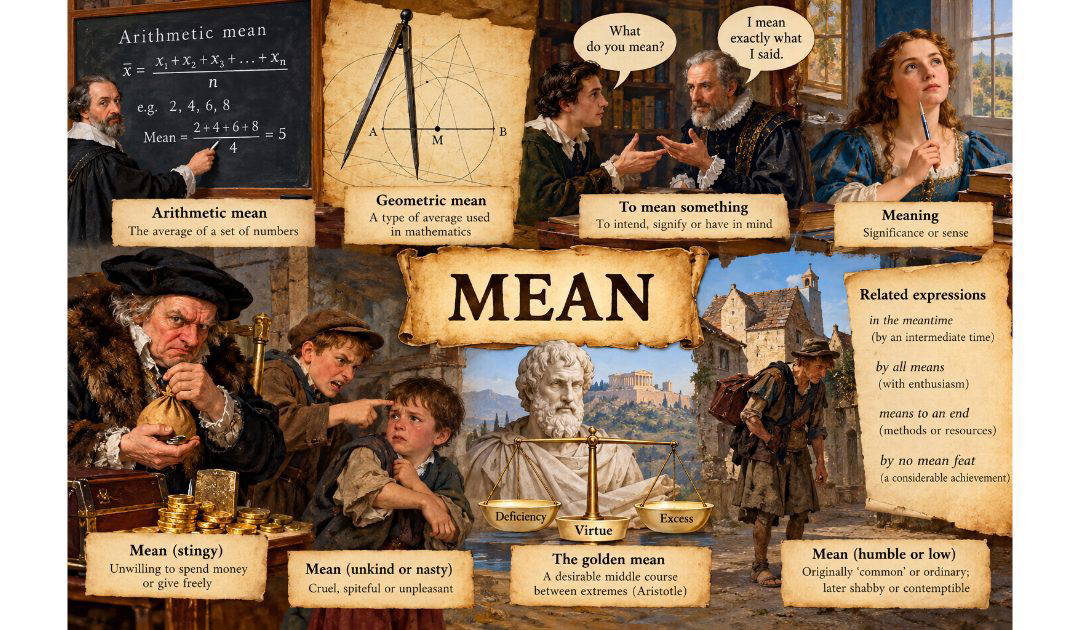
Few words in the English language work quite as hard as mean. We use it to describe an average, an intention, a miserly disposition, a mathematical calculation, and even something nasty or unpleasant. Remarkably, these meanings arise from three distinct linguistic roots.
The first is the Old English mænan, meaning to intend, signify, or have in mind. It descended from a Germanic root associated with thought and intention. When we ask, “What do you mean?”, we are using a word that has changed remarkably little in over a thousand years. From this root also comes meaning, and expressions such as “I mean well” or “I didn’t mean to offend.” Something meaningful possesses significance, while something meaningless does not.
The second root is the Latin medianus, meaning middle, which entered English through Old French meien. This gave us mean in the sense of an intermediate position or average. The arithmetic mean is calculated by adding a set of numbers and dividing by their quantity. The geometric mean, by contrast, is found by multiplying positive numbers together and taking the appropriate root of the product.
The mathematical use developed from the older idea of something lying between extremes. Aristotle’s celebrated golden mean described virtue as a desirable middle course between excess and deficiency. Courage, for example, lies between cowardice and recklessness.
This same family of meanings survives in expressions such as “in the meantime” and “by no mean feat”, although the latter actually belongs to another development of the word.
The third root is Old English gemǣne, meaning common, shared, or belonging to everyone. It is related to the German gemein, which similarly developed from “common” to “vulgar” or “nasty”.
Originally, mean could simply describe someone of humble or ordinary status. Over time, however, the social prejudice that equated poverty with inferiority gave the word increasingly negative associations. By the sixteenth century, it could mean shabby, contemptible, or ignoble. Eventually it acquired its modern senses of stingy, unkind, or malicious.
Thus a mean person might be someone unwilling to spend money, or someone deliberately cruel. American English particularly favours the latter meaning.
There are further curiosities. The expression means to an end refers to methods or resources, while by all means conveys enthusiastic agreement. Both belong to the historical family associated with the middle or intermediary.
The extraordinary versatility of mean demonstrates how English combines separate linguistic ancestries with centuries of social change. A mathematician calculating a mean, a philosopher seeking the golden mean, and a child complaining that someone is mean are using the same spelling, but not quite the same word.