
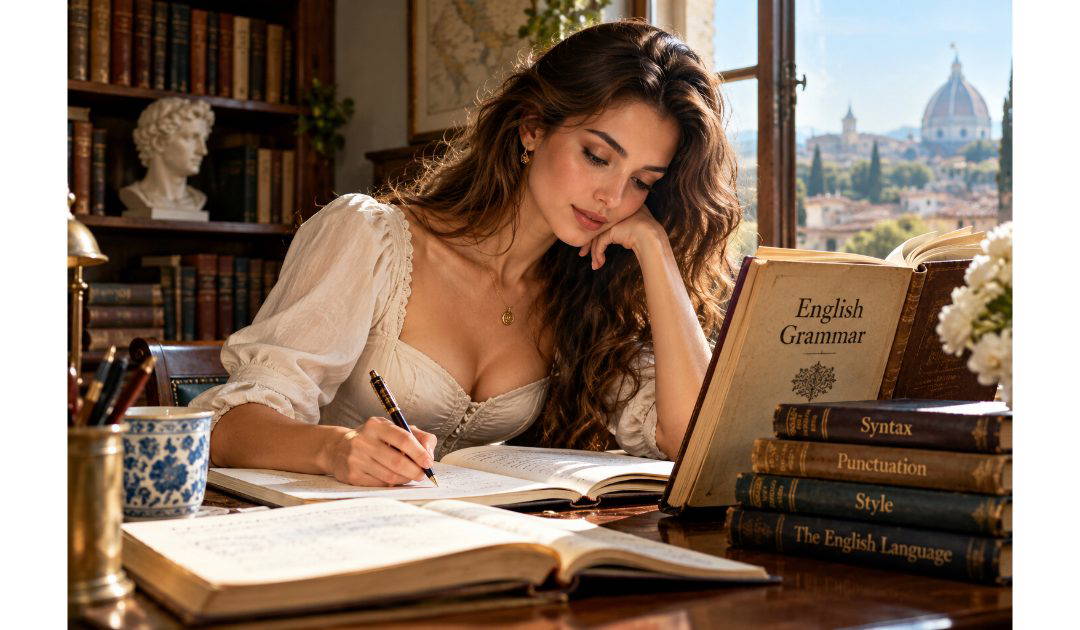
Can it be true that attention to good grammar in our writing makes us glamorous? The Greek word graphein (γραʹφειν), to write, is the root of the word grammar.
At first glance, the words glamour and grammar seem to have little in common. One conjures images of beauty, elegance and sophistication; the other suggests schoolrooms, textbooks and the rules of language. Yet, remarkably, glamour and grammar are essentially the same word, having travelled along different linguistic paths.
In medieval Europe, grammar was considered one of the seven liberal arts, forming part of the trivium alongside rhetoric and logic. To possess grammatical knowledge was to belong to a privileged, educated minority.
During the Middle Ages, however, the meaning of grammar extended beyond the study of language. Books were rare, literacy was uncommon, and learned men who could decipher mysterious Latin manuscripts sometimes appeared to possess supernatural powers. Grammar consequently became associated with arcane knowledge, astrology, alchemy and magic.
In Scotland, the word underwent a fascinating transformation. By the eighteenth century, grammar had developed into gramarye or glamer, referring to occult learning, enchantment or a magical spell. The alteration of the initial r to l helped produce the Scottish word glamour.
The Scottish novelist Sir Walter Scott played an important part in popularising the term. In his 1805 poem The Lay of the Last Minstrel, he referred to magical powers capable of making people perceive things differently from reality. A glamour was originally a spell cast over someone’s eyes, creating an illusion.
During the nineteenth century, the supernatural meaning gradually softened. Glamour came to describe a captivating or alluring quality, something that enchanted the observer without necessarily involving actual magic. By the twentieth century, it had become closely associated with fashionable society, beautiful women, Hollywood film stars and luxurious lifestyles.
The modern adjective glamorous emerged from this development, while glamourise came to mean presenting something as more attractive or exciting than it really was.
Thus, the relationship between grammar and glamour reveals a delightful linguistic irony. The rules of language and the power of enchantment share a common ancestry. What began as the scholarly study of letters eventually became a word describing the irresistible magic of beauty and illusion.