
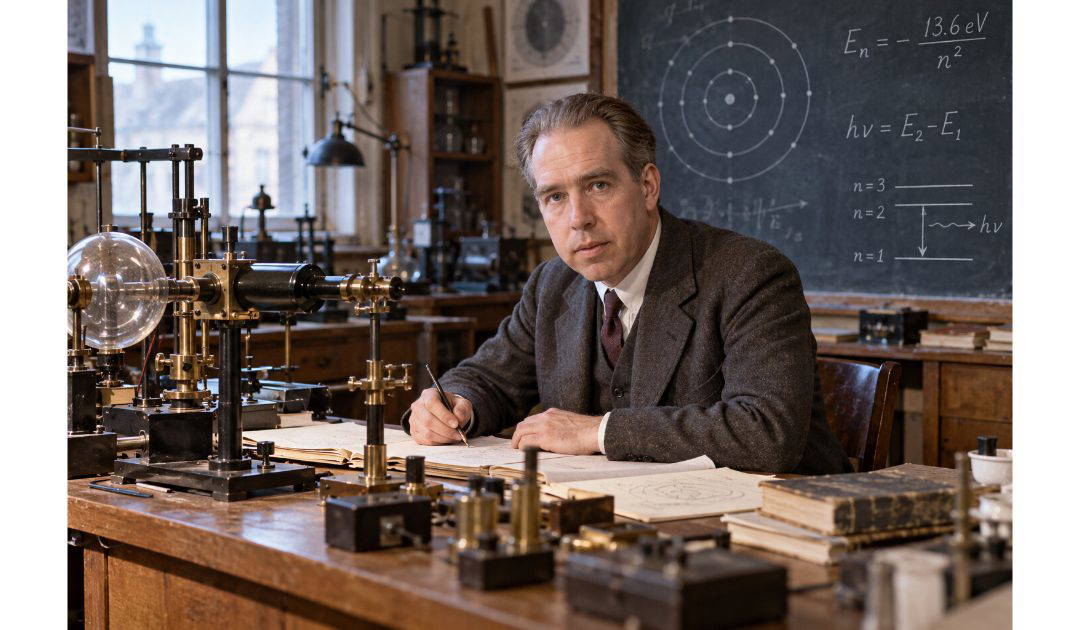
I will always be grateful to Niels Bohr because there was almost always a question on Bohr’s model of the atom in the Oxford Entrance and Scholarship Examination, and knowing that helped me pass. Niels Henrik David Bohr (1885–1962) was a Danish physicist whose ideas transformed our understanding of atoms and helped establish quantum mechanics. He is best remembered for the Bohr model of the atom, but his deeper contribution was philosophical as well as scientific: he helped physicists come to terms with a microscopic world that behaves very differently from everyday experience.
Bohr was born in Copenhagen on the 7th of October, 1885, into an academic family. His father, Christian Bohr, was a professor of physiology, while his mother, Ellen Adler Bohr, came from a prominent Danish Jewish family. Niels studied physics at the University of Copenhagen, receiving his doctorate in 1911.
He subsequently travelled to Britain, initially working at Cambridge before joining Ernest Rutherford in Manchester. Rutherford had recently proposed that an atom consisted largely of empty space, with its positive charge and most of its mass concentrated in a tiny central nucleus. The problem was that Rutherford’s atom appeared impossible according to classical physics. Electrons orbiting the nucleus ought continuously to lose energy and spiral into it. Matter should therefore collapse. In 1913 Bohr proposed an extraordinary solution. Electrons, he suggested, could occupy only certain permitted energy levels around the nucleus. An electron did not gradually drift between them. Instead it could make a “quantum jump” from one state to another, absorbing or emitting a particular quantity of energy.
This model successfully explained the characteristic spectrum of hydrogen. Although subsequent quantum mechanics replaced the idea of electrons literally travelling around the nucleus like miniature planets, Bohr’s quantised energy levels remain fundamental to atomic physics. In 1922, at only 37, Bohr received the Nobel Prize in Physics “for his services in the investigation of the structure of atoms and of the radiation emanating from them.”
Bohr’s importance increased as quantum mechanics developed during the 1920s. Working in Copenhagen with younger physicists including Werner Heisenberg, he became one of the principal architects of what became known as the Copenhagen interpretation. Quantum theory appeared to say that nature at the atomic level could not always be described in terms of definite positions and trajectories. Instead, physicists often had to deal with probabilities and with properties whose experimental manifestation depended upon how they were measured. Bohr developed the principle of complementarity: apparently contradictory descriptions—such as treating light or matter as particles in one experiment and waves in another—could both be necessary for a complete account of physical phenomena.
This led to his famous intellectual encounters with Albert Einstein. Einstein admired quantum mechanics but disliked the suggestion that probability was fundamental to reality. Their debates, particularly around the Solvay conferences, became one of the great episodes in twentieth-century science. Einstein repeatedly devised thought experiments intended to expose weaknesses in quantum theory. Bohr would study them intensely and return with counterarguments. Neither persuaded the other philosophically, although Bohr generally succeeded in showing that Einstein’s proposed experiments did not invalidate quantum mechanics.
Bohr’s life changed dramatically following Nazi Germany’s occupation of Denmark in 1940. Because of his Jewish ancestry and his connections with Allied scientists, his position became increasingly dangerous. In 1943 he escaped Denmark by fishing boat to Sweden and was then flown to Britain. He subsequently travelled to the United States and became involved with the Manhattan Project, which was developing the atomic bomb. Bohr understood both the scientific possibilities of nuclear fission and its frightening political implications. He became convinced that nuclear weapons would fundamentally alter international relations. Even before the war ended, he advocated openness and international cooperation over atomic energy. He personally approached Winston Churchill and Franklin Roosevelt, hoping to persuade Allied leaders of the need for cooperation—including eventually with the Soviet Union. Churchill was deeply suspicious of Bohr’s ideas. After the war Bohr returned to Copenhagen and increasingly devoted himself to peaceful international scientific cooperation. In his 1950 “Open Letter to the United Nations”, he argued for greater openness between nations in an attempt to prevent a catastrophic nuclear arms race.
Bohr died in Copenhagen on the 18th of November, 1962, aged 77. His scientific legacy is immense. The familiar picture of electrons circling an atomic nucleus is an oversimplification of modern quantum mechanics, but it marks one of the decisive steps between classical and modern physics. More importantly, Bohr helped formulate the intellectual framework through which physicists learned to understand quantum phenomena. He also left science with a profound lesson about certainty. Classical physics had encouraged the hope that, given sufficient information, nature could be described with absolute precision. Bohr helped reveal a stranger universe—one in which observation, probability and apparently incompatible descriptions are woven into our understanding of physical reality.