
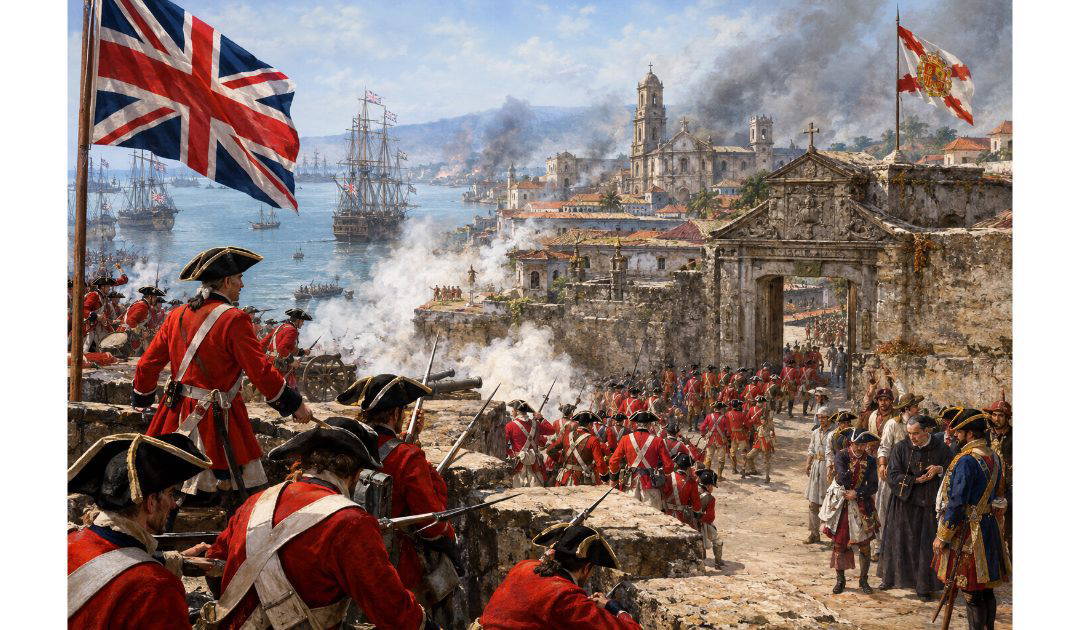
I have written often enough about the Eighty Year’s War because my ancestor, Sir Anthony Standen, was involved as Francis Walsingham’s spy, but I have not written about the Seven Year’s War.
On the 6th of October, 1762, the British captured Manila from the Spanish and occupied it. The Seven Years’ War (1756–1763) was one of the largest and most important conflicts of the eighteenth century. Although it is often described as a European war, fighting took place across Europe, North America, the Caribbean, West Africa, India and the Philippines. For this reason, historians sometimes describe it as the first truly global war.
The war grew out of a complicated struggle for power among the European great powers. Britain and France were bitter commercial and colonial rivals, competing particularly for control of North America and India. Meanwhile, Austria wanted to recover Silesia, a wealthy province seized by Prussia during the War of the Austrian Succession. The principal powers eventually divided into two opposing alliances. Britain allied with Prussia, while Austria, France, Russia and Sweden aligned against them, with Saxony also joining the anti-Prussian side.
The immediate European crisis began in 1756. Frederick the Great of Prussia, fearing an attack by his enemies, invaded Saxony in August. This pre-emptive move helped turn the existing diplomatic tensions into a general European war.
Frederick faced formidable opposition. Prussia was surrounded by Austria, Russia, Sweden and France, while Britain was initially preoccupied with protecting its own interests. Nevertheless, Frederick proved an exceptionally capable military commander. He defeated the Austrians at Lobositz in 1756, the French and Imperial forces at Rossbach and the Austrians at Leuthen in 1757. These victories prevented the destruction of Prussia.
The war was also being fought thousands of miles away. In North America, Britain and France were competing for control of territory and trade. The North American conflict is known as the French and Indian War. British forces eventually captured the strategically vital French fortress of Louisbourg and, in 1759, defeated the French at the Battle of Quebec. British success gradually destroyed France’s position in Canada.
India became another major theatre. The British East India Company and the French Compagnie des Indes supported rival Indian rulers while attempting to establish commercial and political dominance. British victories, particularly under Robert Clive, greatly strengthened British influence in Bengal and southern India. The war therefore helped establish the foundations of Britain’s later territorial empire in India.
At sea, Britain’s powerful Royal Navy was crucial. British naval victories restricted French trade and reinforcements while protecting Britain’s worldwide communications. The Battle of Quiberon Bay in 1759 was particularly significant because it effectively prevented France from mounting a major invasion of Britain.
That same year became known in Britain as its “Annus Mirabilis”, or “year of miracles”, because of a succession of victories on land and sea. (I suppose that may have been the inspiration for Queen Elizabeth II’s “Annus Horribilis” in her 1992 speech.) British forces defeated the French at Quebec and Minden, while the navy won important victories at Lagos and Quiberon Bay.
The war continued despite these successes. Spain entered the conflict on France’s side in 1762, leading Britain to attack Spanish possessions. British forces captured Havana in Cuba and, most relevant to your earlier image, Manila in the Philippines in October 1762. Manila was taken after a British expeditionary force attacked the Spanish colonial capital. The occupation lasted until the end of the war, although Spain’s local allies continued resistance outside the city.
The war eventually became too expensive for the combatants to continue. The Treaty of Paris, signed in February 1763, brought the Anglo-French and Anglo-Spanish conflict to an end. Britain emerged with major territorial gains. France ceded Canada and territory east of the Mississippi to Britain, while Spain ceded Florida. Spain received Louisiana from France as compensation for its losses.
In Europe, the settlement was different. The Treaty of Hubertusburg restored the territorial position that had existed before the war. Most importantly, Prussia retained Silesia, confirming Frederick the Great’s country as a major European power.
The consequences were enormous. Britain had become the dominant European colonial and naval power, while France had suffered a major setback overseas. Prussia had survived against a powerful coalition and emerged as a recognised great power.
Yet Britain’s victory carried a heavy financial cost. The enormous debt accumulated during the war encouraged the British government to seek greater revenue from its American colonies. Measures such as the Stamp Act of 1765 and other taxes contributed to growing colonial resistance. In this sense, the Seven Years’ War helped create the circumstances that eventually led to the American Revolution.
The Seven Years’ War therefore transformed the balance of power both in Europe and around the world. It strengthened Britain and Prussia, weakened France’s overseas position, expanded British influence in India and North America, and helped set in motion political developments that would shape the later eighteenth century.