
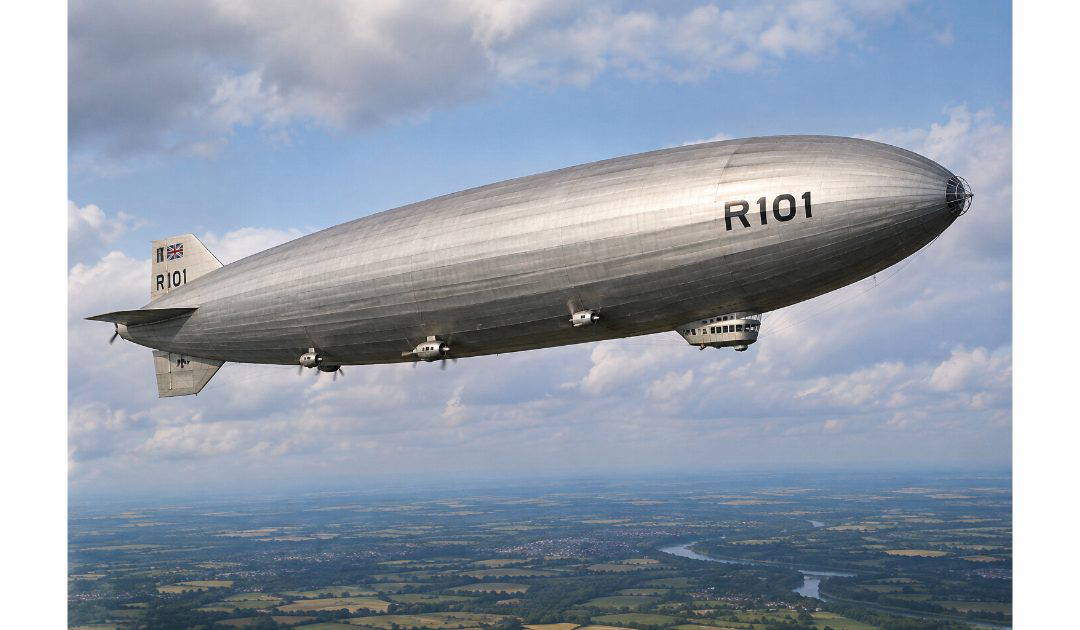
I choose the tragic crash of the R101 airship on the 5th of October, 1930, for today’s post. I have already posted on the attempted assassination of Paulo Sarpi on this day in 1607. That is a key event in Fire and Earth, the second book in the Sir Anthony Standen Adventures. But back to the R101.
The R101 was one of the most ambitious aircraft ever built in Britain. Conceived during the great age of the rigid airship in the 1920s, it was intended to demonstrate that enormous lighter-than-air craft could provide a practical long-distance passenger service linking Britain with the countries of the British Empire. Its spectacular failure, however, became one of the most famous disasters in the history of aviation.
R101 was constructed at the Royal Airship Works at Cardington, Bedfordshire, as part of the British Government’s Imperial Airship Scheme. The programme envisaged a network of giant airships capable of carrying passengers and freight over long distances, particularly to India and the Dominions. R101 was the government-built airship, while its principal rival, R100, was developed by a private consortium led by Vickers. The two projects were intended to test competing approaches to the future of long-distance air transport.
R101 was an extraordinary machine. It was originally about 735 feet (224 metres) long, but was subsequently lengthened to approximately 777 feet (237 metres). Its diameter was about 131 feet. Inside its rigid metal framework were numerous hydrogen-filled gasbags providing the lift.
The airship was designed to offer a remarkably comfortable form of travel. Passengers had access to a dining room, lounge and smoking room, with furnishings deliberately intended to resemble those found aboard a luxury ocean liner. The RAF Museum describes the lounge as having seating for around thirty people, while the dining salon could accommodate twenty-four at a sitting.
Yet R101’s enormous size created major engineering problems. The airship was heavier than originally anticipated, and the engines presented particular difficulties. It was eventually equipped with five Beardmore Tornado heavy-oil engines. These were technologically ambitious but heavy and suffered from vibration and other problems. The choice of heavy-oil engines was partly connected with the proposed route to India, where petrol was considered particularly hazardous in high temperatures.
R101 made its first flight on the 14th of October, 1929, flying from Cardington over Bedford and London before returning to its base. Further trials followed, but the aircraft’s performance remained problematic. Its weight and limited lifting capacity meant that carrying sufficient fuel, ballast, crew and passengers for the intended journey to India was a considerable challenge.
There was also a significant political dimension to the project. The British Government had invested heavily in the Imperial Airship Scheme, and there was considerable public interest in demonstrating that Britain could compete with Germany’s highly successful Zeppelin programme. The R100’s successful trial flight to Canada and back in 1930 had demonstrated that long-distance rigid-airship travel was technically possible. R101 therefore carried enormous expectations.
On the 4th of October, 1930, R101 finally departed Cardington on its intended proving flight to Karachi, then part of British India, via a refuelling stop at Ismailia in Egypt. Among those aboard was Lord Christopher Thomson, the Secretary of State for Air, together with Sir Sefton Brancker, Director of Civil Aviation. There were 54 people aboard.
The weather deteriorated as the airship crossed northern France. During the early hours of the 5th of October, near Beauvais, R101 encountered strong and gusty winds. The official investigation concluded that the precise sequence could never be established with certainty, but considered that a substantial loss of hydrogen from the forward part of the ship was probably involved. The airship became increasingly difficult to control and lost altitude.
At approximately 2:08 a.m., R101 struck the ground near the village of Allonne, outside Beauvais. The wreckage caught fire, and the hydrogen and combustible materials produced a catastrophic blaze.
Only six of the 54 people aboard survived. Forty-eight died, including Lord Thomson and Sir Sefton Brancker. The disaster therefore destroyed not merely an aircraft but much of the political confidence behind Britain’s airship programme.
A public inquiry examined the disaster in considerable detail. The official conclusion emphasised the probable loss of gas in turbulent weather, while later researchers have proposed additional explanations involving structural damage, control difficulties and the behaviour of the gasbags. The exact chain of events remains debated. The National Archives preserves the original inquiry material, while modern aeronautical research has continued to analyse the final moments of the flight.
The consequences were immediate. The Imperial Airship Scheme effectively ended, and R100, despite having completed its successful Canadian flight, was withdrawn and eventually scrapped. Britain abandoned the idea of developing giant rigid airships as a major means of imperial transport.
The tragedy of R101 therefore occupies a fascinating place in aviation history. It represented the extraordinary optimism of the late 1920s: a gigantic flying machine, luxurious accommodation, global ambitions and the belief that technology could shrink the distances of the British Empire. But on a stormy October night in France, that vision came to an abrupt and terrible end.
P.S. Enthusiasts will criticise the image. The pod was more central, aft of the forward engines. Well that’s AI image creation for you!