
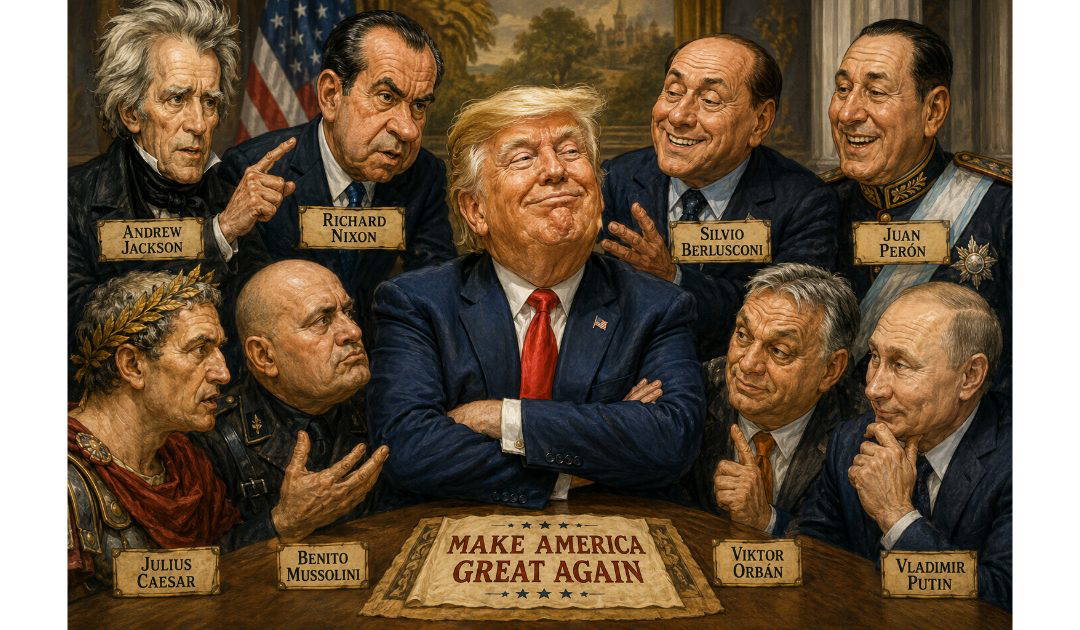
History is useful if we learn from it, which sadly we so often don’t. Are there historical figures we can compare to Trump? Let’s start with Andrew Jackson, president from 1829 to 1837. Both men presented themselves as outsiders fighting a corrupt political establishment. Jackson portrayed himself as the champion of the ordinary American against Washington’s political elite; Trump similarly campaigned against the “establishment”, the “swamp” and entrenched institutions. Both also:
- appealed strongly to nationalism;
- cultivated a highly personal relationship with their supporters;
- distrusted established political elites;
- treated political opponents as enemies rather than merely competitors;
- favoured a powerful presidency;
- used confrontational rhetoric;
- appealed particularly strongly to voters who believed the political system had ceased to serve them.
Trump has explicitly embraced Jackson as a political predecessor, and historians have devoted considerable attention to the comparison. One scholarly study describes Jackson as a central historical model invoked by Trump’s supporters. There is, however, an important difference. Jackson’s political movement emerged from the expansion of mass democracy in the 1820s and 1830s. Trump operates in an extraordinarily different environment of mass media, television, social media and permanent political campaigning.
Sticking with U.S. presidents for a while, Richard Nixon offers perhaps an even more interesting comparison. Nixon cultivated what he called the “silent majority”: ordinary Americans whom he believed were ignored by liberal elites, journalists, intellectuals and protesters. Trump’s political appeal contains a strikingly similar structure: ordinary Americans versus an entrenched elite. Both men also had a deep suspicion of the press and regarded hostile journalism not simply as criticism but as part of a political opposition. There is another parallel: the politics of enemies. Nixon famously maintained lists of political opponents and used government machinery against some of his perceived enemies. Trump’s first and especially second presidency has likewise been marked by an unusually personal approach to political conflict, including efforts to punish or investigate opponents and critics. Recent legal battles over executive orders directed at law firms illustrate how far this confrontational approach has extended in his second term. The great difference is that Nixon ultimately operated within a Republican establishment that was considerably more powerful than Trump’s Republican Party has become.
Silvio Berlusconi is one of the most revealing non-American comparisons. Like Trump, Berlusconi was a hugely successful businessman and television personality who entered politics claiming that professional politicians had failed the country. Both men:
- possessed enormous personal wealth;
- understood television and celebrity;
- treated politics partly as an extension of their personal brand;
- presented themselves as outsiders;
- attacked hostile journalists;
- surrounded themselves with intensely loyal supporters;
- made their own personalities central to their political movements;
- faced repeated controversies involving their personal conduct.
The crucial similarity is perhaps the fusion of celebrity, business and politics. Traditional politicians ask voters to support a party or programme. Trump and Berlusconi have often asked voters to support the man himself.
What about Juan Perón of Argentina? Perón constructed a political movement in which the leader became inseparable from the movement itself. He appealed directly to people who believed established elites had exploited or ignored them. Trump’s relationship with his supporters has some similarities. “Trumpism” is much more personally identified with Trump than conventional Republican conservatism was with earlier Republican presidents. There is also a similar political technique: take genuine economic and social grievances and combine them with a powerful narrative of national restoration. Perón promised a stronger Argentina. Trump promised to “Make America Great Again.” The comparison should not be taken too far, however. Perón governed within a very different political and economic system and established a substantially more organised ideological movement.
Perhaps the most dramatic comparison is Julius Caesar. This comparison concerns not ideology but the relationship between a popular leader and political institutions. Caesar presented himself as a champion against an arrogant and corrupt senatorial establishment. His supporters believed the traditional political class was incapable of solving Rome’s problems. He accumulated extraordinary personal authority while claiming to represent the Roman people. The analogy becomes relevant whenever a democratic system begins to revolve around one individual rather than institutions. But there is an enormous difference: Caesar eventually destroyed the Roman Republic through civil war and dictatorship. The United States remains a constitutional republic with independent courts, federalism, elections and a legislature. It would therefore be wrong to say “Trump is Caesar”. The more useful question is: What happens when a political system begins to depend increasingly upon the personal authority of one leader? That is a question Caesar’s career makes particularly vivid.
Sticking with Italians, the comparison with Benito Mussolini is much more controversial. There are genuine similarities in political style:
- extreme personalisation of leadership;
- nationalism;
- attacks on political opponents;
- contempt for conventional political norms;
- celebration of strength and decisive leadership;
- attempts to undermine independent institutions;
- use of spectacle and mass communication;
- portrayal of the leader as the embodiment of national renewal.
But the differences are enormous. Mussolini established a one-party dictatorship, abolished meaningful political opposition, controlled the press, destroyed parliamentary democracy and ultimately created a fascist state. Trump has not done that, yet.
Vladimir Putin and Viktor Orbán — the modern authoritarian comparison. These comparisons concern the direction of political development rather than personality. Viktor Orbán’s Hungary is particularly interesting because Orbán demonstrated how an elected leader can gradually weaken institutional checks while retaining elections and democratic terminology. Putin represents a much more advanced stage: political institutions remain formally present but genuine competition has been severely constrained. Trump’s second presidency has prompted some commentators and former officials to explicitly discuss authoritarian models because of attempts to centralise executive power, demand personal loyalty and weaken institutional restraints. But there is an important distinction: the United States has much stronger constitutional, judicial, federal and civil-society institutions than either Russia or contemporary Hungary. Indeed, American courts have continued to challenge administration policies. That institutional resistance is one of the most important differences between the United States and established authoritarian regimes.
Perhaps the most historical analogy is actually not to one particular ruler but to a political crisis. The late Roman Republic experienced: economic and social disruption, distrust of the political class, popular leaders,increasing political polarisation, weakening of constitutional conventions, and concentration of power in individuals. That sequence occurred over generations and involved figures including the Gracchi, Marius, Sulla, Pompey and Caesar. America obviously isn’t Rome. But the Roman example illustrates an important historical principle. Democratic and republican systems depend not merely upon written constitutions but upon political conventions and a willingness by competing sides to accept limits on their power. When those conventions weaken, a constitution can survive on paper while the political system changes substantially in practice.
My conclusion is that Trump is historically unusual precisely because he combines characteristics that previously belonged to different political traditions. He is simultaneously a populist in the Jackson tradition, a grievance politician in the Nixon tradition, a celebrity-businessman in the Berlusconi tradition and, in the eyes of his critics, a leader testing the limits of liberal democracy in ways that invite comparison with authoritarian movements. The most significant historical question, therefore, is probably not “Which leader is Trump like?” It is whether the American constitutional system can absorb an exceptionally personalised presidency without permanently changing the balance between executive power, Congress, courts, political parties and civil society. That question has become particularly pertinent in Trump’s second term, as his administration has continued to test the boundaries of executive authority and as courts, Congress, and other institutions have resisted some of those initiatives.