
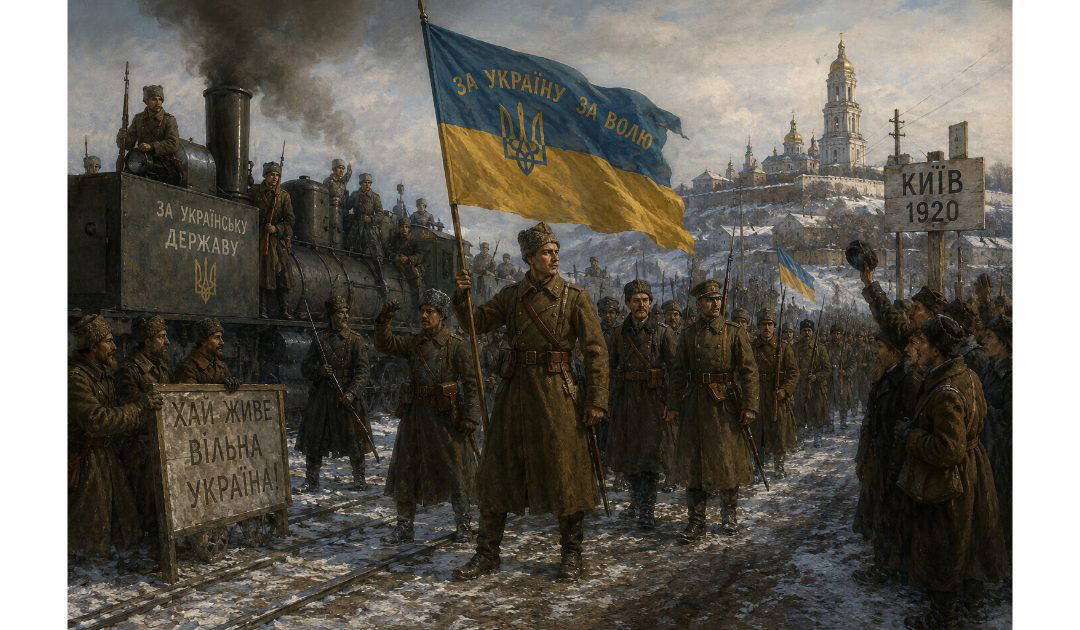
On the 2nd of October, 1920, Mikhail Frunze ordered the Red Army to immediately cease hostilities with the Revolutionary Insurgent Army of Ukraine.
The Ukrainian War of Independence was a complex struggle between 1917 and 1921 in which Ukrainian nationalists attempted to establish an independent Ukrainian state amid the collapse of the Russian and Austro-Hungarian empires and the violence of the Russian Civil War. The conflict involved Ukrainian forces, Bolshevik armies, White Russian forces, Polish troops, anarchists and various local militias. Although Ukrainian independence ultimately failed, the struggle profoundly influenced Ukrainian national identity and laid the foundations for the modern Ukrainian state.
Before 1917, most Ukrainian territory belonged to the Russian Empire, while western Ukrainian lands were part of Austria-Hungary. Ukrainian national consciousness had grown during the nineteenth century, but the Russian authorities had restricted the use of the Ukrainian language and suppressed political nationalism. The February Revolution of 1917, which overthrew Tsar Nicholas II, dramatically changed the situation.
In Kyiv, Ukrainian political and cultural organisations established the Central Rada, or Central Council, headed by the historian and politician Mykhailo Hrushevsky. Initially, the Rada sought Ukrainian autonomy within a democratic Russia rather than complete independence. In November 1917, however, after the Bolsheviks seized power in Petrograd, the Rada proclaimed the Ukrainian People’s Republic (UPR).
The Bolsheviks rejected the Rada’s authority and launched an invasion of Ukraine. Kyiv fell temporarily to Bolshevik forces in early 1918, although Ukrainian troops subsequently regained the capital. Facing military crisis, the Ukrainian government turned to Germany and Austria-Hungary for assistance. The resulting Treaty of Brest-Litovsk, signed in February 1918, recognised the Ukrainian People’s Republic and brought German and Austro-Hungarian troops into Ukraine.
The Central Rada was soon overthrown, however, and replaced by the conservative Hetmanate, headed by Pavlo Skoropadsky. Supported by Germany, Skoropadsky attempted to create an effective Ukrainian administration and army. His government promoted Ukrainian institutions and education, but depended heavily upon German military support.
Germany’s defeat in the First World War, in November 1918, destroyed the Hetman’s position. Skoropadsky resigned, and the Directory, led initially by Volodymyr Vynnychenko and Symon Petliura, restored the Ukrainian People’s Republic. Petliura eventually became its dominant military and political leader.
The UPR now faced enemies on several fronts. The Bolsheviks returned with a large Red Army offensive, while White Russian forces under Anton Denikin opposed Ukrainian independence because they sought to restore a united Russia. In the south, the anarchist forces of Nestor Makhno established a powerful movement in parts of Ukraine, sometimes fighting both Reds and Whites. Meanwhile, Poland emerged as another crucial power.
In January 1919, Ukrainian nationalists also proclaimed the Western Ukrainian People’s Republic in former Austro-Hungarian territory. In an important symbolic development, the two Ukrainian republics proclaimed the Act of Union in Kyiv on 22 January 1919. Their military and political circumstances, however, made genuine unification extremely difficult.
Disease, famine, economic collapse and constant warfare devastated the country. Ukrainian armies fought with great courage but suffered from shortages of weapons, supplies and reliable political support. Different Ukrainian factions also disagreed over political objectives, while some local populations were hostile to requisitioning armies of every kind.
In 1920, Petliura sought Polish assistance against the Bolsheviks. The resulting Treaty of Warsaw led to a joint Polish-Ukrainian offensive that briefly captured Kyiv in May 1920. The Red Army counter-attacked and drove the Polish and Ukrainian forces westward. Poland eventually halted the Soviet advance near Warsaw, but the subsequent peace negotiations left Petliura and the Ukrainian independence movement in a precarious position.
The Peace of Riga, signed in 1921, ended the main Polish-Soviet conflict. Much of Ukraine became incorporated into the Ukrainian Soviet Socialist Republic within the Soviet Union, while western Ukrainian territories were divided principally between Poland, Romania and Czechoslovakia. Petliura’s remaining forces were defeated, and many Ukrainian leaders went into exile.
The Ukrainian War of Independence therefore ended in defeat. Yet it was not without lasting consequences. Between 1917 and 1921, Ukrainians had created governments, armies, diplomatic missions, universities and cultural institutions and had demonstrated that Ukrainian independence was a political possibility rather than merely an intellectual aspiration.
The Soviet government subsequently attempted to suppress Ukrainian nationalism, although during the 1920s it temporarily permitted a degree of Ukrainian cultural development. The memory of the independence struggle survived among Ukrainians at home and in the diaspora.
When Ukraine declared independence again in 1991, following the collapse of the Soviet Union, the events of 1917–1921 acquired renewed significance. The Ukrainian People’s Republic, its leaders and its soldiers came to be regarded as predecessors of the modern Ukrainian state. The failed revolution had ultimately demonstrated the strength of Ukrainian national aspirations—and the extraordinary difficulty of preserving independence when surrounded by powerful and competing armies. That strength is now very evident in the resistance to Putin’s special military operation.