
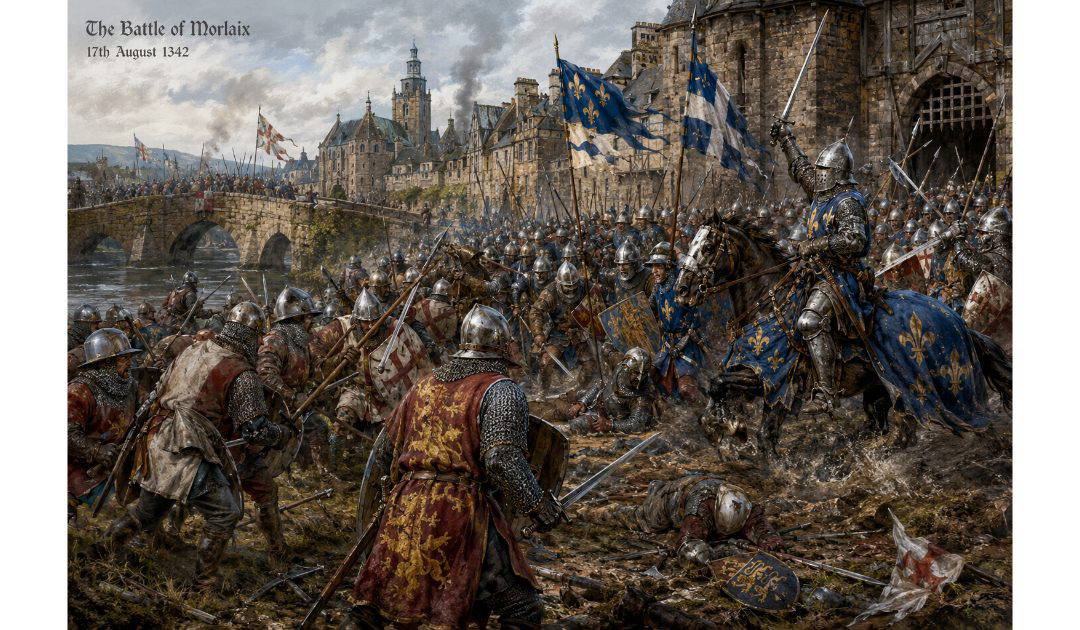
The Battle of Morlaix was fought on the 30th of September, 1342. I was part of the crew which won the Plymouth – Morlaix yacht race in July 2004, whilst on a race training course. But back to the battle. It was one of the earliest major land battles of the Hundred Years’ War and an important engagement in the War of the Breton Succession. It was fought near the Breton town of Morlaix in north-western France between an Anglo-Breton force commanded by William de Bohun, Earl of Northampton, and a much larger Franco-Breton army led by Charles of Blois. Although relatively little known today, the battle demonstrated several of the tactics that would make English armies formidable on the battlefields of France during the fourteenth century.
The origins of the battle lay in a succession crisis in Brittany. In 1341, John III, Duke of Brittany, died without a surviving heir. Two rival claims emerged. John’s half-brother, John of Montfort, claimed the duchy, while John III’s niece, Joanna of Penthièvre, claimed it with her husband, Charles of Blois. Charles was a nephew of Philip VI of France, and therefore enjoyed powerful French support. John of Montfort appealed to Edward III of England, whose conflict with Philip VI had already developed into the Hundred Years’ War.
The Breton dispute consequently became intertwined with the larger Anglo-French conflict. John of Montfort was captured by the French, but his formidable wife, Joanna of Flanders, continued the struggle on behalf of their infant son. English assistance arrived in Brittany during 1342, and an English army under Northampton helped revive the Montfortist cause.
By the summer, the English had established themselves in western Brittany. Their forces relieved Brest, where Joanna of Flanders had been under siege. Northampton subsequently moved against Morlaix, an important fortified port. While the English were besieging the town, Charles of Blois assembled a substantial army and marched west to relieve it.
Northampton was heavily outnumbered. Estimates vary considerably, but the English force probably numbered only a few thousand men, while Charles may have commanded 10,000 or more. Rather than meet such a superior army in open battle, Northampton adopted a defensive strategy. Having received warning of Charles’s approach, the English abandoned their immediate positions and made a night march to occupy a carefully selected defensive position near Lanmeur, outside Morlaix.
The position was crucial. The English deployed their archers where they could shoot at the advancing French while being protected by the terrain and prepared obstacles. Their men-at-arms fought on foot, rather than relying upon a conventional mounted charge. Northampton was effectively turning the numerical superiority of Charles’s army into a disadvantage.
When the French arrived, Charles divided his army into several formations. The first advanced towards the English position but came under intense fire from the English archers. Arrows disrupted the formation and inflicted heavy casualties before the troops could properly engage the defenders.
The second French division, composed largely of men-at-arms, then advanced. Here the English preparations proved particularly effective. A concealed ditch had been dug across the front of the position. The attacking troops and horses fell into it, becoming disordered and presenting an exceptionally vulnerable target to the English archers. Some French cavalry managed to cross the obstacle and reach the English line, but they found themselves isolated among the defending men-at-arms. Many were killed or captured.
Northampton nevertheless recognised that his position could not hold indefinitely. His archers were beginning to run short of arrows, while the ditch was becoming filled with dead and wounded men and horses and was consequently losing some of its defensive value. When Charles prepared another attack, Northampton made a remarkable decision: he withdrew his army into a nearby wood.
The French were unable to dislodge the English from this new position. They surrounded the wood, effectively trapping Northampton’s force, but the English commander eventually broke out during the night and returned towards Morlaix. Charles, having failed to destroy the English army or relieve the town immediately, withdrew.
The battle was therefore a significant English tactical success, although its strategic consequences were more limited. The English had demonstrated that disciplined infantry, defensive preparation and massed archery could defeat a considerably larger force. The battle foreshadowed the famous English victories at Crécy in 1346 and Poitiers in 1356, where similar principles would again prove devastating.
Morlaix also illustrated an important development in medieval warfare: commanders were becoming increasingly willing to reject the traditional ideal of the decisive mounted charge and instead exploit terrain, missile fire and defensive positions. For the English, Morlaix was an early demonstration of the tactical system that would become one of the defining features of their fourteenth-century military success in France.