
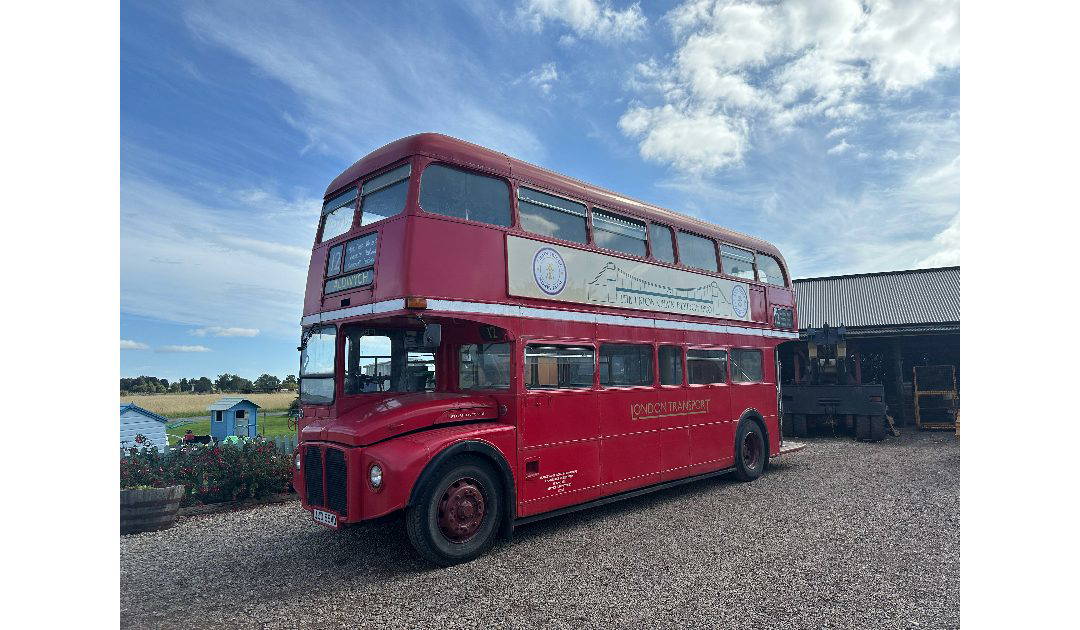
The iconic Routemaster bus was introduced on the 24th of September, 1954. If it was raining when I was a child I took the 229 bus to school, otherwise I’d walk the two and a half miles. The bus was a Routemaster. I’ve written often enough about aviation, so it’s high time the Routemaster got a look in.
The Routemaster is one of the most recognisable buses ever built and has become an enduring symbol of London, alongside Big Ben, black cabs and Tower Bridge. Instantly identifiable by its bright red paintwork, open rear platform and distinctive rounded styling, the Routemaster combined elegant design with practical engineering. Although no longer the mainstay of London’s public transport system, it remains a cherished part of Britain’s industrial and cultural heritage.
The Routemaster was developed in the late 1940s and early 1950s by the London Transport Executive to replace older double-decker buses that had become expensive to maintain after the Second World War. Rather than adapting an existing commercial design, London Transport commissioned an entirely new vehicle tailored specifically to the needs of the capital. The prototype first appeared in 1954, and after extensive testing the first production buses entered passenger service in February 1956.
The design was revolutionary for its time. Instead of the heavy steel construction used by earlier buses, the Routemaster employed a lightweight aluminium body inspired by aircraft technology. This reduced its weight significantly, making it more economical to operate while also improving acceleration and fuel efficiency. The bus used independent front suspension and power steering, providing a smoother ride for passengers and making it easier for drivers to manoeuvre through London’s crowded streets.
One of the Routemaster’s defining features was its open rear platform. Passengers could board and alight quickly without waiting for the bus to stop completely, although officially they were expected to use the platform only when stationary. A uniformed conductor stood on the platform selling tickets, giving change and helping passengers. The conductor also rang the traditional bell to signal the driver when it was safe to move away. This two-person operation contributed to the friendly atmosphere for which London buses became famous.
Inside, the Routemaster could typically accommodate around 64 passengers, depending on the exact model. The lower saloon offered comfortable seating with large windows, while a narrow spiral staircase led to the upper deck. Sitting at the front of the top deck became almost a rite of passage for visitors, offering panoramic views of London’s streets and landmarks.
Several versions of the Routemaster were built. The standard RM model measured 27 feet 6 inches (8.4 metres) in length. Later came the longer RML version, stretched by eight feet to provide additional seating. There were also specialised versions, including the RMC and RCL coaches designed for longer-distance routes. Between 1954 and 1968, more than 2,800 Routemasters were constructed by Associated Equipment Company (AEC), Park Royal Vehicles and, later, Leyland after it acquired AEC.
Mechanically, the buses proved remarkably durable. Most were powered by AEC diesel engines, although later examples received Leyland engines. Their modular construction made maintenance unusually straightforward. Major mechanical components could be swapped quickly, allowing buses to return to service with minimal downtime. Many remained in daily use for over forty years, an extraordinary lifespan for public transport vehicles.
By the 1980s and 1990s, however, the Routemaster was showing its age. New accessibility legislation highlighted one of its principal shortcomings: the high step and open platform made the buses unsuitable for many elderly passengers and impossible for wheelchair users without assistance. Operating a conductor also increased staffing costs at a time when transport authorities were seeking greater efficiency. Modern one-person-operated buses with low floors gradually replaced the fleet.
Regular Routemaster services ended on most London routes in December 2005, an event marked by widespread public affection and nostalgia. Thousands of Londoners and visitors rode the final services, with many photographing or filming the occasion. Although some criticised the decision, accessibility and operating costs made replacement unavoidable.
The Routemaster did not disappear entirely. Heritage routes continued to operate a small number of buses for several years, allowing tourists and enthusiasts to experience travelling on these classic vehicles. Many examples have also been preserved by museums, private collectors and preservation societies. Some continue to operate at rallies and special events, while others have found new lives as cafés, mobile shops, restaurants and even holiday accommodation.
The bus’s influence extends well beyond transport. It has appeared in countless films, television programmes, postcards and advertisements, becoming a visual shorthand for London itself. Visitors from around the world often seek out surviving Routemasters for photographs, while scale models and souvenirs remain popular collectibles.
In 2012, London introduced the New Routemaster, sometimes nicknamed the “Boris Bus.” Inspired by the classic design, it incorporated modern features such as hybrid propulsion, air conditioning and improved accessibility while echoing the original’s curved lines and, initially, an open-style rear platform with controlled access.
More than seventy years after its conception, the Routemaster remains an outstanding example of British engineering and industrial design. Combining innovation, reliability and unmistakable style, it transformed urban transport and became far more than a bus. For generations of Londoners it was part of daily life, and for millions of visitors it remains one of the capital’s most enduring and beloved icons.