
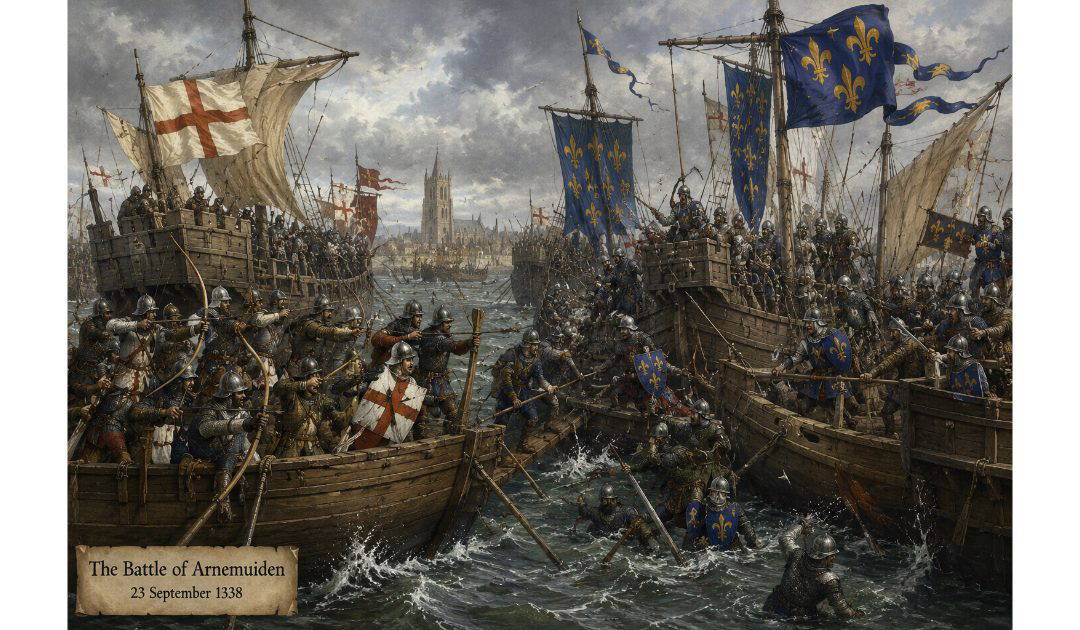
The Battle of Arnemuiden, fought on the 23rd of September, 1338, was one of the opening naval engagements of the Hundred Years’ War between England and France. Although much smaller than later famous battles such as Sluys (1340), Arnemuiden was historically significant because it marked the first major naval clash of the conflict and demonstrated the increasing importance of sea power in medieval warfare. It also became remembered for the execution of an English commander after the battle, an event that hardened English attitudes towards the French.
In 1337, King Edward III of England formally asserted his claim to the French throne, initiating the Hundred Years’ War. The struggle was fought not only on land but also across the English Channel and the North Sea, where control of shipping lanes was essential. England depended heavily on maritime trade, particularly the export of wool to the cloth-producing towns of Flanders. Wool exports generated much of the English Crown’s income, while the wealthy Flemish cities relied upon English wool for their textile industry.
Edward III had worked hard to cultivate alliances with the rulers and merchants of Flanders, many of whom opposed the influence of the French king, Philip VI. To support these alliances, England regularly sent ships carrying wool, money, weapons and diplomatic envoys to the Low Countries. Protecting these merchant convoys became an important strategic objective.
The English convoy involved in the Battle of Arnemuiden consisted of five large merchant ships. These vessels were heavily laden with wool and other valuable cargo destined for Flanders. Although merchant ships were not purpose-built warships, they were commonly armed for protection against pirates and hostile fleets. They carried archers, crossbowmen and men-at-arms who could defend the ships during boarding actions.
Waiting for them near the port of Arnemuiden, on the island of Walcheren in Zeeland, was a considerably larger French fleet. The French force was commanded by two experienced admirals, Hugues Quiéret and Nicolas Béhuchet, both of whom would later play prominent roles in the early naval campaigns of the Hundred Years’ War.
The French fleet probably numbered more than a dozen vessels, although medieval chroniclers give widely differing figures. Their objective was straightforward: intercept English shipping before it could reach Flanders, thereby disrupting Edward III’s diplomacy and depriving him of vital financial resources.
The English convoy was commanded by John Kingston, sometimes identified as Sir John Kingston. Despite being heavily outnumbered, Kingston chose to fight rather than surrender. His ships formed a defensive group and prepared to repel French attacks.
Naval combat in the fourteenth century bore little resemblance to the great sailing battles of later centuries. Although cannon were either absent or still in their infancy, playing almost no role in warfare at sea, the Battle of Arnemuiden is the first naval battle in which gunpowder was used, albeit only three cannons and one handgun. Instead, ships fought much like floating fortresses. Archers and crossbowmen attempted to clear enemy decks with volleys of arrows and bolts before grappling hooks drew opposing vessels together. The decisive stage usually came when heavily armed soldiers boarded enemy ships and fought hand-to-hand with swords, axes, spears and maces.
The battle lasted for several hours. The English crews fought stubbornly, using their longbows to inflict casualties as the French attempted repeated boarding attacks. Nevertheless, numerical superiority gradually told. One by one, the English merchant ships were overwhelmed. Their crews suffered heavy losses, and the valuable cargoes fell into French hands.
John Kingston himself was captured after fierce resistance. Rather than treating him according to the conventions increasingly observed among noble prisoners, the French commanders ordered his execution. Kingston was reportedly beheaded shortly after the battle.
The decision shocked English opinion. During the Middle Ages, captured noblemen were normally held for ransom rather than executed, since ransom represented both profit and an accepted code of chivalric warfare. The killing of Kingston was viewed in England as a serious breach of these customs. English chroniclers later portrayed Béhuchet in particular as cruel and dishonourable, and memories of the incident lingered.
The French victory gave them temporary control of the Channel approaches and encouraged increasingly aggressive naval operations against English commerce. During the following two years, French fleets raided English shipping and even attacked settlements along England’s southern coast. These operations exposed England’s vulnerability to seaborne attack and demonstrated that the war could not be confined to France alone.
Edward III responded by investing more heavily in naval preparations. Merchant ships continued to be requisitioned and armed for military service, while alliances with Flemish ports were strengthened. These efforts culminated in one of the greatest naval victories of the Middle Ages at the Battle of Sluys in June 1340. There, Edward personally commanded an English fleet that virtually destroyed French naval power in the Channel. Both Quiéret and Béhuchet, victorious at Arnemuiden, were killed during the defeat at Sluys.
In retrospect, the Battle of Arnemuiden occupies an important place in the history of the Hundred Years’ War. Although tactically a French success, it demonstrated the growing strategic importance of maritime trade, naval logistics and control of the sea. It also revealed the vulnerability of merchant shipping during wartime and highlighted the increasingly close relationship between commerce and military strategy.
While overshadowed by later and larger naval engagements, Arnemuiden was the battle that opened the naval dimension of the Hundred Years’ War. It set patterns that would continue throughout the conflict, with both kingdoms recognising that victory depended not only upon armies in the field but also upon maintaining secure communications and trade across the seas.