
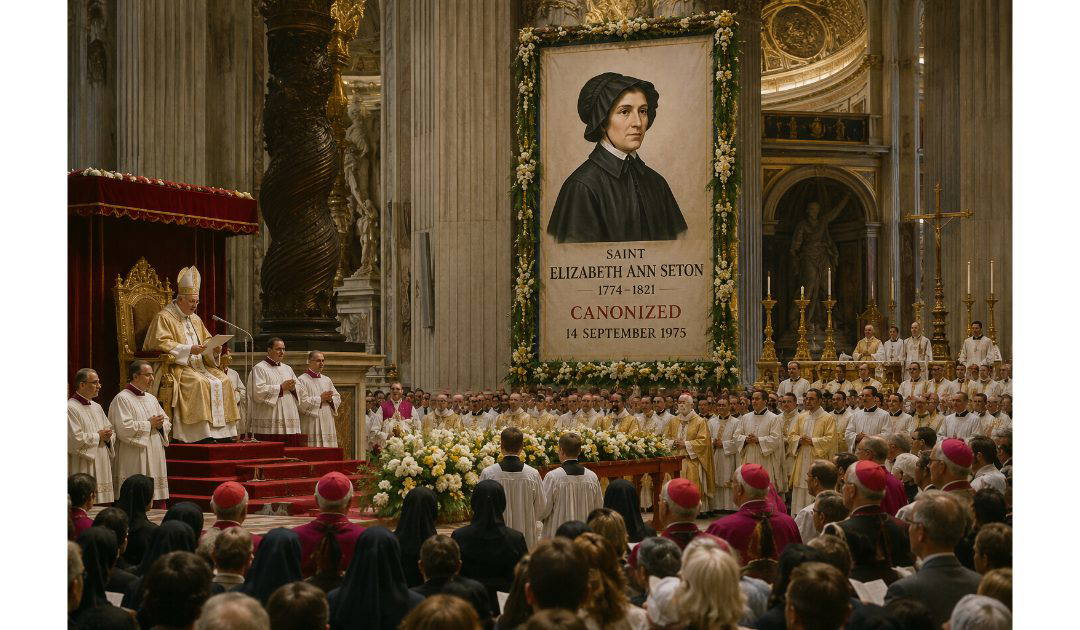
I have written about a number of saints: Saint Francis, Saint Crispin, and Saint Edmund, amongst others. But they were all men. So it’s high time for a female saint. On the 14th of September, 1975, Elizabeth Ann Seton became the first person born in what would become the United States to be canonized by the Catholic Church.
Elizabeth Ann Bayley was born in New York City on the 28th of August, 1774, into a respected Episcopalian family. Her father, Dr Richard Bayley, was a distinguished physician and one of New York’s leading medical practitioners. Her mother died when Elizabeth was only three years old, an event that left a lasting impression on her. Despite this early loss, she enjoyed a comfortable upbringing and developed a love of reading, music, and nature. She also cultivated a strong religious faith, finding comfort in prayer and the Bible.
In 1794 she married the wealthy merchant William Magee Seton. The marriage was a happy one, and together they had five children. Elizabeth became active in charitable work, caring for the poor and visiting the sick, while also fulfilling her responsibilities as a wife and mother. However, the Seton family’s fortunes declined dramatically after William’s shipping business suffered heavy losses during the political upheavals associated with the Napoleonic Wars.
William’s health also deteriorated. Suffering from tuberculosis, he travelled with Elizabeth to Italy in 1803 in the hope that the warmer climate would improve his condition. They stayed with the Filicchi family, prosperous Catholic merchants in Livorno, who welcomed them with extraordinary kindness. Sadly, William died there on the 27th of December, 1803, at the age of thirty-seven.
While in Italy, Elizabeth was deeply impressed by the faith of her Catholic hosts. She was particularly moved by the Catholic belief in the Real Presence of Christ in the Eucharist. After returning to New York, she spent many months studying Catholic teaching despite fierce opposition from many of her family and friends. Converting from the Episcopal Church to Catholicism was a controversial decision in early nineteenth-century America, where Catholics often faced suspicion and prejudice.
In March 1805 Elizabeth was received into the Catholic Church. The decision came at considerable personal cost. Many former friends withdrew their support, and opportunities to earn a living became more difficult because of anti-Catholic feeling. Nevertheless, she remained convinced that she had followed God’s call.
Seeking a way to support her children, Elizabeth opened a small school in Baltimore, Maryland, at the invitation of church leaders. This venture marked the beginning of her lifelong contribution to Catholic education. In 1809 she moved to Emmitsburg, Maryland, where she established a religious community known as the Sisters of Charity of St Joseph. The community followed a rule inspired by the Daughters of Charity founded by Vincent de Paul and Louise de Marillac in seventeenth-century France.
Mother Seton, as she became known, also founded Saint Joseph’s Academy and Free School, regarded as the first free Catholic parish school in the United States. Her educational philosophy combined academic excellence with religious formation and practical skills. She believed that every child, regardless of wealth, deserved a sound education rooted in Christian values. Her sisters soon established additional schools and orphanages, creating a model that spread throughout the growing nation.
Life at Emmitsburg was far from easy. The community experienced financial difficulties, harsh winters, illness, and the constant challenge of caring for orphans and educating children with limited resources. Elizabeth herself suffered recurring health problems, yet she continued to guide the sisters with patience, humility, and optimism. Her letters reveal a woman of warmth, humour, and unwavering trust in God, even during periods of grief and uncertainty.
Elizabeth Ann Seton died of tuberculosis on the 4th of January, 1821, at Emmitsburg at the age of forty-six. By the time of her death, the Sisters of Charity had become firmly established and were poised for continued growth. Over the following decades, her community expanded across the United States, founding schools, hospitals, and charitable institutions that transformed Catholic life in America.
Her reputation for holiness steadily increased. She was beatified in 1963 by Pope John XXIII and canonized on the 14th of September, 1975, by Pope Paul VI. Her canonization recognised not only her personal sanctity but also her immense contribution to education and charitable service.
Today, Saint Elizabeth Ann Seton is honoured as the patron saint of Catholic schools, educators, widows, and converts to Catholicism. Her feast day is celebrated on the 4th of January. Her enduring legacy is seen in the thousands of schools, hospitals, and charitable organisations inspired by her example. More than two centuries after her death, Elizabeth Ann Seton remains a powerful symbol of compassion, perseverance, and faith, demonstrating how one person’s courage and dedication can shape the spiritual and educational life of an entire nation.
One thing that attracts me to this story is that the education aspect reminds me of Joseph Calasanz’s free school in Frascati, Europe’s first, and the setting for Cade’s Point, the sixth book in the Sir Anthony Standen Adventures. It’s in first draft stage at the moment. Hopefully it will be published next year.