
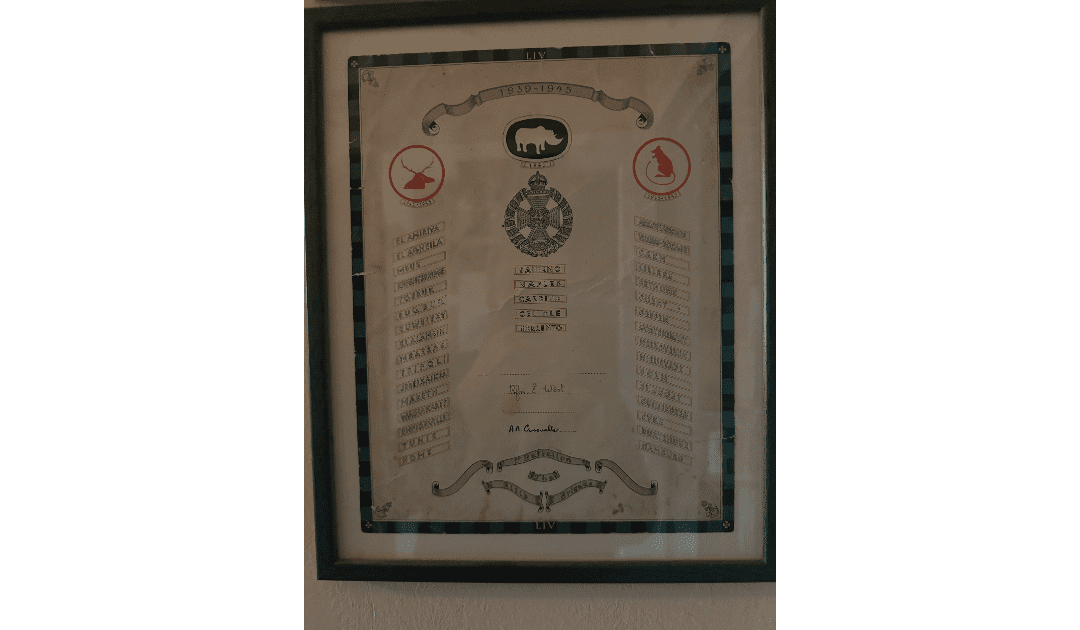
Operation Avalanche was the codename for the allied landings at Salerno in Italy, on the 9th of September, 1943. My father was one of those allied troops in the 1st Battalion Rifle Brigade, battle hardened as desert rats in North Africa.
It marked a crucial stage in the Italian Campaign during the Second World War, following the successful conquest of Sicily. Although overshadowed in popular memory by the Normandy landings of June 1944, Operation Avalanche was one of the war’s most fiercely contested amphibious assaults and played a significant role in forcing Germany to commit valuable troops to the defence of Italy.
The strategic background to the operation lay in the Allied victory in Sicily during the summer of 1943. That campaign had contributed to the downfall of Benito Mussolini, who was overthrown on the 25th of July. Italy’s new government, led by Marshal Pietro Badoglio, secretly negotiated an armistice with the Allies. Although the armistice was signed on the 3rd of September, it was not announced until 8 September, just hours before the Salerno landings. The Allies hoped that many Italian troops would cease fighting, making the invasion easier. Instead, the sudden collapse of Italy as an Axis partner prompted Germany to move swiftly to disarm Italian forces and occupy much of the country.
The Allied commander in the Mediterranean, General Dwight D. Eisenhower, approved Operation Avalanche as part of a broader strategy to secure southern Italy, capture Naples with its valuable port facilities, and advance towards Rome. The operation was commanded by Lieutenant General Mark Clark of the United States Fifth Army. His force consisted primarily of the American VI Corps under Major General Ernest Dawley and the British X Corps under Lieutenant General Richard McCreery.
Approximately 190,000 Allied troops eventually took part in the invasion. British forces landed north of the Sele River, while American divisions landed to the south. Unlike the Normandy landings the following year, there was no preliminary airborne seizure of the beaches, and Allied planners chose to forgo a heavy pre-landing naval bombardment in the hope of achieving surprise. This decision proved costly because the Germans were fully prepared.
Facing the Allies was General Heinrich von Vietinghoff’s German Tenth Army. Although initially smaller than the invading force, German units were highly experienced and quickly reinforced the beachhead. Among the most formidable defenders were elements of the 16th Panzer Division, which occupied strong defensive positions overlooking the landing areas.
The invasion began before dawn on the 9th of September. British troops encountered determined resistance but gradually secured their objectives. American forces faced even stronger opposition, particularly around the town of Paestum. German artillery and machine-gun fire inflicted heavy casualties as landing craft approached the beaches. Tanks and infantry launched repeated counter-attacks that threatened to split the Allied beachhead in two.
The most dangerous period came between the 12th and 14th of September. German armoured forces mounted a major offensive aimed at driving the Allies back into the sea before they could fully establish themselves. Several American units were forced to retreat, and at one stage General Clark even considered preparing plans for evacuation. Naval gunfire from British and American warships proved decisive. Battleships, cruisers and destroyers moved close to shore and bombarded advancing German tanks and infantry with remarkable accuracy. Their heavy guns disrupted the German attacks and bought time for reinforcements to arrive.
Air power also played a critical role. Allied aircraft flew hundreds of sorties against German troop concentrations, bridges and supply routes, making it increasingly difficult for the defenders to sustain their offensive. Meanwhile, airborne units from the US 82nd Airborne Division were dropped into the beachhead to strengthen the hard-pressed defenders.
Gradually the balance shifted in the Allies’ favour. The German high command concluded that the beachhead could no longer be eliminated without unacceptable losses. On the 16th of September the Germans began withdrawing to prepared defensive positions farther north, conducting a disciplined fighting retreat.
The capture of Naples on 1st of October, 1943, represented the immediate success of Operation Avalanche. The city’s large port became an essential logistical base for the continuing advance into Italy. However, hopes that Italy would collapse quickly proved overly optimistic. The Germans established a series of powerful defensive lines across the mountainous peninsula, including the formidable Winter Line and later the Gothic Line. The Italian Campaign became a long and costly struggle that lasted until Germany’s surrender in May 1945.
Operation Avalanche demonstrated both the strengths and weaknesses of Allied amphibious warfare. It highlighted the importance of naval gunfire, close air support and rapid reinforcement of vulnerable beachheads. It also showed how dangerous it could be to underestimate a determined and skilful defender.
Although it did not bring a swift end to the war in Italy, Operation Avalanche achieved its principal strategic objectives. It secured a foothold on the European mainland, diverted substantial German forces away from France and the Eastern Front, and opened a campaign that ultimately contributed to the defeat of Nazi Germany. Its success came at a high cost, with the Allies suffering around 12,500 casualties during the landings and the Germans approximately 3,500 casualties, but it remains one of the pivotal amphibious operations of the Second World War.