
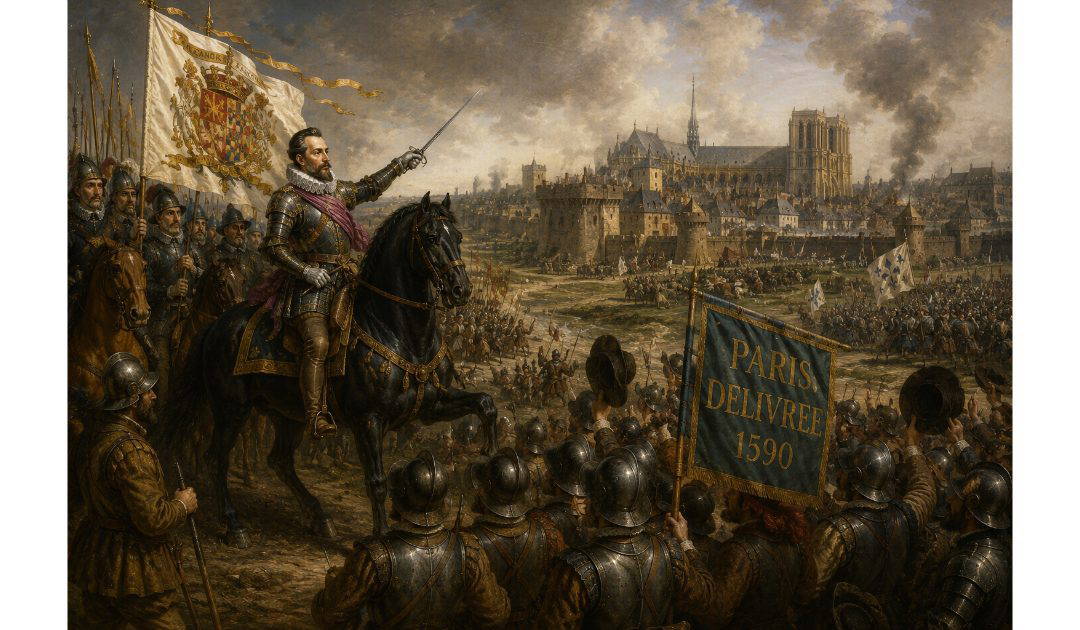
On the 5th of September, 1590, Alexander Farnese, Duke of Parma, led an army which forced Henry IV of France to lift his siege of Paris. There are some intersections with the Sir Anthony Standen Adventures here. Henry IV features in The Suggested Assassin, the third book in the series. Alexander Farnese became Governor of the Spanish Netherlands in 1578 replacing Don Juan, Duke of Austria, who caught Anthony in a rather embarrassing moment in 1577, in The Spy who Sank the Armada.
Alexander Farnese (1545–1592), Duke of Parma and Piacenza, was one of the greatest military commanders of the sixteenth century. A brilliant general, skilled diplomat and capable administrator, he restored Spanish control over much of the rebellious Netherlands during the Dutch Revolt. Although his achievements were often overshadowed by the fame of his uncle, King Philip II of Spain, and by the later successes of commanders such as the Duke of Alba and Ambrogio Spinola, many historians regard Alexander Farnese as Spain’s finest soldier of the age.
Alexander was born in Rome on 27 August 1545. He was the son of Ottavio Farnese, Duke of Parma and Piacenza, and Margaret of Parma, the illegitimate daughter of the Holy Roman Emperor Charles V. Through his mother he belonged to the powerful Habsburg dynasty, while his father’s family had risen to prominence through Pope Paul III, who had established the Duchy of Parma for the Farnese family. This combination of papal and imperial connections gave Alexander an exceptional political inheritance.
He spent much of his youth at the Spanish court, where he formed a close relationship with his cousin, the future King Philip II. There he received an education befitting a Renaissance prince, studying languages, history, mathematics and military science while learning the arts of diplomacy and courtly conduct. From an early age he demonstrated remarkable intelligence, courage and self-discipline.
Alexander first gained military experience during the Battle of Lepanto in 1571, the great naval victory of the Holy League over the Ottoman Empire. Although the battle was fought at sea, he distinguished himself by personally leading assaults during the boarding actions. The victory enhanced his reputation throughout Europe and confirmed his promise as a military leader.
His greatest achievements came in the Spanish Netherlands. By the late 1570s much of the region had risen against Spanish rule. Religious conflict between Catholics and Protestants combined with resentment over taxation and foreign troops to create a prolonged rebellion. In 1578 Alexander succeeded his half-brother, Don John of Austria, as Governor-General of the Netherlands.
Unlike some earlier Spanish governors, Alexander understood that military victories alone would not restore order. He pursued a careful strategy that combined force with negotiation. He exploited divisions between the predominantly Catholic southern provinces and the increasingly Protestant northern provinces. By offering generous terms to moderate Catholic nobles while isolating the more determined rebels, he persuaded several southern provinces to return to Spanish allegiance.
His diplomatic success was matched by exceptional military ability. Alexander reorganised the Spanish Army of Flanders into one of Europe’s most effective fighting forces. He paid close attention to logistics, discipline and engineering, enabling his army to conduct lengthy sieges with remarkable efficiency.
His masterpiece was the Siege of Antwerp (1584–1585). Antwerp was one of Europe’s richest commercial cities and an important centre of the Dutch rebellion. Capturing it would be both a military and psychological triumph.
The city’s position on the River Scheldt presented enormous challenges. Rebel ships could sail upriver with supplies, making a conventional siege ineffective. Alexander devised an audacious solution. He ordered the construction of a massive bridge of boats stretching across the Scheldt, fortified with artillery and defensive works. Despite repeated attacks by Dutch fire ships and ingenious floating explosive devices, the bridge held. After many months the starving city surrendered in August 1585.
The capture of Antwerp was one of the greatest siege operations of the sixteenth century. It restored Spanish authority over much of the southern Netherlands, although many Protestant merchants fled north to Amsterdam, helping shift Europe’s commercial centre away from Antwerp.
Philip II valued Alexander highly and entrusted him with wider responsibilities. In 1588 he was expected to support the Spanish Armada by invading England once the fleet had secured control of the English Channel. The plan required close coordination between the Armada and Alexander’s army stationed in Flanders. The Armada’s defeat, thanks to the intelligence which Standen had gathered, made the crossing impossible, despite Alexander having assembled experienced troops for the invasion.
In the following years he continued campaigning in both France and the Netherlands. During the French Wars of Religion he intervened to support the Catholic League against the Protestant King Henry of Navarre, later Henry IV of France. Although Alexander won several impressive victories and relieved the siege of Paris in 1590, these campaigns stretched Spanish resources and diverted attention from suppressing the Dutch Revolt.
Alexander was admired even by many of his enemies. Contemporary writers praised his personal bravery, moderation and humanity. Unlike some commanders of the period, he generally discouraged unnecessary brutality and preferred negotiation when it could achieve lasting results. His soldiers respected him because he shared their hardships and inspired loyalty through personal example rather than fear.
His health declined during his final campaigns. Wounded in battle and suffering from illness, Alexander Farnese died at Arras on the 3rd of December, 1592, at the age of forty-seven.