
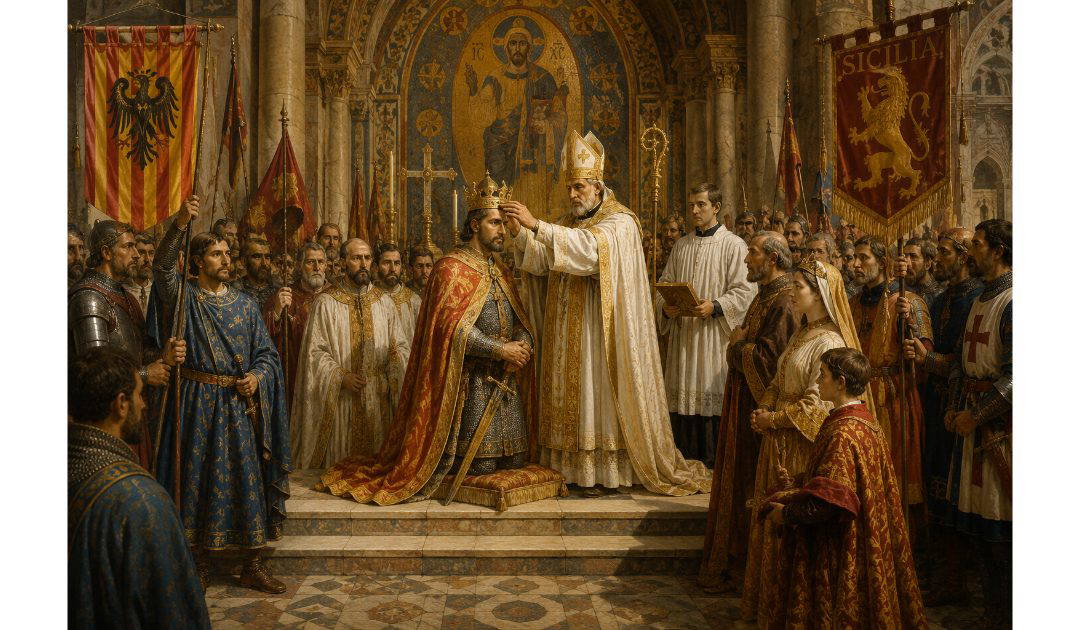
On the 4th of September, 1282, Peter III of Aragon became King of Sicily. Here’s another great opportunity to swat up on Sicilian history in preparation for our holiday there in September.
Peter was the eldest son of James I of Aragon, known as James the Conqueror, whose military successes had already expanded Aragon’s territories by conquering Valencia and the Balearic Islands from Muslim rulers. Peter inherited a kingdom with a formidable navy, prosperous trading cities such as Barcelona, and ambitious Catalan nobles eager for opportunities overseas.
An important turning point in Peter’s life came in 1262 when he married Constance of Sicily. She was the daughter of King Manfred of Sicily, an illegitimate but capable son of the Emperor Frederick II. Through this marriage Peter acquired a strong dynastic claim to the Kingdom of Sicily.
The political situation in Sicily changed dramatically after the intervention of the papacy. The popes viewed the Hohenstaufen dynasty, to which Manfred belonged, as dangerous rivals. Pope Clement IV invited Charles of Anjou, the younger brother of King Louis IX of France, to conquer Sicily. Charles defeated and killed Manfred at the Battle of Benevento in 1266 and later crushed the last Hohenstaufen claimant, the young Conradin, at Tagliacozzo in 1268. Conradin was subsequently executed in Naples, ending Hohenstaufen rule.
Although Charles proved an effective administrator, his government rapidly became unpopular. Heavy taxation funded his military ambitions, while French officials dominated important offices. Many Sicilians deeply resented what they regarded as foreign occupation. Charles also planned ambitious campaigns against the Byzantine Empire, requiring even greater financial burdens on his subjects.
Peter carefully observed these developments. Although he possessed a legitimate dynastic claim through his wife, directly invading Sicily while Charles remained powerful would have been extremely risky. Instead, Peter strengthened his fleet, cultivated alliances and waited for an opportunity.
That opportunity arrived unexpectedly during the famous Sicilian Vespers. On Easter Monday, the 30th of March, 1282, outside the Church of the Holy Spirit near Palermo, a French soldier allegedly insulted or assaulted a Sicilian woman during evening prayers. The incident ignited long-standing resentment. A riot erupted, the soldier was killed, and violence spread rapidly throughout Palermo. Within days the rebellion had engulfed much of the island. Thousands of French soldiers and settlers were massacred as Sicilians sought to overthrow Angevin rule.
The rebels urgently needed an experienced ruler capable of defending them against Charles’s inevitable attempt to reconquer the island. They invited Peter III, whose wife’s hereditary claim gave his intervention legitimacy.
Peter had already assembled a powerful fleet, ostensibly for an expedition against Muslim North Africa. In reality, many historians believe he intended to exploit any favourable opportunity in Sicily. He sailed from North Africa to Trapani, landing on the island in August 1282. His arrival was greeted enthusiastically. He entered Palermo and, on the 4th of September, was crowned King of Sicily as Peter I of Sicily.
Charles of Anjou reacted immediately. He invaded the island and laid siege to the important city of Messina. The citizens, reinforced by Peter’s forces, defended the city with remarkable determination. The Aragonese fleet controlled the surrounding waters, preventing Charles from fully investing the city. After suffering heavy losses and recognising that victory was unlikely, Charles abandoned the siege.
The conflict quickly widened into an international war. Pope Martin IV strongly supported Charles and refused to recognise Peter’s claim. The pope excommunicated Peter and declared him deprived of his kingdoms, even proclaiming a crusade against Aragon. This extraordinary political move effectively turned a dispute over Sicily into a holy war sanctioned by the Church.
France answered the papal call. In 1285 King Philip III led a large army across the Pyrenees into Aragon. Peter, however, demonstrated impressive military leadership. His admiral, Roger of Lauria, achieved a series of brilliant naval victories that destroyed much of the Angevin fleet and secured Aragonese control of the western Mediterranean. Disease devastated the French army during its retreat, and Philip III himself died shortly afterwards.
Peter did not long survive these triumphs. He died in November 1285 at the age of only forty-six. Nevertheless, he had preserved both Aragon and Sicily. His sons inherited separate branches of his dominions: Alfonso III succeeded in Aragon, while James inherited Sicily before later exchanging thrones with his brother.
Peter III’s conquest of Sicily had lasting consequences. The island remained under Aragonese influence for centuries, laying the foundations for a Mediterranean empire that would later include Sardinia, Naples and territories in Greece. The war also weakened Angevin ambitions and demonstrated the growing importance of naval power in medieval politics. Above all, Peter’s bold intervention ensured that Sicily would no longer be dominated by French rulers but would instead become closely linked with the Crown of Aragon, reshaping Mediterranean history for generations.