
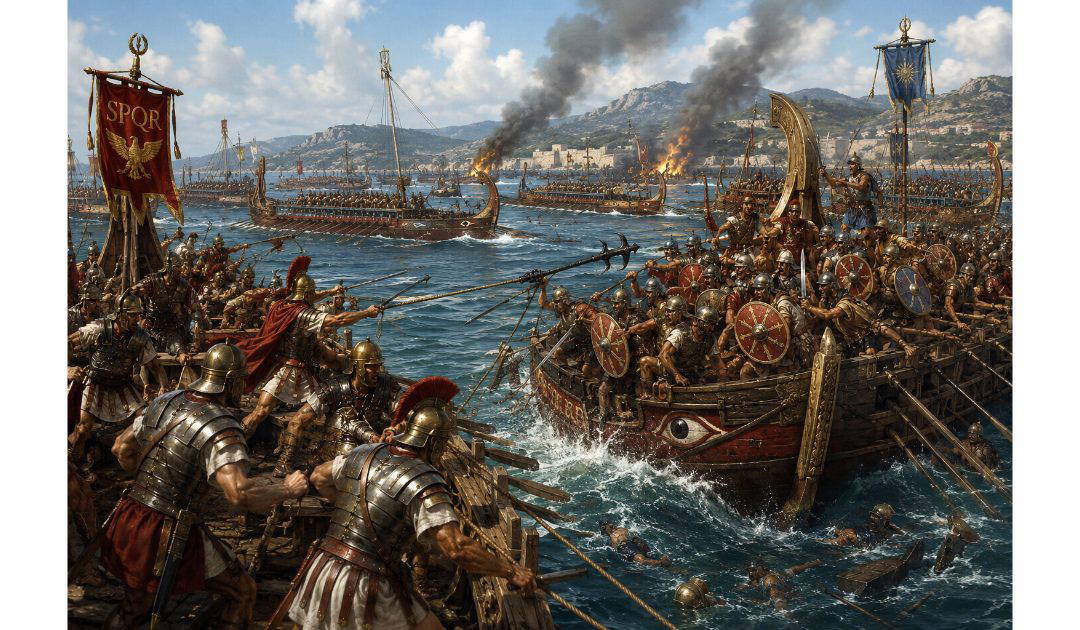
The Battle of Naulochus was fought on the 3rd of September, 36BCE. It was one of the most decisive naval engagements of the late Roman Republic. It marked the destruction of the naval power of Sextus Pompeius, the son of Pompey the Great, and secured control of the western Mediterranean for the Second Triumvirate. Although often overshadowed by the later Battle of Actium, Naulochus was equally important in determining the course of Roman history, for it eliminated one of the last major opponents of Octavian and greatly strengthened his position in his eventual struggle against Mark Antony.
Following the assassination of Julius Caesar in 44 BCE, Rome descended into another period of civil war. While Octavian, Mark Antony, and Lepidus formed the Second Triumvirate to hunt down Caesar’s assassins, Sextus Pompeius established himself as a powerful independent ruler based in Sicily. He inherited much of his father’s prestige and attracted supporters who opposed the triumvirs. More importantly, he commanded a formidable fleet that dominated the seas around Italy.
Sextus used this naval superiority to blockade the Italian peninsula. Sicily was Rome’s principal source of grain, and by disrupting the grain supply he caused food shortages and unrest in Rome itself. His control of Sardinia, Corsica, and parts of southern Italy made him a serious political and military threat. Attempts at negotiation, including the Treaty of Misenum in 39 BCE, temporarily eased tensions but ultimately failed. War resumed when neither side trusted the other.
Octavian recognised that victory required complete control of the sea. Although he lacked experience as a naval commander, he possessed an outstanding lieutenant in Marcus Vipsanius Agrippa. Agrippa spent months preparing for the campaign. He constructed a secret naval base at Portus Julius near Naples by linking lakes to the sea with canals. Here thousands of sailors trained intensively while new ships were built.
Agrippa also introduced an important technological innovation known as the harpax. This was a ballista-fired grappling hook attached to a long rope. Unlike the earlier corvus boarding bridge used during the First Punic War, the harpax was lighter and could seize enemy ships from a distance, allowing Roman marines to pull them alongside for boarding. Since Octavian’s soldiers were generally superior in hand-to-hand combat, this invention gave his fleet a significant advantage.
The campaign against Sextus involved multiple fleets converging on Sicily. Initial operations met with mixed success, and storms wrecked many of Octavian’s ships. Nevertheless, Agrippa steadily gained control of the surrounding waters. He captured key ports and gradually forced Sextus into a decisive confrontation.
The two fleets finally met off Naulochus on the northern coast of Sicily. Ancient sources suggest that each side fielded around 300 warships, making it one of the largest naval battles ever fought in the ancient Mediterranean. The vessels consisted mainly of heavily armed quadriremes and quinqueremes, propelled by banks of oars and carrying contingents of marines.
Sextus Pompeius had long enjoyed a reputation as one of Rome’s finest naval commanders. His crews were highly experienced sailors who had spent years operating around Sicily’s waters. Agrippa, however, possessed better-trained soldiers and more effective tactical planning.
As the fleets closed, Agrippa used the harpax repeatedly to disable enemy manoeuvres. Roman marines boarded the captured vessels and fought fierce close-quarters battles on their decks. Sextus’s captains attempted to rely on superior seamanship, avoiding direct engagements whenever possible, but the grappling devices increasingly neutralised this advantage.
The battle gradually turned into a disaster for Sextus. Many of his ships were captured rather than sunk, while others caught fire or were rammed. Ancient writers report that only seventeen of his vessels escaped the battlefield. The remainder were destroyed or taken by Agrippa’s forces.
Sextus himself fled eastward with the surviving ships, abandoning Sicily. Although he later sought refuge in the eastern Mediterranean, his political fortunes had collapsed. Two years later he was captured and executed on Antony’s orders, bringing an end to the last significant resistance based on Pompey’s legacy.
The consequences of Naulochus were profound. Octavian secured Sicily, restored Rome’s grain supply, and gained enormous prestige. The victory also enabled him to remove Lepidus from power. Lepidus attempted to seize Sicily after the campaign but found his troops defecting to Octavian. Rather than executing him, Octavian stripped him of his political authority while allowing him to retain the office of Pontifex Maximus.
With Sextus defeated and Lepidus politically neutralised, only Mark Antony remained as Octavian’s rival. The resources, confidence, and reputation gained through Naulochus paved the way for the final civil war that culminated in the Battle of Actium in 31 BCE. After Antony and Cleopatra were defeated, Octavian became the undisputed ruler of the Roman world and, in 27 BCE, assumed the title Augustus, inaugurating the Roman Empire.
Although the Battle of Actium is more famous, the Battle of Naulochus deserves equal recognition. It demonstrated Agrippa’s brilliance as a naval commander, showcased Roman innovation in naval warfare, and removed a dangerous opponent whose control of the sea had threatened Rome itself. By securing the western Mediterranean and consolidating Octavian’s power, Naulochus became one of the pivotal battles that transformed the Roman Republic into the Roman Empire.