
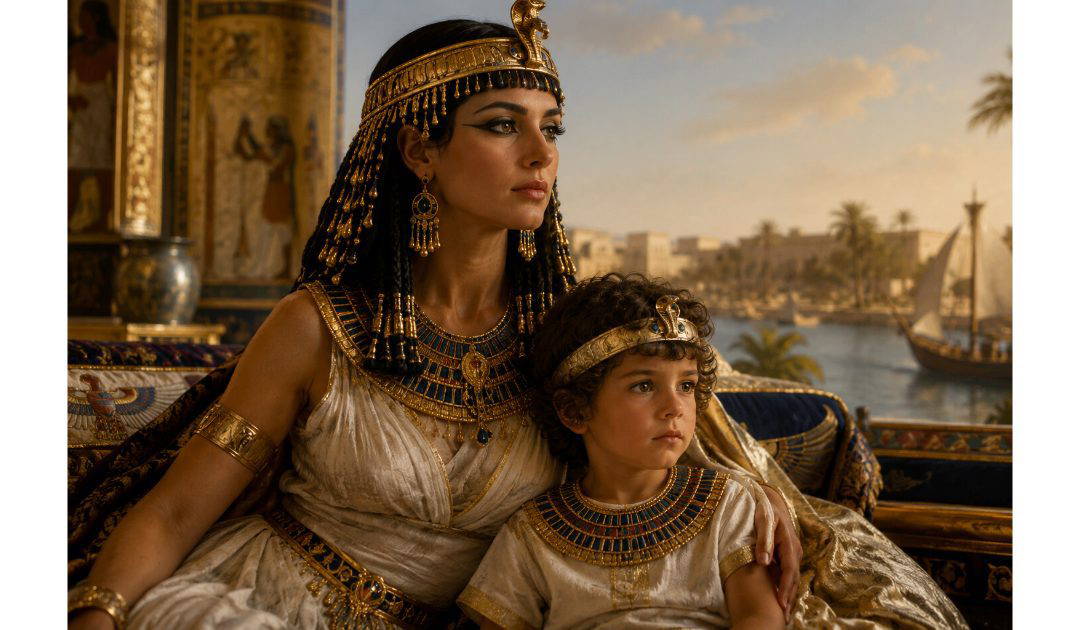
On the 2nd of September, 44BCE, Pharaoh Cleopatra VII of Egypt declared her son, Ptolemy VII Caesarion co-ruler. Cleopatra (69–30 BC) was the last effective ruler of the Ptolemaic Kingdom of Egypt and one of the most remarkable political figures of the ancient world. Although she has often been remembered primarily for her relationships with Julius Caesar and Mark Antony, Cleopatra’s true achievement lay in her determination to preserve Egypt’s independence during a period when the expanding Roman Republic dominated the Mediterranean.
Cleopatra belonged to the Ptolemaic dynasty, a Greek royal family founded by Ptolemy I Soter after the death of Alexander the Great in 323 BC. For nearly three centuries the Ptolemies ruled Egypt while retaining their Greek language and customs. Unlike many of her predecessors, however, Cleopatra embraced Egyptian traditions. She is believed to have been the first member of her dynasty to learn the Egyptian language, and ancient writers praised her ability to converse in several other languages without the aid of interpreters. This linguistic skill made her an exceptionally capable diplomat.
She became co-ruler of Egypt in 51 BC at about eighteen years of age following the death of her father, Ptolemy XII Auletes. According to Ptolemaic custom she ruled jointly with her younger brother, Ptolemy XIII, whom she was also expected to marry. The arrangement quickly broke down as court advisers manoeuvred for power, forcing Cleopatra into exile.
Her fortunes changed dramatically in 48 BC when Julius Caesar arrived in Alexandria while pursuing his rival Pompey. According to the famous story recorded by later ancient authors, Cleopatra had herself secretly brought into Caesar’s presence wrapped inside a carpet or bedding sack. Whether literally true or not, the tale captures her flair for dramatic political theatre. Caesar was impressed by her intelligence and backed her claim to the throne. After the ensuing Alexandrian War, Ptolemy XIII drowned while fleeing the fighting, and Cleopatra regained control of Egypt.
Cleopatra and Caesar became political allies and lovers. In 47 BC she gave birth to a son, Ptolemy XV Caesar, commonly known as Caesarion. Although Cleopatra maintained that Julius Caesar was the boy’s father, Caesar never publicly recognised him as his heir. Instead, his great-nephew Octavian was adopted in his will.
Cleopatra visited Rome between 46 and 44 BC, where she stayed in one of Caesar’s villas. Her presence caused considerable interest among Romans, who regarded her as an exotic and powerful foreign queen. Caesar even placed a gilded statue of her in the Temple of Venus Genetrix, an extraordinary honour. Following Caesar’s assassination in 44 BC, however, Cleopatra prudently returned to Egypt.
The next decisive chapter of her life began with Mark Antony. In 41 BC Antony summoned Cleopatra to meet him at Tarsus to explain her political loyalties. She arrived aboard a magnificent barge adorned with purple sails and gold fittings, deliberately presenting herself as the goddess Isis. Antony was captivated, and the two formed both a political alliance and a personal relationship. Together they had three children.
Their partnership strengthened Egypt economically and militarily, but it also intensified Antony’s rivalry with Octavian. Roman propaganda portrayed Cleopatra as a dangerous eastern temptress who had bewitched Antony and threatened Rome itself. This image proved highly effective, although modern historians generally regard it as a calculated distortion designed to justify war against Antony.
The conflict culminated in the Battle of Actium in 31 BC. Octavian’s fleet, commanded by Marcus Vipsanius Agrippa, decisively defeated Antony and Cleopatra. The following year Octavian invaded Egypt. Antony, believing Cleopatra had died, fell on his sword. Mortally wounded, he was carried to Cleopatra, where he died in her arms.
Cleopatra herself died on the 10th or 12th of August, 30 BCE. Ancient tradition claims that she committed suicide by allowing an Egyptian cobra, or asp, to bite her, though some modern scholars believe she may instead have taken a carefully prepared poison. She was thirty-nine years old. Caesarion was captured and executed shortly afterwards, bringing the Ptolemaic dynasty to an end. Egypt became a Roman province under Octavian, who soon became the Emperor Augustus.
Cleopatra’s reputation has shifted repeatedly over the centuries. Roman writers often depicted her as a seductive and manipulative queen, while Renaissance artists and later dramatists, especially William Shakespeare in Antony and Cleopatra, emphasised her romance and tragic grandeur. Modern historians present a more balanced portrait: a highly educated monarch, skilled administrator, accomplished diplomat and determined ruler who faced almost impossible geopolitical circumstances. Rather than merely a legendary beauty, Cleopatra was a capable sovereign whose intelligence, political judgement and charisma enabled her to hold Egypt independent for two decades against the greatest power of her age. Her dramatic life and tragic death have ensured that she remains one of history’s most enduring and fascinating figures.