
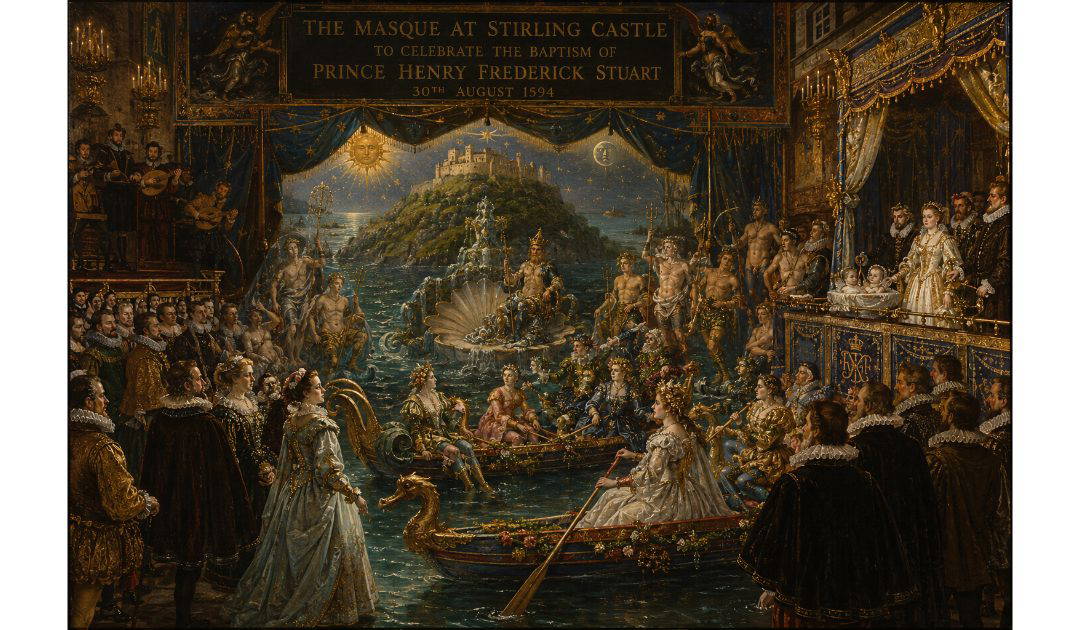
On the 30th of August, 1594, King James VI of Scotland held a masque at Stirling Castle to celebrate the baptism of Prince Henry Frederick, his eldest son and heir. I mentioned Prince Henry in my post on Royal Golf, and referred to my then work in progress, The Favourite Murder, the fifth book in the Sir Anthony Standen Adventures. I would no longer call it my work in progress, and it is now called Serpent’s Teeth. I have written the first draft of the sixth book, Cade’s Point, and Claire is reading it. She’s picked up a few errors. Meanwhile I have submitted Serpent’s Teeth for editorial review to Kirkus and the Historical Fiction Company. I hope that they will supply some useful comments that I can include in the cover blurb, fingers crossed I can publish it in time for Christmas. Now, where was I? Oh yes, Prince Henry Frederick.
Prince Henry Frederick Stuart (19th of February 1594 – 6th of November 1612) was the eldest son of King James VI of Scotland (later James I of England) and Queen Anne of Denmark. Although he never became king, he was one of the most admired and promising heirs in British history. Intelligent, energetic, athletic and deeply interested in military affairs, exploration and the arts, Henry inspired enormous hopes among contemporaries. His unexpected death at the age of eighteen changed the course of British history and ultimately led to the accession of his younger brother, Charles I.
Henry was born at Stirling Castle in Scotland while his father was still King James VI. Following Scottish royal custom, he spent much of his childhood under the care of the Earl and Countess of Mar at Stirling rather than with his parents. James believed this separation would help produce a strong and independent prince, although Queen Anne bitterly resented being denied a larger role in her son’s upbringing.
From an early age Henry demonstrated unusual intelligence and determination. He received a rigorous education in classical languages, history, theology, mathematics and statecraft. He also excelled at riding, fencing, hunting and other aristocratic pursuits. Unlike his scholarly father, whose greatest passions were books and theological debate, Henry was physically vigorous and delighted in displays of martial skill. Observers frequently commented on his handsome appearance, confidence and natural dignity.
In 1603 James inherited the English throne following the death of Queen Elizabeth I, becoming James I of England while remaining James VI of Scotland. Nine-year-old Henry travelled south with the rest of the royal family as the Stuart dynasty took possession of the English crown. The move transformed his position. Instead of being merely heir to Scotland, he became heir apparent to the kingdoms of England, Scotland and Ireland.
Henry rapidly became the focus of national hopes. Many English Protestants regarded him as everything they wished to see in a future monarch. He appeared committed to the Protestant cause in Europe at a time when religious conflict was intensifying. He admired military leaders such as Maurice of Nassau and took a keen interest in naval power and England’s overseas expansion. Some contemporaries believed he would revive the chivalric ideals associated with Henry V.
In 1610 James formally invested his son as Prince of Wales. The ceremony was one of the most magnificent of the Stuart age and confirmed Henry’s status as the future king. He established his own household at St James’s Palace, attracting talented artists, architects, scholars and soldiers. His court became a centre of youthful energy, contrasting sharply with the more cautious and intellectual atmosphere surrounding King James.
Henry was also an enthusiastic patron of the arts. He employed the architect Inigo Jones and supported leading painters, poets and musicians. His collections of paintings, sculptures and scientific instruments reflected both his curiosity and his ambition to create a magnificent Renaissance court. At the same time, he maintained a practical interest in shipbuilding, navigation and military engineering.
Politically, Henry increasingly differed from his father. James preferred diplomacy, negotiation and peace, particularly in his dealings with Catholic Spain. Henry’s sympathies lay more firmly with England’s Protestant allies on the continent. Although still very young and never in a position to determine policy, many nobles and politicians viewed him as the leader of a more assertive future government. This difference in outlook contributed to the immense popularity he enjoyed among those dissatisfied with James’s cautious foreign policy.
Henry also developed a reputation for personal morality. Unlike many royal courts of the period, his household was considered disciplined and relatively free from scandal. He expected high standards from those around him and cultivated an image of honour, courage and public service. Whether this reputation would have survived the realities of kingship can never be known, but it greatly enhanced his standing during his lifetime.
His promising career came to a sudden end in the autumn of 1612. After participating in swimming and other strenuous activities, Henry fell seriously ill, probably with typhoid fever, although historians have occasionally suggested other infectious diseases. Rumours of poisoning spread rapidly, fuelled by political tensions and the shock of his death, but modern scholarship finds no convincing evidence of foul play.
Henry died at St James’s Palace on 6 November 1612, only eighteen years old. His death plunged Britain into widespread mourning. Thousands attended his funeral procession, while poets, clergy and statesmen lamented the loss of the prince they believed destined for greatness. His younger brother Charles became heir to the throne and eventually succeeded James in 1625.
Many historians have speculated how differently British history might have unfolded had Henry lived. Charles I’s reign led to bitter disputes with Parliament, the English Civil War, his execution in 1649 and the temporary abolition of the monarchy. Henry possessed a more outgoing personality, greater popularity and a stronger instinct for leadership than Charles. Whether these qualities would have enabled him to avoid similar conflicts remains uncertain, but many contemporaries believed he had the potential to become one of England’s greatest kings.