
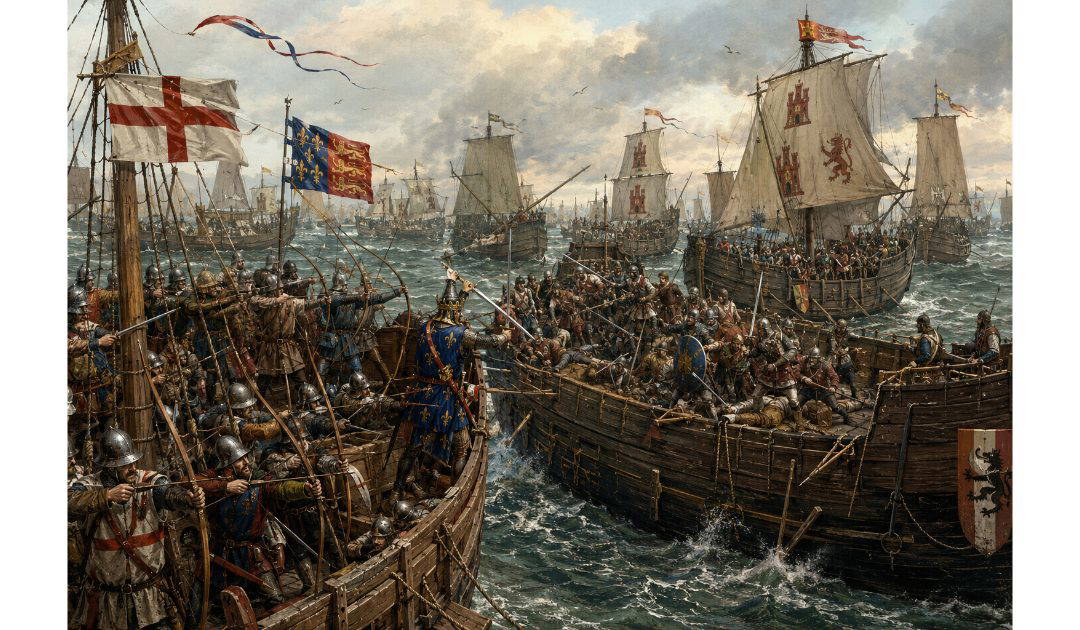
The Battle of Winchelsea was fought on the 29th of August, 1350, during the Hundred Years’ War between England and France. Also known as the Battle of Les Espagnols sur Mer (“The Battle of the Spaniards at Sea”), it was fought off the coast of Winchelsea in Sussex. It was one of the most dramatic naval engagements of the early phase of the Hundred Years’ War and demonstrated the personal courage of King Edward III, who fought alongside his men in the thick of the battle.
Although smaller than famous land battles such as Crécy or Poitiers, Winchelsea secured English control of the Channel at a crucial moment and weakened Castilian support for France.
By 1350 England had enjoyed remarkable military successes during the Hundred Years’ War. Edward III had won a crushing victory at the Battle of Crécy in 1346, followed by the capture of Calais in 1347. However, the conflict had entered a temporary lull after the terrible outbreak of the Black Death, which devastated populations across Europe from 1348 onwards.
France sought new allies against England, and one of the most important was the Kingdom of Castile, in what is now Spain. Castilian merchants possessed one of Europe’s largest merchant marines, while their sailors were among the finest in the Atlantic. Many Castilian ships also served as armed privateers, attacking English merchant vessels and coastal settlements.
During 1350 a large Castilian fleet sailed north through the Bay of Biscay into the English Channel. Officially, many of the ships were engaged in trade with Flanders, but they were heavily armed and had recently captured several English merchant vessels. Their activities severely disrupted English commerce.
Edward III regarded this as both piracy and a direct challenge to English authority in the Channel. Rather than waiting for the Castilians to attack again, he decided to intercept them personally.
Edward assembled a fleet of around fifty ships from ports along England’s southern coast. Although smaller than the Castilian fleet, his vessels were manned by experienced sailors and soldiers, including many veterans of the campaigns in France.
Among those accompanying the king were his eldest son, Edward of Woodstock, then about twenty years old, and several prominent English nobles. Chroniclers describe the atmosphere before departure as almost festive. Musicians entertained aboard ship, and the king appeared confident despite the odds.
The Castilian fleet, commanded by the experienced sailor Carlos de la Cerda according to some accounts, consisted largely of large merchant cogs converted into formidable fighting ships. These vessels were often bigger and taller than their English counterparts, giving their crews an advantage when boarding enemy ships.
The two fleets sighted each other on the 29th of August off Winchelsea. Naval warfare during the fourteenth century differed greatly from later battles fought with cannon. Ships relied primarily on boarding actions. Archers, crossbowmen and men-at-arms attempted to weaken an enemy vessel before grappling hooks drew the ships together for hand-to-hand combat.
Edward ordered a direct attack. His own flagship collided violently with a massive Castilian vessel. The impact was so severe that the English ship began taking on water and was close to sinking. Despite the danger, Edward led the boarding party personally.
English longbowmen poured arrows onto the enemy deck while heavily armed knights fought with swords, axes and maces. After fierce resistance the Castilian crew was overcome, and Edward transferred to the captured ship just before his own vessel foundered beneath him.
Elsewhere the fighting was equally savage. The Black Prince narrowly escaped disaster when his ship became locked alongside an enemy vessel. He fought throughout the engagement before English reinforcements arrived to secure victory. Several English ships were sunk or badly damaged, but the English gradually gained the upper hand through determined boarding actions and disciplined use of the longbow. By the end of the battle many Castilian vessels had been captured, while others fled towards the French coast.
The victory removed an immediate threat to English shipping and demonstrated that Edward III remained willing to lead from the front despite being nearly forty years old.
The battle also discouraged further large-scale Castilian raids for several years, although Castile would later become an even more significant naval opponent of England during later phases of the Hundred Years’ War.
Control of the English Channel was essential for maintaining communications with English possessions in France. Without secure sea routes, armies could not easily be supplied or reinforced. Winchelsea therefore had strategic importance well beyond the number of ships involved.
The Battle of Winchelsea illustrates the nature of medieval naval warfare before the widespread use of gunpowder artillery. Success depended on seamanship, courage and close-quarters combat rather than long-range firepower. The engagement also reinforced Edward III’s reputation as a warrior king. Medieval chroniclers admired the fact that he personally fought in a battle where his own ship sank beneath him, seeing it as proof of his bravery and leadership.
Although overshadowed by the famous English victories at Crécy, Poitiers and Agincourt, Winchelsea was a significant English naval triumph. It protected trade, maintained England’s command of the Channel, and demonstrated that the English crown could challenge powerful maritime rivals as effectively at sea as on land.
Today, the battle is remembered as one of the most notable naval actions of the fourteenth century. It highlighted the growing importance of sea power during the Hundred Years’ War and foreshadowed England’s long tradition of seeking security through control of the surrounding seas.