
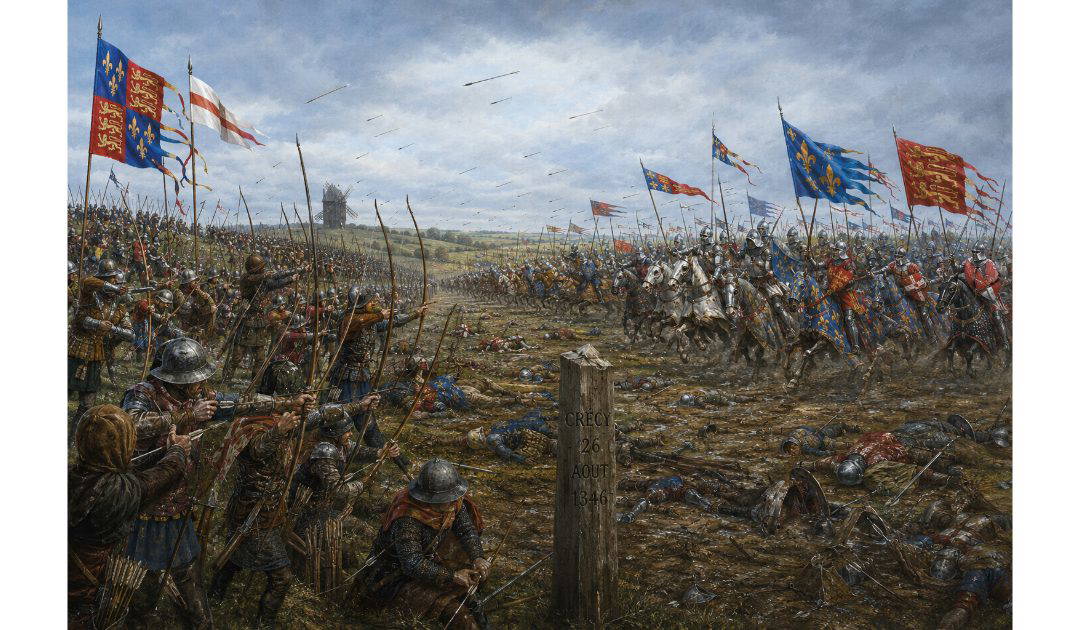
The Battle of Crécy was fought on the 26th of August 1346, and the English defeated a French army twice its size.It marked a turning point in medieval warfare, demonstrating that disciplined infantry and missile troops could defeat a much larger force of heavily armoured knights. The victory secured the reputation of King Edward III as one of England’s greatest military commanders and paved the way for the capture of Calais the following year.
The battle occurred during Edward III’s ambitious campaign in northern France. Having landed in Normandy in July 1346 with an army of around 12,000 to 15,000 men, he marched across the countryside, capturing towns, gathering supplies, and devastating French territory. His campaign was designed not only to weaken the French economy but also to force King Philip VI into a decisive battle.
After crossing the River Somme, Edward selected high ground near the village of Crécy-en-Ponthieu in northern France. The position was chosen with great care. His men occupied a gentle slope, with woods protecting one flank and obstacles limiting cavalry movement. Rather than advancing, the English prepared defensive positions and waited for the French army to attack.
The English army was organised into three divisions, known as “battles.” The sixteen-year-old Edward, the Black Prince commanded the foremost division, despite his youth. Experienced nobles supported him, while Edward III himself remained on a nearby windmill hill, from where he could observe the entire battlefield and direct reserves if necessary.
The most formidable element of the English force was its corps of longbowmen. Armed with powerful yew bows standing around six feet in length, these archers could fire between six and ten arrows a minute. Although individual arrows did not always penetrate the finest plate armour, they could wound horses, strike less protected areas, and create confusion among advancing troops. Their rapid, continuous volleys proved devastating against tightly packed formations.
Philip VI’s army was substantially larger, perhaps numbering between 20,000 and 35,000 men, although medieval sources often exaggerated these figures. It consisted of French knights, men-at-arms, infantry, and several thousand Genoese crossbowmen serving as mercenaries. The French had marched hard throughout the day, and many commanders advised delaying the attack until the following morning. Philip, however, either lost control of his eager nobles or chose to press the attack immediately.
A heavy rainstorm had passed over the battlefield shortly before the fighting began. English archers had unstrung their bows to keep the strings dry beneath their caps or clothing. The Genoese crossbowmen, by contrast, had little opportunity to protect their crossbows, whose strings became damp and less effective. Furthermore, their large protective shields, known as pavises, had reportedly been left behind with the baggage train.
When the Genoese advanced, they found themselves outranged by the English longbows. Their slower rate of fire meant they were overwhelmed before they could inflict significant damage. As they began to retreat, the impatient French cavalry interpreted their withdrawal as cowardice. Charging forward, the mounted knights rode directly into the fleeing crossbowmen, trampling many of their own allies before continuing uphill towards the English positions.
What followed was a disaster for the French. The muddy ground, the slope, and the relentless hail of arrows disrupted every cavalry charge. Horses fell, wounded riders blocked the advance, and successive waves of French knights crashed into the wreckage left by those before them. Instead of coordinated attacks, the French launched a series of fragmented assaults throughout the afternoon and evening.
The Black Prince’s division came under intense pressure during the fighting. At one point, a messenger reportedly rode to Edward III requesting reinforcements. The king asked whether his son was dead or wounded. When told that he was not, Edward is said to have replied that the prince should be allowed to “win his spurs,” refusing immediate assistance so that his heir could earn glory through his own leadership. Whether the story is entirely true or embellished by later chroniclers, it became one of the enduring legends of the battle.
By nightfall, the French army had been shattered. Thousands of French nobles and knights lay dead, including John of Bohemia, who, though blind, insisted on being led into battle. According to tradition, his crest of three ostrich feathers and the motto Ich dien (“I serve”) were later adopted by the Black Prince, although historians debate whether this occurred immediately after the battle.
English losses were remarkably light by comparison, perhaps only a few hundred men. While precise casualty figures remain uncertain, the contrast between the two armies was striking and reflected the effectiveness of Edward’s defensive tactics and disciplined troops.
The victory at Crécy had profound consequences. It confirmed the growing importance of infantry, missile weapons, and careful battlefield preparation over the traditional dominance of mounted knights. Although cavalry continued to play an important role in warfare, the battle demonstrated that heavily armoured charges alone could no longer guarantee victory against a well-prepared opponent.
Following Crécy, Edward III advanced to besiege the strategic port of Calais. After an eleven-month siege, the town surrendered in 1347, giving England a valuable continental base that it would hold for more than two centuries.
Today, the Battle of Crécy remains one of the defining battles of medieval Europe. Alongside later English victories at Poitiers (1356) and Agincourt (1415), it symbolises the effectiveness of disciplined leadership, tactical planning, and the famous English longbow, whose impact permanently altered the conduct of warfare in the late Middle Ages.