
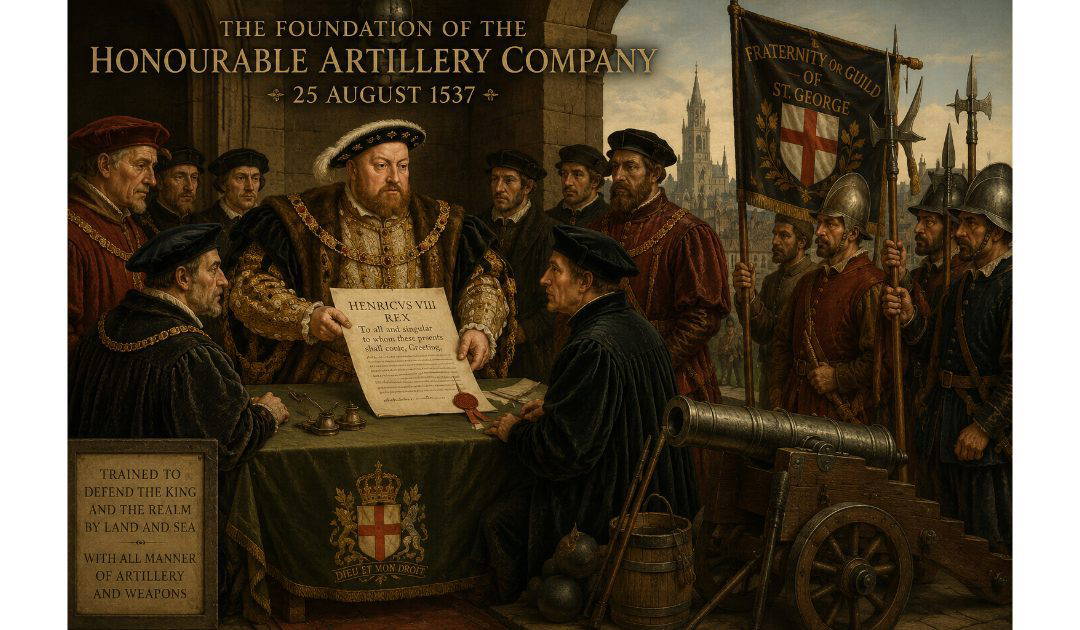
On the 25th of August, 1537, the Honourable Artillary Company was formed. It is the oldest surviving regiment of the British Army and the second most senior after the Life Guards. My father was in the Rifle Brigade in World War II, and my third great-grandfather, Elias Standen, was a Sergeant Farrier at the Battle of Waterloo. I was a Sub-Lieutenant in the Royal Naval Reserve for a few years.
during the reign of King Henry VIII, it has combined military service with civic duty for nearly five centuries. Throughout its long history, the Company has adapted to changing methods of warfare while preserving many of its ancient traditions.
The HAC traces its origins to a period when England’s military system was undergoing significant change. Gunpowder weapons were becoming increasingly important, and there was a growing need for men trained in the use of artillery and firearms. On the 25th of August, 1537, Henry VIII granted a royal charter incorporating the Fraternity or Guild of St George, an organisation of London citizens devoted to military training. Although the Company would eventually become known as the Honourable Artillery Company, its original purpose was broader than artillery alone. Members were expected to become proficient with the longbow, crossbow, pike, halberd and, increasingly, handguns and cannon.
During the sixteenth and seventeenth centuries, the HAC played an important role in training the London Trained Bands, the militia responsible for defending the capital. At a time when England had no permanent standing army, the Company served as a centre of military expertise. It developed standards of drill and discipline that influenced military practice throughout the country.
The English Civil War (1642–1651) marked a turning point in the Company’s history. Members found themselves divided in loyalty, with some supporting King Charles I while others sided with Parliament. As with many institutions of the period, the HAC reflected the political divisions within English society. Despite these internal differences, the Company survived the conflict and resumed its role after the Restoration of the monarchy in 1660.
During the seventeenth century, the HAC attracted many distinguished members. Among them was the diarist and naval administrator Samuel Pepys, who praised the Company’s discipline and military exercises. The Company’s annual displays became notable public events, demonstrating the increasing professionalism of citizen soldiers.
By the eighteenth century, Britain possessed a large professional army, reducing the HAC’s original function as London’s principal military training body. Nevertheless, it retained its prestige and continued to provide volunteer military service. The Company also became an important social institution within the City of London, attracting merchants, professionals and civic leaders who wished to combine public service with military training.
The nineteenth century brought renewed importance. Following fears of invasion during the French Revolutionary and Napoleonic Wars, volunteer military organisations experienced a revival. The HAC expanded and modernised its training. Later in the century it became part of the Volunteer Force established to strengthen Britain’s home defences. Members trained regularly while pursuing civilian careers, embodying the tradition of the citizen soldier.
The Company first saw overseas active service during the South African War (1899–1902), often known as the Second Boer War. HAC volunteers served with distinction in South Africa, demonstrating that the organisation could contribute effectively beyond Britain’s shores.
The First World War transformed the Company. Thousands of members volunteered for service. HAC infantry units fought on the Western Front, while others served as officers in numerous British Army regiments. The casualty rate was exceptionally high, reflecting the intensity of trench warfare. More than 1,600 members lost their lives during the conflict, and the Company’s courage earned numerous decorations for gallantry.
During the Second World War, the HAC again made a significant contribution. Initially serving in anti-aircraft roles defending Britain against Luftwaffe attacks, its units later specialised in reconnaissance and observation. Members served across Europe, North Africa and elsewhere, adapting to the increasingly technical demands of modern warfare.
After 1945, the HAC became part of the Army Reserve (formerly the Territorial Army). Although much smaller than in wartime, it continued to provide highly trained reservists capable of supporting the regular army during periods of conflict. HAC personnel have served in operations in Northern Ireland, the Balkans, Iraq and Afghanistan.
Today, the Company has two closely connected identities. It is both a regiment within the Army Reserve and a charitable organisation preserving centuries of military tradition. Its headquarters remains at Armoury House in the City of London, adjacent to the historic Artillery Garden, where military training has taken place for hundreds of years. The Company maintains ceremonial duties, competitive shooting, sporting activities and charitable work alongside its operational military responsibilities.
One of the HAC’s most enduring traditions is its emphasis on excellence in marksmanship and military skills. Its members continue to undergo demanding training in surveillance, reconnaissance, communications and artillery support. At the same time, ceremonial events preserve customs dating back to Tudor England, including parades, formal dinners and the wearing of distinctive uniforms.
The Honourable Artillery Company occupies a unique place in British military history. It has survived the Reformation, civil war, empire, two world wars and the transformation of warfare from bows and pikes to drones and satellite communications. Throughout these changes, its essential character has remained remarkably consistent: a body of committed citizen soldiers prepared to serve their country while maintaining strong ties to the City of London. Its longevity reflects both its ability to adapt to new military realities and its determination to preserve traditions that stretch back almost five hundred years, making it one of Britain’s most remarkable and enduring military institutions.