
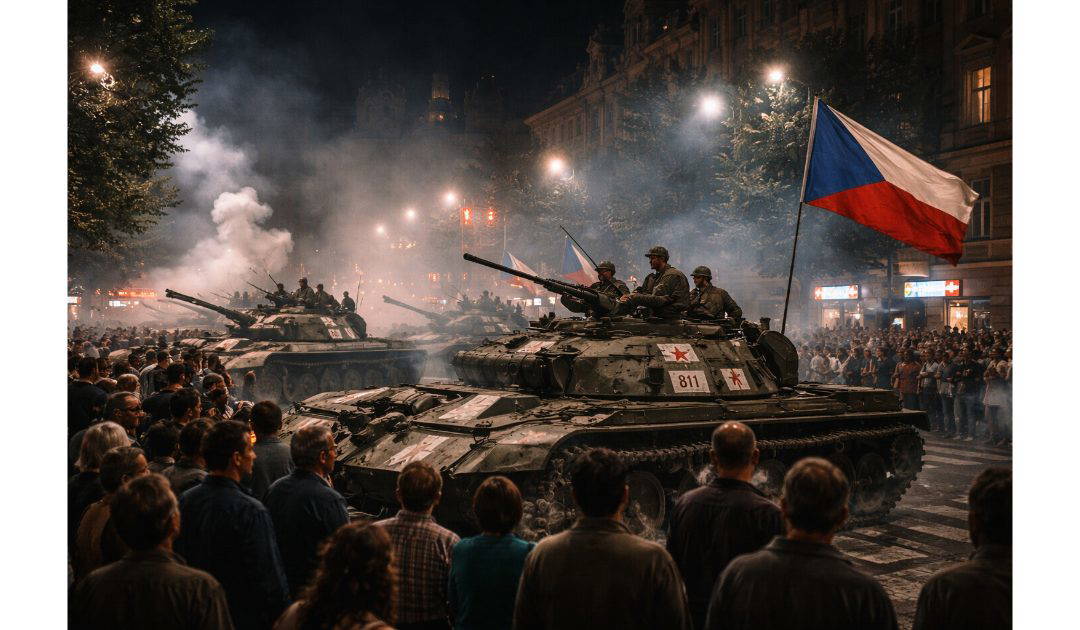
On the 20th of August, 1968, Warsaw Pact troops invaded Czechoslovakia and crushed the Prague Spring. The Prague Spring was one of the defining political crises of the Cold War: a bold attempt to create “socialism with a human face” inside the Soviet bloc, followed by a military invasion that crushed reform and reaffirmed Soviet domination over Eastern Europe.
The movement unfolded in Czechoslovakia during 1968, though its roots stretched back several years. After the Second World War, Czechoslovakia fell within the Soviet sphere of influence. In 1948, the Communist Party seized complete control of the country, establishing a rigid one-party state aligned with the Soviet Union. Political dissent was suppressed, the press was censored, and economic planning followed the Soviet model.
By the 1960s, however, dissatisfaction was growing. The economy had stagnated, living standards lagged behind those of Western Europe, and many intellectuals, students, and even Communist officials felt that the system had become oppressive and inefficient. Writers, academics, and journalists began calling for greater openness. At the same time, divisions appeared within the Communist Party itself between hardliners loyal to Moscow and reformers who believed socialism could be modernised.
The key figure of the Prague Spring was Alexander Dubček. In January 1968, Dubček replaced the conservative party leader Antonín Novotný as First Secretary of the Communist Party. Dubček was a committed socialist, not an anti-Communist revolutionary, but he believed the regime needed profound reform if it were to survive.
Under Dubček, censorship was relaxed, and newspapers suddenly began publishing criticism of the government. Citizens could speak more openly, debate political questions, and discuss subjects that had previously been forbidden. Writers and filmmakers flourished, contributing to a remarkable cultural awakening. Travel restrictions eased, and there were proposals for greater political participation, including limited democratic reforms.
In April 1968, Dubček’s government announced an “Action Programme” promising economic decentralisation, increased freedom of speech, rehabilitation of victims of earlier political purges, and greater autonomy for Slovakia within the federal state. The reforms generated enormous enthusiasm among ordinary citizens. Crowds gathered in the streets of Prague to support the changes, and many hoped Czechoslovakia might pioneer a new, more humane form of socialism.
The Soviet leadership watched these developments with growing alarm. The Soviet premier Leonid Brezhnev feared that liberalisation in Czechoslovakia might spread to other Eastern Bloc countries and undermine Communist control throughout the region. Leaders in East Germany, Poland, and other allied states shared these concerns.
Throughout the summer of 1968, Soviet pressure intensified. Meetings were held between Soviet and Czechoslovak leaders, with Moscow demanding tighter controls and a reversal of reforms. Dubček attempted to reassure the Soviets that Czechoslovakia would remain loyal to the Warsaw Pact and to socialism, but he refused to abandon the reform programme completely.
In the night of 20th – 21st of August, 1968, the crisis reached its climax. Troops from the Warsaw Pact — principally from the Soviet Union, but also from Poland, Hungary, Bulgaria, and East Germany — invaded Czechoslovakia. Around 200,000 soldiers and thousands of tanks crossed the borders in one of the largest military operations in post-war Europe.
The invasion shocked the world. Czechoslovak citizens responded with largely non-violent resistance. Protesters removed street signs to confuse invading forces, argued with soldiers in the streets, and organised strikes and demonstrations. Radio stations broadcast appeals for calm and national unity. Although the resistance was mostly peaceful, more than one hundred civilians were killed during the invasion and its immediate aftermath.
Dubček and other leaders were arrested and taken to Moscow. Under intense pressure, they were compelled to sign agreements rolling back the reforms. Though Dubček briefly remained in office, he was removed in 1969 and replaced by the more compliant Gustáv Husák. What followed became known as the “Normalisation” period: censorship returned, dissent was suppressed, and reformers were purged from public life. It was on the 19th of January, 1969, that Jan Palach died, having set fire to himself in Wenceslas Square in protest against the Soviet crackdown.
The Prague Spring had lasting international consequences. It led to the articulation of the so-called “Brezhnev Doctrine,” which claimed that the Soviet Union had the right to intervene in socialist countries if Communist rule was threatened. The invasion also damaged the reputation of the Soviet Union among many Western Communists and left-wing intellectuals, some of whom abandoned their support for Moscow altogether.
Despite its defeat, the Prague Spring retained enormous symbolic power. It demonstrated the widespread desire within Eastern Europe for political freedom and national independence. Later dissident movements, including Charter 77 led in part by Václav Havel, drew inspiration from the ideals of 1968.
Two decades later, in 1989, Communist rule in Czechoslovakia collapsed during the peaceful Velvet Revolution, when Vaclav Havel became the first president of the Czech Reepublic. Many observers saw that revolution as the delayed fulfilment of the hopes first expressed during the Prague Spring.