
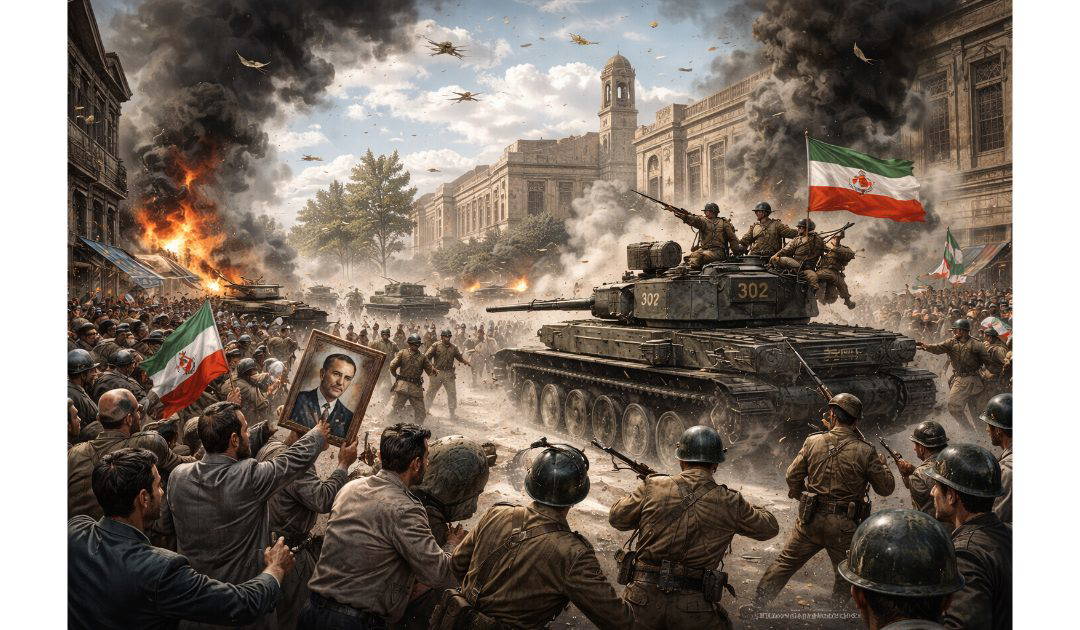
Operation Ajax was the code name for the covert Anglo-American operation that overthrew the government of Iranian Prime Minister Mohammad Mosaddegh in August 1953. Planned jointly by the Central Intelligence Agency and Britain’s MI6, it remains one of the most consequential intelligence operations of the twentieth century. Its immediate purpose was to remove a nationalist leader who had challenged Western control of Iranian oil. Its long-term consequence was to poison relations between Iran and the West for generations.
The roots of the crisis lay in Iran’s oil industry. Since the early twentieth century, British interests had dominated Iranian petroleum through the Anglo-Iranian Oil Company. Although Iran possessed vast reserves, the profits were heavily skewed toward Britain, while ordinary Iranians saw relatively little benefit. Growing resentment over this arrangement became a powerful force in Iranian politics.
In 1951, Mosaddegh, a charismatic nationalist and leader of the National Front, became prime minister. He pushed through legislation nationalising the oil industry. The move made him enormously popular in Iran but provoked outrage in Britain, which imposed an oil embargo and sought international support to reverse the decision. When legal and diplomatic pressure failed, British officials began to consider covert action.
Initially, the administration of Harry S. Truman was reluctant to participate. However, when Dwight D. Eisenhower entered the White House in 1953, American policy hardened. The Cold War was at its height, and Washington feared that political instability in Iran might strengthen the communist Tudeh Party and potentially open the way for Soviet influence.
The CIA operation was formally known as TP-AJAX. It was directed in the field by Kermit Roosevelt Jr., the grandson of President Theodore Roosevelt. The plan was also shaped by CIA operative Donald Wilber and British intelligence officers. Their strategy combined propaganda, bribery, and political manipulation.
American and British agents funded newspaper articles portraying Mosaddegh as anti-Islamic, unstable, and sympathetic to communism. Politicians, clerics, military officers, and street organisers were secretly paid to oppose him. The intention was to create a climate of chaos in which the Shah could dismiss Mosaddegh and appoint a new prime minister.
The figure chosen to replace Mosaddegh was General Fazlollah Zahedi. Although initially hesitant, Mohammad Reza Pahlavi eventually signed decrees dismissing Mosaddegh and appointing Zahedi in his place.
The first attempt to execute the coup, on the 15th of August, 1953, failed. Officers sent to arrest Mosaddegh were themselves arrested, and the Shah fled first to Baghdad and then to Rome. For a brief moment, it appeared that the operation had collapsed.
Roosevelt refused to abandon the mission. Over the next several days, he rallied supporters and financed large demonstrations in Tehran. On the 19th of August, pro-Shah crowds, joined by military units, seized key government buildings and attacked Mosaddegh’s residence. After fierce fighting that killed hundreds, Mosaddegh surrendered.
Zahedi became prime minister, and the Shah returned to Iran in triumph. Mosaddegh was tried for treason, sentenced to prison, and then placed under house arrest for the rest of his life.
In the short term, Operation Ajax seemed a spectacular success for London and Washington. Western access to Iranian oil was restored under a new consortium, and Iran became a key American ally in the Middle East.
Yet the long-term consequences were profound. The Shah consolidated an increasingly authoritarian regime backed by the feared security service SAVAK. Political opposition was suppressed, and resentment toward foreign interference deepened.
This anger contributed directly to the Iranian Revolution of 1979, which toppled the Shah and established the Islamic Republic under Ayatollah Ruhollah Khomeini. Since then, the memory of Operation Ajax has shaped Iranian perceptions of the United States and Britain.
For many historians, Operation Ajax stands as a classic example of the dangers of covert intervention. It achieved its immediate objectives, but at the cost of undermining Iranian democracy and fostering decades of mistrust. The coup remains central to understanding modern Iranian politics and the troubled relationship between Iran and the West.