
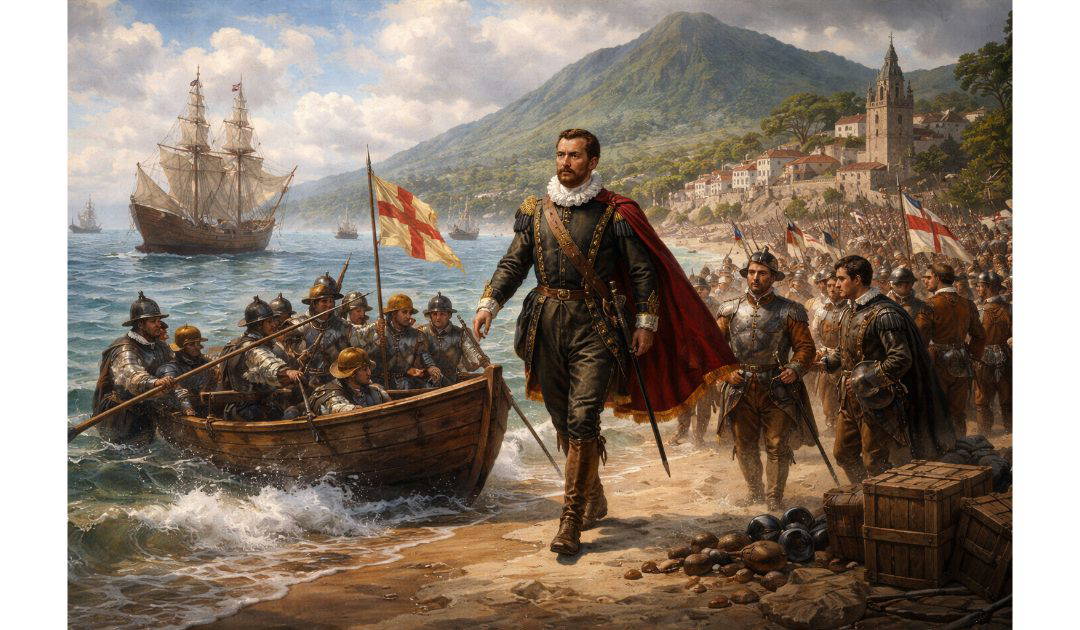
On the 17th of August, 1597, Robert Devereux, 2nd Earl of Essex and Sir Walter Raleigh set sail on an expedition to the Azores. With Essex was Sir Anthony Standen, the elder brother of my 10th great-grandfather. The voyage is an episode in The Spy who Sank the Armada, the first book in the Sir Anthony Standen Adventures.
Despite being a keen yachtsman, I’ve haven’t yet been to the Azores, so what are the islands like?
The Azores are a remarkable archipelago of nine volcanic islands lying in the North Atlantic Ocean, roughly 1,400 kilometres west of mainland Portugal. Though politically part of Portugal, the islands possess a distinct identity shaped by their isolation, dramatic landscapes, and maritime traditions. Often described as one of Europe’s best-kept secrets, the Azores combine rugged natural beauty with a rich cultural heritage.
The islands are divided into three groups. The eastern group consists of São Miguel and Santa Maria; the central group includes Terceira, Graciosa, São Jorge, Pico, and Faial; and the western group contains Flores and Corvo. Together they cover around 2,300 square kilometres and are home to approximately 250,000 people.
The Azores were uninhabited when Portuguese navigators discovered them in the early fifteenth century, probably around 1427. Settlement began soon afterward under the direction of Prince Henry the Navigator. Colonists came from Portugal, as well as from Flanders and other parts of Europe. Because the islands lay on the sea route between Europe, Africa, and the Americas, they became strategically important staging posts for ships returning from the New World laden with silver, spices, and exotic goods.
Volcanic activity created the islands, and their landscapes are among the most spectacular in the Atlantic. Towering crater lakes, steaming fumaroles, black lava fields, and fertile green pastures characterize the scenery. On Pico Island rises Mount Pico, Portugal’s highest mountain at 2,351 metres. The twin lakes of Sete Cidades, one blue and one green, fill a vast caldera and have become one of the islands’ iconic views.
The Azores enjoy a mild oceanic climate. Temperatures are moderate year-round, with winters rarely cold and summers pleasantly warm rather than hot. Rainfall is frequent, which explains the lush vegetation. Hydrangeas, camellias, and cryptomeria trees flourish, lending the islands an almost subtropical appearance.
Historically, the economy relied on agriculture, cattle farming, fishing, and whaling. In the nineteenth and early twentieth centuries, Azorean crews hunted sperm whales, a dangerous occupation commemorated in local museums. Since the 1980s, whaling has given way to whale watching, and the waters around the islands are now renowned for sightings of sperm whales, blue whales, dolphins, and turtles.
Today, dairy farming remains important, and Azorean cheese and butter are exported widely. Tea and pineapple are also grown on São Miguel, where Europe’s only commercial tea plantations continue to operate. Tourism has expanded rapidly, attracting visitors interested in hiking, birdwatching, diving, and geothermal hot springs.
Azorean culture blends Portuguese traditions with local customs. Religious festivals, particularly the Festas do Espírito Santo, play a central role in community life. These celebrations feature processions, music, and the sharing of food. Traditional dishes include cozido das Furnas, a stew cooked underground using volcanic heat.
The islands have also been shaped by emigration. Large Azorean communities settled in the United States, Canada, and Brazil, especially in Massachusetts, California, and Bermuda. These communities have preserved ties with the homeland and influenced its culture and economy.
The Azores possess significant strategic importance. During the Second World War, air and naval bases on the islands were vital to Allied operations in the Atlantic. Today, Lajes Field on Terceira remains an important military and transport facility.
In 1976, following Portugal’s democratic revolution, the Azores became an autonomous region with their own government and legislative assembly. This arrangement allows the islands to manage many local affairs while remaining an integral part of Portugal and the European Union.
The Azores are a place where volcanic forces, Atlantic weather, and centuries of seafaring history have created a landscape and culture unlike any other. Remote yet welcoming, they offer a striking blend of natural grandeur and enduring tradition.