
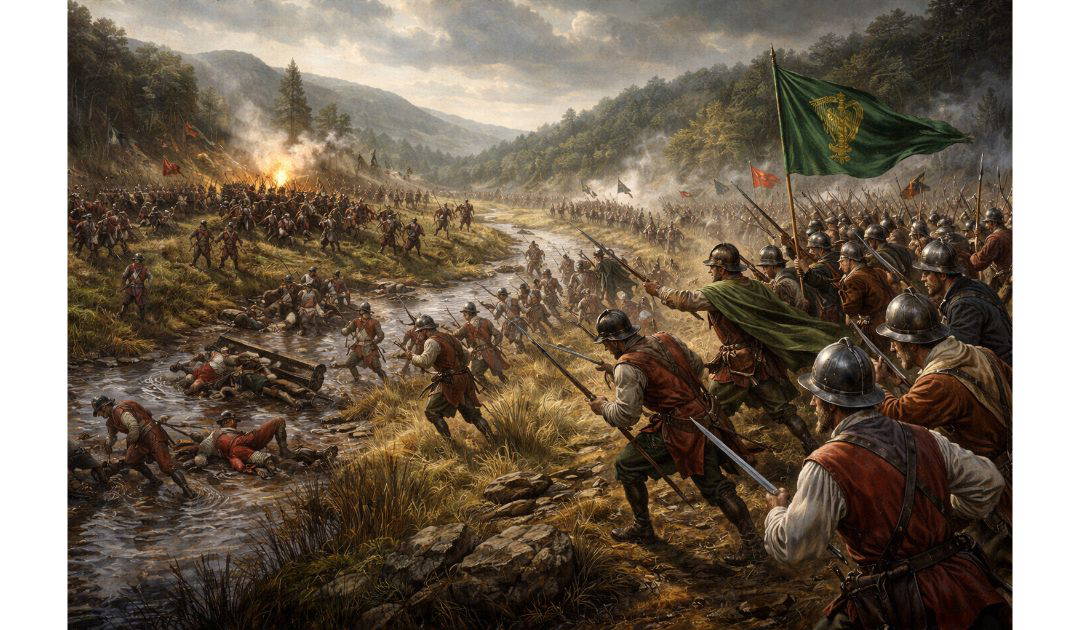
The Battle of Yellow Ford, fought on the 14th of August, 1598, was one of the most devastating defeats ever suffered by English forces in Ireland. Taking place near the River Blackwater in County Armagh, it marked the high point of the Irish resistance during the Nine Years’ War (1594–1603), when the Gaelic lords of Ulster challenged the authority of Queen Elizabeth I.
The war was led chiefly by Hugh O’Neill, 2nd Earl of Tyrone, and his ally Hugh Roe O’Donnell of Tyrconnell. O’Neill was a remarkable figure: outwardly an English nobleman and Earl of Tyrone, inwardly a determined defender of Gaelic autonomy and the Catholic faith. By the late 1590s he had forged an alliance of northern clans and built a disciplined army trained in modern tactics, armed with muskets and pikes, and supported by Spain.
The immediate cause of the battle was the plight of the English fort at Blackwater, situated in hostile territory on the borders of Tyrone’s lands. The fort was under siege and short of supplies. Sir Henry Bagenal, Marshal of the English army in Ireland and O’Neill’s bitter personal enemy, assembled a relief force of around 4,000 men at Armagh.
Relations between the two men were poisonous. O’Neill had secretly married Bagenal’s sister, Mabel, and the affront deepened an already intense political rivalry. Bagenal regarded O’Neill as a dangerous traitor; O’Neill saw Bagenal as the embodiment of English aggression in Ulster.
On the morning of the 14th of August, Bagenal marched south from Armagh toward the fort. His troops included English veterans and Irish loyalists, but the terrain strongly favoured the defenders. The route crossed boggy ground and narrow passages where movement was slow and formations became stretched.
O’Neill had carefully prepared the battlefield near a crossing known as the Yellow Ford, probably named for the yellowish colour of the water and surrounding clay. Trenches were dug, trees felled, and earthworks erected to channel the English into killing zones. Concealed among woods and marshes, Irish musketeers and pikemen waited in ambush.
As Bagenal’s column advanced, it came under sustained musket fire. The English attempted to press on, but confusion spread as units became separated. Then disaster struck: Bagenal was killed, reportedly by a shot to the head. His death deprived the army of its commander at the critical moment.
The English vanguard reached the Blackwater fort, but the main body was collapsing. At one point a wagon carrying gunpowder exploded, causing heavy casualties and panic. Irish troops surged forward, attacking from all sides with musket fire and in close combat.
Many of the Irish soldiers fighting for the Crown switched sides or deserted. Morale among the English plummeted. The retreat toward Armagh turned into a rout, with men cut down in the bogs and pursued relentlessly by O’Neill’s forces.
Of the roughly 4,000 men who set out from Armagh, about 1,500 were killed, along with many officers. Hundreds more were wounded. Irish losses were comparatively light, perhaps around 200. It was a crushing and humiliating defeat for the English government.
The victory transformed O’Neill’s standing. Lords across Ireland who had hesitated now rallied to his cause, and the rebellion spread into Leinster and Munster. For a time it seemed possible that English authority in Ireland might collapse entirely.
In London, news of the disaster caused alarm. The government responded by sending larger armies and appointing new commanders, including the Earl of Essex in 1599 and later Lord Mountjoy, whose relentless campaign eventually wore down the rebellion.
Despite the triumph at Yellow Ford, O’Neill could not secure decisive foreign assistance. Spanish intervention came too late and ended in defeat at the Siege of Kinsale in 1601–1602. By 1603, exhausted and isolated, O’Neill submitted to the Crown.
The Battle of Yellow Ford remains one of the greatest Irish military victories over an English army. It demonstrated that Gaelic forces, when united and effectively led, could defeat one of Europe’s most formidable powers. Yet it also proved a fleeting success. Though the battle won glory for O’Neill, it could not prevent the eventual extension of English control over Ireland, paving the way for the profound political and social transformations of the seventeenth century.
Sir Anthony Standen, the elder brother of my 10th great-grandfather, and the hero of the Sir Anthony Standen Adventures, accompanied Essex to Ireland and remained there for three years after Essex returned to England in September, thereby avoiding Essex’s fall from grace and execution. Standen was the elder brother of my 10th great-grandfather and is the hero of my Sir Anthony Standen Adventures. Hugh O’Neill features in The Spy who Sank the Armada, and Fire and Earth.