
This is really starting to get difficult. I’m searching for events for the 13th of August. Michael Servetus was arrested by John Calvin for heresy in 1553, but I’ve written about him already. In 1624 Louis XIII appointed Cardinal Richelieu as prime minister but I’ve written about them both too. Ah, the Battle of Blenheim, that will do nicely.
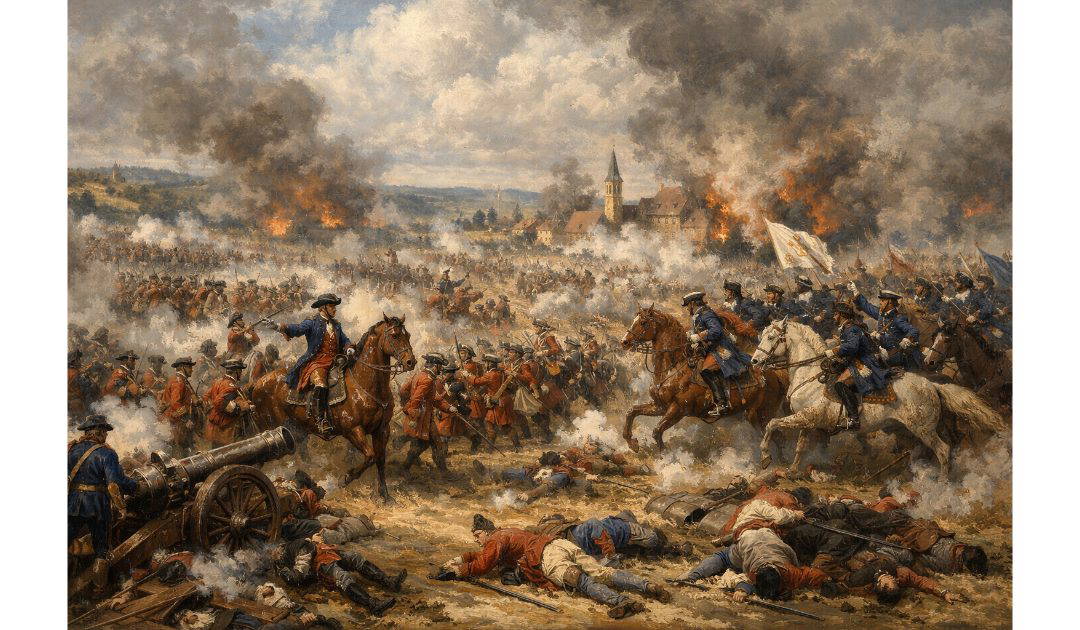
The Battle of Blenheim, fought on the 13th of August, 1704, was one of the most decisive engagements in European history. It took place near the village of Blindheim—anglicised as Blenheim—on the banks of the Danube in Bavaria during the War of the Spanish Succession. The battle pitted the Grand Alliance, led by John Churchill, 1st Duke of Marlborough, and Prince Eugene of Savoy, against the armies of Louis XIV of France and his Bavarian ally, Maximilian II Emanuel, Elector of Bavaria.
The War of the Spanish Succession began in 1701 after the death of the childless Charles II of Spain. His will left the vast Spanish Empire to Philip V, grandson of Louis XIV, raising fears that France and Spain would be united under the Bourbon dynasty. England, the Dutch Republic, and the Austrian Habsburgs formed the Grand Alliance to prevent this.
By 1704 the war had reached a critical point. French and Bavarian forces threatened Vienna, the capital of the Habsburg Empire. If Vienna fell, Austria might be forced out of the war, leaving Louis XIV dominant in Europe. Marlborough, commander of the English and Dutch forces in the Low Countries, conceived a bold plan. Rather than continue operations in Flanders, he would march his army hundreds of miles across Germany to join Prince Eugene and confront the enemy in Bavaria.
Marlborough’s march from the Netherlands to the Danube was a masterpiece of logistics and deception. He kept both his allies and his enemies uncertain of his intentions until it was too late for the French to react effectively. By early August he had united with Eugene’s Imperial army.
The Franco-Bavarian army, commanded by Marshal Tallard, Ferdinand de Marsin, and the Elector of Bavaria, occupied a strong defensive position stretching from the village of Lutzingen on the left to Oberglauheim in the centre and Blindheim on the right. The Nebel stream ran in front of their line, seemingly an obstacle to any Allied attack.
Tallard concentrated a large number of infantry in Blindheim, believing the village to be the key to the battlefield. This decision would prove fatal.
Marlborough and Eugene devised a coordinated attack. Eugene would assault the enemy left around Lutzingen, tying down the Bavarians. Marlborough would attack the centre and right, with the ultimate aim of breaking through the middle once Tallard’s reserves were exhausted.
The battle began in the morning. Eugene’s troops met fierce resistance and suffered heavy casualties, but they held the Bavarians in place. On the Allied left, British and Dutch infantry attacked Blindheim. They were repulsed several times, but their assaults compelled Tallard to send more and more troops into the village. Eventually nearly 10,000 French soldiers were packed into Blindheim, far more than could effectively fight.
In the centre, Marlborough carefully moved his infantry and cavalry across the Nebel under heavy fire. This difficult manoeuvre required exceptional discipline. Once his forces were deployed on firmer ground, he launched repeated cavalry attacks against the French horse.
By mid-afternoon the French cavalry began to buckle. Marlborough personally led charges and rallied units under intense fire. At a critical moment, the Allied cavalry broke through the French centre. Tallard’s army split apart. Thousands of French soldiers fled toward the Danube, where many drowned attempting to escape.
Marshal Tallard himself was captured. According to tradition, he was brought before Marlborough and said, “Your Grace has conquered the bravest army in Europe.”
Meanwhile, Blindheim remained isolated. Surrounded and cut off, its commander, the Marquis de Clérambault, had already been killed. As evening approached, the trapped French infantry surrendered en masse. More than 10,000 men laid down their arms.
The Franco-Bavarian army suffered catastrophic losses: around 30,000 killed, wounded, or captured. The Allies lost roughly 12,000 men. The scale of the victory stunned Europe.
Blenheim had immense strategic consequences. The immediate threat to Vienna vanished. Bavaria was occupied and effectively removed from the war. France, which had appeared nearly invincible under Louis XIV, suffered its first truly major battlefield defeat in decades.
The battle transformed Marlborough into one of Britain’s greatest military heroes. In gratitude, Queen Anne granted him the royal estate at Woodstock, where Blenheim Palace was built as a monument to his victory. Winston Churchill was born in Blenheim Palace.
Blenheim also enhanced Prince Eugene’s reputation and strengthened the alliance between Britain and Austria. The war would continue until 1714, but the myth of French invincibility had been shattered.
Military historians continue to admire Blenheim as a masterpiece of operational planning and battlefield command. Marlborough’s long march, his coordination with Eugene, and his exploitation of Tallard’s mistakes demonstrated a rare combination of strategic vision and tactical skill.