
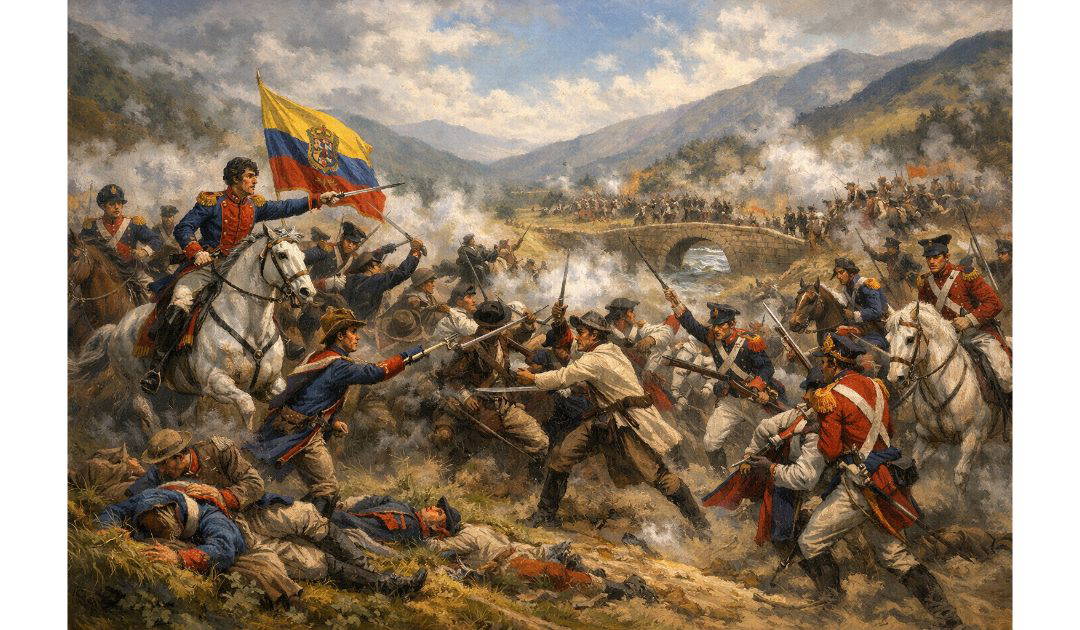
On the 7th of August, 1819, Simon Bolívar triumphed over Spanish forces in the Battle of Boyacá. Simón Bolívar is one of the towering figures of Latin American history, remembered as “El Libertador” — the Liberator — for his leading role in freeing much of northern South America from Spanish rule during the early nineteenth century. Born in 1783 in Caracas, Venezuela, to a wealthy Creole family of Spanish descent, Bolívar grew up during an age of revolution. The American and French Revolutions, together with the weakening of the Spanish Empire during the Napoleonic Wars, deeply influenced his political outlook. Educated in Enlightenment ideas, Bolívar came to believe that the Spanish colonies in the Americas should govern themselves rather than remain under distant royal authority.
The struggle for independence in Spanish South America was long, chaotic, and brutal. After Napoleon invaded Spain in 1808 and placed his brother Joseph Bonaparte on the Spanish throne, many colonies began forming local juntas. Bolívar quickly became involved in revolutionary politics in Venezuela. Early attempts at independence failed, and Bolívar experienced defeat, exile, and disappointment. Yet he remained determined. During the following decade he developed into a brilliant military commander and political leader, combining personal charisma with relentless ambition.
Bolívar’s vision extended beyond Venezuelan independence alone. He hoped to unite the former Spanish colonies into a powerful federation capable of resisting European interference. This dream would eventually inspire the creation of Gran Colombia, a state incorporating present-day Venezuela, Colombia, Ecuador, and Panama. To achieve that vision, however, Bolívar first needed decisive military victories over Spanish royalist forces.
One of the most important moments in his career came during the campaign of 1819, culminating in the Battle of Boyacá. At the time, the Spanish still controlled much of New Granada, the region roughly corresponding to modern Colombia. Bolívar understood that capturing this territory would transform the independence struggle. If New Granada could be liberated, the revolutionaries would gain resources, manpower, and political legitimacy.
Bolívar launched an audacious campaign that has become legendary in military history. In the rainy season of 1819 he led his army from the plains of Venezuela across the flooded Llanos and over the freezing Andes Mountains. The march was extraordinarily difficult. Soldiers endured hunger, exhaustion, icy temperatures, and disease. Many men and horses died during the crossing. Nevertheless, Bolívar succeeded in surprising the Spanish, who believed such a route impossible.
After several engagements, Bolívar moved toward Bogotá, the capital of New Granada. To stop him, Spanish royalist forces under Colonel José María Barreiro attempted to block the patriot advance near the Boyacá River on the 7th of August 1819. The battle took place close to a bridge near the town of Tunja in central Colombia.
The patriot army included Venezuelans, New Granadans, British volunteers, and men of mixed racial backgrounds. Bolívar’s commanders included talented officers such as Francisco de Paula Santander and José Antonio Anzoátegui. Although the royalists were disciplined and experienced, Bolívar’s forces had the advantage of momentum and morale after their extraordinary campaign through the mountains.
The Battle of Boyacá itself lasted only a few hours but proved decisive. Patriot troops attacked aggressively, dividing the Spanish forces and preventing them from regrouping. Fighting centred around the bridge and surrounding hills. Bolívar’s cavalry and infantry coordinated effectively, trapping many royalist soldiers before they could retreat. By the end of the engagement, the patriots had captured Barreiro and much of the Spanish army. Royalist casualties were relatively modest by the standards of the age, but the political consequences were immense.
The victory opened the road to Bogotá, which patriot forces entered soon afterwards. The Spanish viceroy fled, leaving behind money, weapons, and administrative resources. With New Granada effectively liberated, Bolívar gained a secure base for future operations. The triumph at Boyacá marked a turning point in the wars of independence in northern South America.
The victory also strengthened Bolívar’s reputation enormously. He was no longer merely a revolutionary leader struggling to survive; he became the architect of a major liberation movement. Over the following years Bolívar and his generals continued campaigning across the continent. Victories at battles such as Carabobo in Venezuela and Pichincha in Ecuador eventually destroyed Spanish power across much of the region.
Despite his military brilliance, Bolívar faced immense political challenges after independence. Regional divisions, personal rivalries, economic instability, and disagreements over federal versus central government weakened Gran Colombia. Bolívar increasingly feared that the newly liberated nations might descend into disorder. Though he championed republican ideals, he also believed strong executive authority was necessary to maintain unity.
By the late 1820s his political position deteriorated. Gran Colombia began fragmenting, and Bolívar, exhausted and disillusioned, resigned from power. He died in 1830 near Santa Marta, Colombia, at the age of forty-seven.