
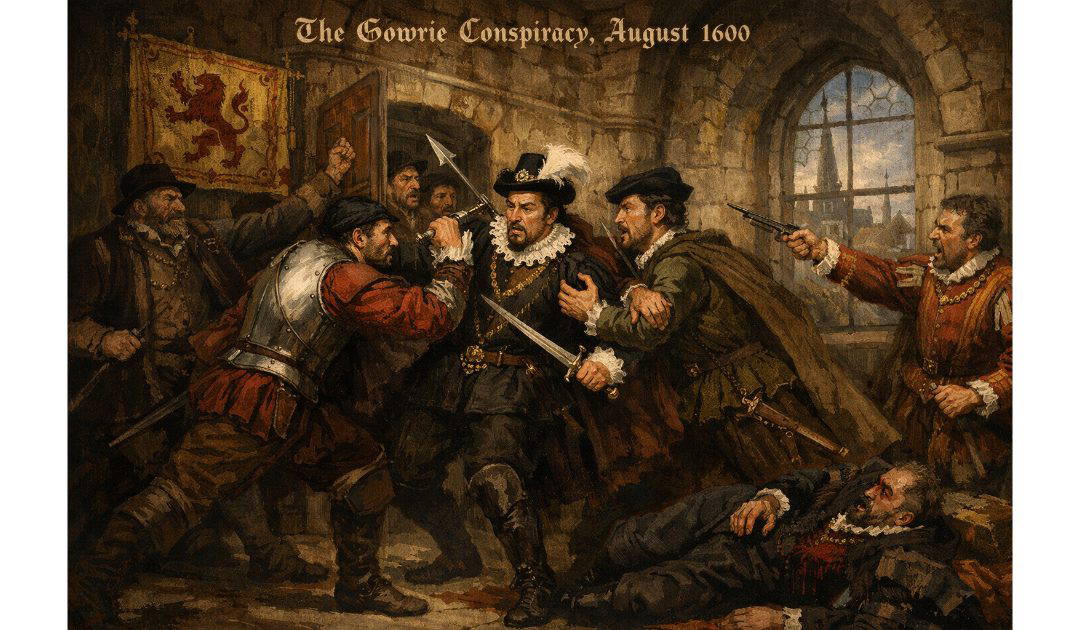
The Gowrie Conspiracy of the 5th of August, 1600, remains one of the most mysterious and disputed episodes in Scottish history. It centres on an alleged attempt to kidnap—or possibly assassinate—King James VI and I by members of the powerful Ruthven family, chiefly John Ruthven, 3rd Earl of Gowrie, and his younger brother Alexander Ruthven. What actually happened that day in Perth has been debated ever since, with contemporaries and historians divided between royalist and sceptical interpretations.
The Ruthven family already had a troubled relationship with the crown. In 1582, during the so-called Raid of Ruthven, their father had participated in the kidnapping of the young James VI, an event that left a deep impression on the king. Although the family later regained favour, suspicion lingered. By 1600, John Ruthven had inherited the earldom and was outwardly reconciled with the king, even entertaining him on occasion. I have to say I have some sympathy for the Ruthven family. My ancestor, Sir Anthony Standen, was sent to the Tower of London accused of treason. It was thought that he would never emerge alive but he was released and banished from England. He is the hero of my series, the Sir Anthony Standen Adventures.
The events of the 5th of August began when Alexander Ruthven sought out the king while he was hunting near Falkland Palace. He told James a curious and enticing story: a stranger had been detained in Perth carrying a pot of foreign gold coins, possibly counterfeit or illicit, and the king’s presence was needed to examine the matter discreetly. Intrigued—and perhaps tempted by the prospect of uncovering hidden treasure—James agreed to accompany Alexander to Perth, bringing only a small retinue.
Upon arrival at Gowrie House, the residence of the Ruthvens, the king was received by John Ruthven. The atmosphere at first seemed cordial, even festive, with a meal prepared. However, after dining, Alexander led the king upstairs to a secluded chamber. What followed is the crux of the mystery. According to James’s later account, he was confronted by a mysterious armed man and held against his will, while Alexander threatened him with a dagger and demanded silence. The king claimed he realised he was the victim of a plot.
Meanwhile, members of the king’s retinue grew uneasy at his prolonged absence. Their suspicions were heightened by the behaviour of the Ruthven household, which seemed evasive and tense. Eventually, a struggle broke out. James reportedly managed to call out for help from a window, crying that his life was in danger. His attendants rushed into the building, forcing their way through locked doors and stairways.
In the chaos that followed, Alexander Ruthven was killed during a confrontation with the king’s men. John Ruthven, alerted to the disturbance, attempted to intervene but was also slain. Several other members of the household were wounded or killed. The king emerged shaken but alive, insisting that he had narrowly escaped assassination.
The official version of events, endorsed by the crown, was that the Ruthven brothers had conspired to kidnap or murder the king. Their motive remains unclear. Some have suggested political ambition, perhaps hoping to control the monarch as their father had done. Others have speculated about financial desperation or even religious tensions, as Scotland at the time was divided by factional conflicts within Protestantism.
However, doubts arose almost immediately. Critics pointed to inconsistencies in the king’s account and the improbability of the plot. Why would the Ruthvens lure the king to their own house, where any violence would inevitably implicate them? Why was there no clear plan for escape or for consolidating power after such a bold act? Moreover, much of the evidence came from the king and his loyal followers, while the principal accused were dead and unable to defend themselves.
Some contemporaries and later historians have proposed an alternative theory: that the incident was staged or exaggerated by James himself. According to this view, the king may have had reasons to eliminate the Ruthvens—perhaps due to lingering distrust or political rivalry—and the events in Perth were manipulated to justify their deaths. There is, however, no definitive proof of such a conspiracy, and the truth remains elusive.
The aftermath was swift and severe. The Ruthven name was attainted, their lands and titles forfeited, and their surviving relatives disgraced. The government ordered annual sermons commemorating the king’s deliverance, reinforcing the official narrative. For years afterward, the Gowrie Conspiracy was presented as a providential escape, evidence of divine favour toward the monarch.
Yet the story refused to settle into certainty. The lack of impartial witnesses, the contradictions in testimony, and the dramatic nature of the king’s own account have kept the debate alive. Modern historians tend to treat the episode with caution, acknowledging that while some form of confrontation clearly occurred, its origins and intentions are far from clear.
In the broader context of James’s reign, the Gowrie Conspiracy highlights the precariousness of royal authority in late sixteenth-century Scotland. The king was still consolidating his power among ambitious nobles, many of whom had histories of rebellion or intrigue. The episode also foreshadows the political complexities James would later face after becoming king of England in 1603.
Ultimately, the Gowrie Conspiracy endures not as a solved crime but as a historical puzzle. Whether it was a genuine attempt on the king’s life, a bungled kidnapping, or a carefully orchestrated political manoeuvre, it reveals a world in which loyalty, ambition, and suspicion were tightly intertwined—and where the truth could be as elusive as power itself.